



































 Dar certo
 Meditação


 Podcast
  E-book


Here is what most people can consider wrong, therefore, Ayurveda is not all about herbs and oil massages. It is a complete mechanism which makes your mind, body and emotions to be interlinked. The food you eat can literally alter your way of thinking and feeling, literally. Crazy, right?
I perceived Ayurveda to be a grandma thing when I first got to learn about it. You see, turmeric milk to make you cold, or neem to make you pimply. However, the further I went (and even after speaking to some Ayurvedic doctors who have dedicated their entire lives to it), I understood that this ancient system amounted to psychology, nutrition and mindfulness in one big, spicy samosa of knowledge.
🌿Understanding the Doshas Without Reading the Full Textbook.
We may, within a few words, dissect this:
- Vata = Air + Space. These are imaginative, imaginative people, with ideas in them,–they run like a squirrel on espresso. They are usually anxious, forget to eat, and they overthink. (Yup, guilty 😅)(1)
- Pitta = Fire + Water. The perfectionists. Very ambitious, keen, too fiery. Being out of balance, they are easily irritated and become mentally exhausted.
- Kapha = Earth + Water. Stable, solid, reliable – however, when out of balance, they will fall into apathy, food comfort or depression.
Here is the magic bit, then, this is that you can calm or arouse these doshas by the kind of food you eat and the rhythm of your day. And that does not only influence digestion, but your mentality, as well.(2)
Histórias relacionadas
 Yoni Mudra: Benefícios, Efeitos Colaterais, Como Fazer e Precauções
  Chinmaya Mudra: Benefícios, Efeitos Colaterais, Como Fazer e Precauções

🍛 Story 1: Dr. Meera has a client, a 27-year-old male, who is diagnosed with a Type 2 Diabetes mellitus.
This is a story which Dr. Meera an Ayurveda practitioner in Pune explained to me.
I had this client who was an anxiety-driven, coffee-drinking marketing executive called Anjali who was constantly in a hurry. Classic Vata imbalance. She was not able to sleep, her hands and feet were cold, and her brain, she stated, was a browser with 20 tabs open.
Meera did not begin with nice herbs. She started with warm food. Kitchari, spiced milk, with nutmeg in the evening, and, this she did not expect, no cold smoothies. Her sleep had improved in a period of two weeks. Her anxiety level decreased after one month.
When Vata is high, then literally your mind loses touch. So the trick? Warmth. Soups, cooked vegetables, ghee, hugs (this last one can be avoided but it is appreciated 😄).
🔥 Story 2: Ravi the Pitta Chef Who Burned out Ravi the Pitta chef literally burned out.
Then there is Ravi, a young Goanese chef who adored spicy food- and man did he live to eat. But his mental state? Always on edge. Angry for no reason. His digestion was keen, and his forbearance wanting.
When I questioned him about his food, said Dr. Aruna, Ayurvedic counselor based in Kerala, he took off laughing saying to me as Ma’am, I eat chili in the morning.
Pitta overload!
So she chilled him off – chilled him literally. Incorporated more coconut, cucumber, mint and coriander into his food. Substituted red chilies with fennel. Asked him to eat tranquilly, not to yell at the kitchen personnel.
Three weeks after, his skin rashes disappeared, and he said, “I do not feel like punching people any more.
Ayurveda magic, emotion control by food.
🌧️ Story 3: The Kapha Who Regained Her Spark.
This one made me smile. Lata, 52 of Mumbai, arrived at her Ayurvedic physician telling him that she simply did not feel like doing anything. She was not depressed as such, but stagnant.
It turns out that she was a Kapha type that had gone into her comfort zone. Late sleeping, consumption of sweets, little atividade física. Her thoughts were her body, dull, sulky, and cloudy.
Her physician suggested light, stimulating food – ginger tea, black pepper, greens, and no afternoon naps (which she despised hearing).
But guess what? She wrote after 21 days that she began dancing again.
It was not about the weight or diet, but energy. Everything moves when Kapha moves even your mood.
Mind Body connection: What Ayurveda has always known even before neuroscience.
According to Ayurveda practitioners, the gut and the brain are brothers.
And eventually science was able to keep pace — we now understand the gut-brain axis, serotonin synthesis in the gut and the ability of inflamação to confuse your mood.
Ayurveda’s version? Maintain your Agni (digestive fire) in equilibrium and your mind will remain pure.
Simple, but profound.
For instance —
- The gluttony clouds Agni Overeats becomes brain fog (and doomscrolling).
- Missing of meals undermines Agni → causes ansiedade, ruminating.
- Poor diet (high consumption of processed food) toxins (or Ama) to lethargy + irritability.
See the pattern? Food does not only provide nutrition, it is emotional software.
My Own Little Realization (Yep, a Personal Story).
I was a poster of Vata imbalance a couple of years ago.
Overworked. Barely eating. Drowning cold brew at 11 PM like a life support.
My yoga teacher (who is unobtrusive Ayurvedic sage) one day looked at me and said,
You are playing with your brain and are starving your body.
Oof. That hit.
I began with little – hot breakfast, less caffeine, decent lunch. In seven days, I stopped feeling brain foggy. I started sleeping again. It was not magic, but then it seemed that somebody had switched on my nervous system an octave lower.
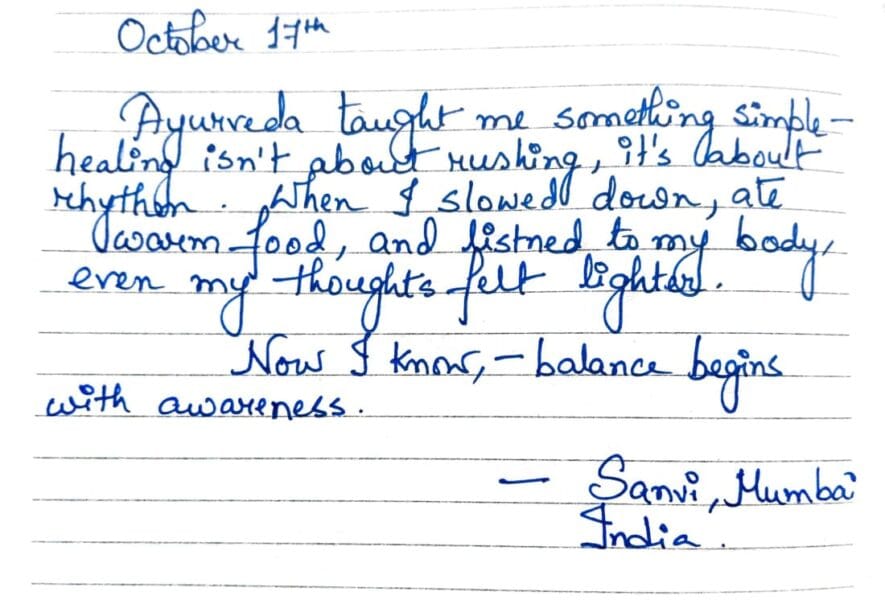
Ayurveda does not hurry up the healing process. It restores rhythm.
🕉️ Advice to make: Diet according to your mind type.
Let’s keep this super simple:(3)
To the Airy minds, anxious, nervousness, Vata (Vata, 2012).
- Consume hot and cooked dish – soups, stews, ghee rice.
- Do not skip meals (do not be serious).
- This spice it with: cumin, ginger, cinnamon.
- Before going to sleep, take warm milk with nutmeg.
According to Pitta (Fiery minds, perfectionist energy).
- Prefer cooling food: cucumber, coconut, greens.
- Too much spice, alcohol or fried food should be avoided.
- Breaks are good, you do not have to win all the arguments. 😉
- Try rose or mint tea for calm.
In the case of Kapha (Sluggish calm minds).
- Light and spicy, warm food, e.g. stir-fries or lentil soups.
- Exercise, though it may be only a walk or a dance.
- Avoid excess dairy or sugar.
- Use of ginger-lemon water in the mornings to get the digestive processes going.
😌 Vibrational Emotional Healing (Routine) (Dinacharya Vibes).
This is what all the practitioners that I interviewed stressed: mental health = rhythm.
It is not even what you eat but when and how you eat.
- Eating schedule Eat the same time every day- your body adores routine.
- Unless you have to work, sit down and eat your food (no phones, no Netflix).
- Sleep before 11 PM. (Don’t argue. Ayurveda wins this one. 😂)
- Go walking to the short after meals – good for the stomach, and clears your head.
You may think of it in this way– your mind will be just as well as your day.
Opinião de especialista.
Dr. Anjali Sharma: Ayurvedic Clinical Researcher and Ayurvedic Practitioner, National Institute of Ayurveda, Jaipur.
Ayurveda is a way of holistic approach in which body, mind or emotion is in harmony. Through correct nutrition and lifestyle, the optimum health and well being can therefore be achieved by matching the lifestyle to the dosha.
Entrevista com especialista.
Interviewer: What is Ayurveda approach to the correlation between the diet and the mental health?
Dr. Sharma:
Ayurveda does not consider food as a fuel, but medicine. To balance it, all doshas contain some dietary requirements. On the example, highly dosha of vata persons may be anxious and restless. Foods that are warmed can be also consumed in order to calm down the nervous system. Similarly, Pitta type that is usually hot and severe is assisted to cool with the consumption of cooling foods.
Interviewer: What is Ayurveda saying in relation to the relationship with the gut-brain?
Dr. Sharma:
The importance of Agni or digestive fire in the Ayurveda has been recognized to play a part in the overall health. A healthy Agni is a promise of proper digestion and assimilation which is directly proportionate to the clarity of mind and emotional stability. Conversely, an agni which is not at peace can lead to eating disorders and mental illnesses.
Interviewer: Are there any winning stories of how Ayurvedic principles served to make one of the patients feel better?
Dr. Sharma:
“Certainly. The patient that I was assigned was a 32-year-old female with the diagnosis of generalized anxiety disorder. On the basis of the assessment of her dosha and lifestyle, we added the exercise of warm and nourishing foods, daily meditation, and herbal supplements. She alleged that her level of anxiety and mood had greatly improved in a number of weeks.
Perguntas frequentes.
Ayurveda has three doshas namely:
Vata (Air + Space): regulates creativity, movement and communication.
Pitta (Fire + Water): control the digestion, metabolism and transformation.
Kapha (Earth + Water): Nourishment, stability and structure.
The Ayurveda manages the mental health by balancing the doshas through diet, lifestyle and herbal medicaments. Using warm and grounding foods and routines could be used to deal with Vata disorders, and cooling foods and stress-reducing activities could be used to deal with Pitta disorders.
Admittedly, the science of Ayurvedic principles has been explored in numerous studies. These investigations have been on gut-brain axis, dietary interventions on human mind, and efficacy of Ayurvedic treatment of various clinical disorders.
The right way is also to use Ayurveda in the combination with the modern medicine. The Ayurvedic practices are supposed to be safe and effective with the assistance of experienced medical specialists with the goal of integrating traditional treatment.
💚 Last Reflections – Your Mind Feeds What You Feed Your Body.
Nah, you can be a regular person, not a saffron-robes Ayurveda crusader chanting to himself (unless you care to be).
But small shifts? They can change everything.
With eating according to your dosha not only are you healing your stomach you are rewiring your mind as well.
I have witnessed it occur with clients, friends and even myself.
Instead, next time you are in a bad mood, you should not simply pick your phone or coffee.
Ask yourself – what dosha needs me today?
Maybe it’s warmth. Maybe it’s rest. It is only a little spice and sunshine, maybe.
Whichever the case, believe me, your body does know. You just gotta listen.
+3 Fontes
A FreakToFit possui diretrizes rigorosas de fontes e se baseia em estudos revisados por pares, institutos de pesquisa educacional e organizações médicas. Evitamos o uso de referências terciárias. Você pode saber mais sobre como garantimos a precisão e a atualização do nosso conteúdo lendo nossa Política de Privacidade. política editorial.
- Physiological concept of Vata Dosha in relation to Brain Function; https://www.jaims.in/jaims/article/view/3396
- Dosha brain-types: A neural model of individual differences; https://pubmed.ncbi.nlm.nih.gov/26834428/
- Ayurveda based diet & life Style Guidelines for Prevention and Management of Skin Diseases; https://ccras.nic.in/wp-content/uploads/2024/06/Ayurveda-Based-diet-lifeStyle-Guidelines-Skin-Diseases.pdf