














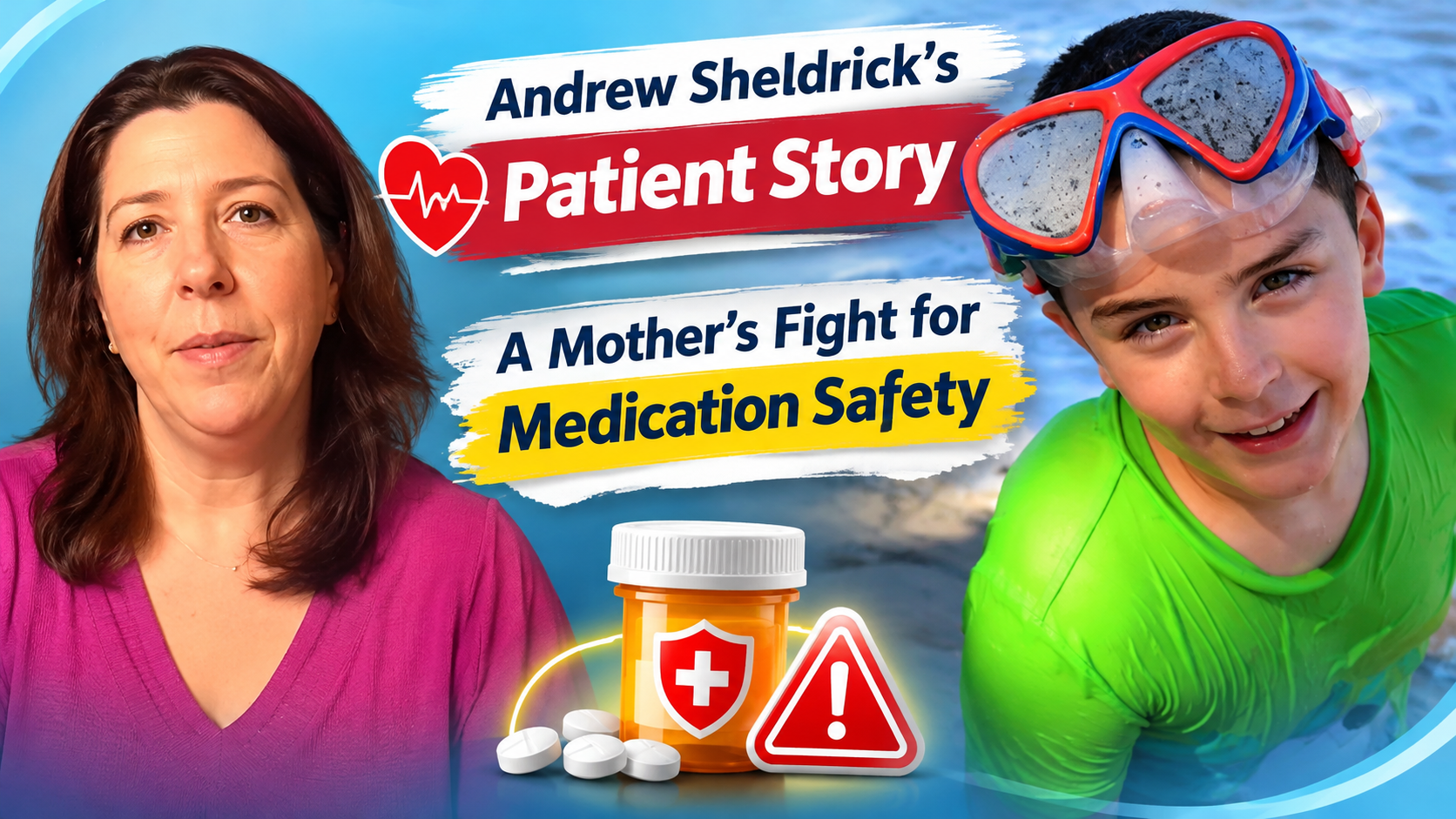
When an 8 year old boy dies after taking the wrong medicine, it transforms his mother’s life, and begins a campaign to improve the safety of medicines for other families.
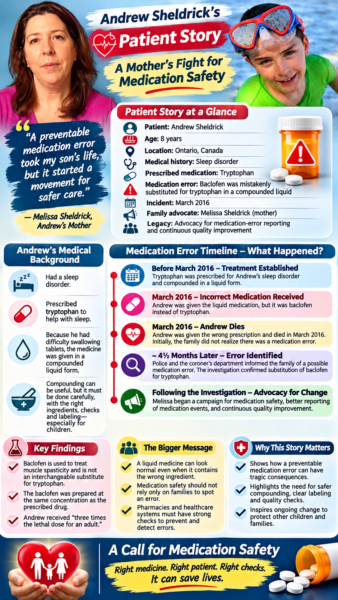
Patient Story at a Glance.
Patient: Andrew Sheldrick
Age: 8 years
Location: Ontario, Canada
Medical history: Sleep disorder
Prescribed medication: Tryptophan
Medication error: Baclofen was mistakenly substituted for tryptophan in a compounded liquid medication
Incident: March 2016
Family advocate: Melissa Sheldrick, Andrew’s mother.
Outcome: Andrew was killed when he was given the wrong medication, which was improperly prepared.
Legacy: Advocacy for medication-error reporting and continuous quality improvement.
The Medicine a Family Trusted.
Melissa Sheldrick and her family had all the reason to place that trust in the medicine that was given to their eight-year-old son, Andrew. Andrew was given a normal night-time dose of medication in March 2016. He did not wake up. At the time, there was no explanation of his death from his family. Later, it was discovered a month apart that the liquid medication that was supposed to contain tryptophan actually contained a different drug: baclofen.A month later an investigation was conducted which uncovered a horrifying secret; the liquid medication containing tryptophan actually contained a different drug: baclofen.
Related Stories
 How To Stay Fit and Healthy During Ramadan?
 This is How It Affects the Brain When We Have Stopped Writing by Hand
The finding led to the realization that a drug error had occurred somewhere that should have prevented Andrew from being affected by the medication. It also raised a difficult question for his family: How could a medicine provided by the pharmacy be made of the wrong material?
For Melissa, it was a quest for answers leading to a campaign for medication safety. She started to promote better reporting of medication events, continuous quality improvement and greater engagement of patients and families for healthcare safety.
Andrew’s story is not a story of recovery. There is no turning back the day of his death and there is nothing to be done by policy changes to repair the loss of his family. It’s a tale of what could have been avoided, and a commitment to ensuring that other families will not experience the same harm.
Andrew’s Medical Background.
Andrew had a sleep disorder and was prescribed tryptophan to help with his sleep. In published accounts it is said that he had difficulty swallowing tablets and medicine was given to him in liquid form. His family picked up refills and gave him the medicine as prescribed.
Pharmaceutical compounding is the process of creating a medication that has a specific form for a particular patient. Can be helpful if a manufactured product is not available or is not appropriate for a patient’s needs.
Medicines for use with children, however, should be carefully compounded, ingredients correctly mixed, the label checked and reviewed before dispensing, and the medicines be appropriate.
When it came to Andrew, the investigation later found he was being administered the incorrect drug. The drug wasn’t just mistakenly labeled, it was a completely different drug than the one ordered.
Medication Error Timeline – What Happened?
The following timeline is a differentiation of the known events from the later investigation. The child learns to share toys with other children.The child is taught to share toys with other children.
Before March 2016 — Treatment Established.
Tryptophan had been prescribed for Andrew’s sleep disorder. Since he had difficulty swallowing the tablets, the medicine was compounded in a liquid form.
March 2016 — Incorrect Medication Received.
Andrew was prescribed and given the liquid medication but the wrong one, baclofen rather than tryptophan.
March 2016 — Andrew dies.
Andrew was given the wrong prescription, and died in March 2016. Initially his family did not realize there was a medication error.
Approximately four and a half months later — Error identified.
Police and the coroner’s department told the family that there was a belief there had been a medication error. The investigation confirmed substitution of baclofen for tryptophan.
Following the investigation — Advocacy for change.
Melissa advocated for changes in medication safety, incident reporting and continual quality improvement in pharmacy practice.
What did you discover during the investigation?
Baclofen is indicated for the treatment of some disorders associated with muscle spasticity. It is not an interchangeable substitute to tryptophan and is used differently and has different effects.
The Patient Safety Movement Foundation says the baclofen was prepared at the same concentration as the prescribed drug, and that Andrew had received “three times the lethal dose for an adult.
These findings helped clarify the medication error, but they did not help to correct the loss.
An important problem with the reliance on the family to detect the wrong medicine is that a liquid may appear normal even when it is actually the wrong ingredient. The responsibility for their prevention and detection falls mainly on the professional systems which have resulted in the preparation and dispensing of the medication.
Search for Answers, by Melissa Sheldrick.
Once Melissa had heard what had occurred, she saw past the initial mistake. She was interested in learning how medicine incidents were reported, investigated, and if used to prevent harm to others in the future.
At the time, her advocacy raised awareness of the lack of reporting of medication errors and continuous quality improvement in the province of Ontario.
If the reporting is not reliable, healthcare organisations may not be able to detect issues that are occurring repeatedly or realise that the incident occurring in one location is just one of many.
Melissa had the opportunity to collaborate with the Ontario College of Pharmacists in their efforts to enhance the safety of medications in community pharmacies. Some of this work contributed to the development and roll-out of the Assurance and Improvement in Medication Safety (AIMS) programme, which includes incident reporting and continuous quality improvement.
She also joined ISMP Canada as a Patient and Family Advisor, bringing the families perspective of a medication error to patient safety initiatives.
Her efforts helped to reinforce an important principle: if a mistake is made, the answer shouldn’t just be what went wrong. Healthcare organisations should also consider what happened to the error that reached the patient and what changes are possible to make to minimise the risk of a repeat error occurring.
Medication-Error Reporting Matters.
Medication errors happen when a drug is prescribed, prepared, dispensed, administered or monitored. In a pharmacy that dispenses compounded medications, measures taken to ensure safety may include checking the appropriate ingredient, ensuring proper preparation, checking the final product, and ensuring the proper label.
No one check will knowingly assure that all errors are avoided. Several measures are in place to minimise the risk of error reaching the patient.
Pharmacies can benefit from reporting errors and near misses to learn from themselves, to make improvements to processes, and to share what they have learned with other pharmacies.
Reporting is just a first step. Incidents need to be analysed, changes made to improve and the effectiveness of the changes checked. A high level of safety culture allows for learning while still holding the professionals to an appropriate level of accountability.
Andrew’s story is representative of why the process is important: Medication safety is not just the responsibility of the prescription; each step between the process of preparing and administering medications is important.
What Patients and Families Can Do?
Patients and caregivers should feel at ease asking questions about their medicines. They can assist them to detect inconsistencies, but cannot be relied upon to take the place of professional verification.(1)
Practical steps include:
- Check the label: Confirm the medication name, strength or concentration, and instructions against the prescription.
- Ask about unexpected changes: If the medicine or instructions look different from previous supplies, ask the pharmacist to explain before using it.
- Confirm the dose: For liquid medication, use an appropriate measuring device and ensure you understand the amount to administer.
- Keep a medication list: Record prescribed medicines, over-the-counter products, and supplements.
- Raise concerns promptly: Contact the pharmacist or prescribing healthcare professional if something appears incorrect.
These are precautions, that can minimize misunderstandings but not all errors. Safeguarding, dispensing and verification systems continue to be key.
Andrew’s Continuing Legacy.
Andrew’s passing is a huge loss for his family. Only a programme or policy change can turn back what has occurred.
Despite this, Melissa’s work has become a catalyst for making medication incident reporting, continuous quality improvement, and involving patients and families in safety efforts visible.
Her advocacy has played a key role in ensuring this challenging but critical question remains central to the debate: what can healthcare systems learn from medication errors and minimise the risk of further harm?
Accurate preparation, checks, incident reporting and learning from mistakes are all key to the answer.
Andrew’s story is not a happy one! It’s a reminder that the patient receiving the medicine is more than a prescription or medical record entry. They are people whose lives are in the hands of systems that must perform 100% of the time.
Reader Safety Takeaway: What Should You Do?
Before giving or taking a medicine, verify the medicine’s name, strength (or concentration) and instructions with the prescriber.
- If a medication or directions have been changed unexpectedly, check with the pharmacist before taking it.
- If you think the wrong medicine or dose has been given, get immediate advice from the dispensing pharmacist or prescribing healthcare professional.
- If the medicine has already been taken, and it is suspected that a potentially dangerous mistake or serious reaction has occurred, immediately seek medical help.
Keep in mind patients and families can ask questions but are not able to catch all medication errors. There is a shared responsibility in preventing harm, and a healthcare professional has a responsibility to have effective systems in place to prepare, check and administer medicines safely.(2)
Frequently Asked Questions.
1. Who was Andrew Sheldrick?
Andrew Sheldrick was eight years old from Ontario, Canada and died in March 2016 after a medication error with a compounded liquid medication. His mother, Melissa Sheldrick, went on to be an advocate for medication safety.
2. What medicine did Andrew get?
Andrew was given Tryptophan, which is a supplement to aid him with his sleep disorder. Prescription made liquid due to difficulty swallowing tablets.
3. What went wrong?
An investigation confirmed that baclofen had been mistakenly substituted for tryptophan. Andrew died after receiving the incorrectly prepared medication.
4. What is pharmaceutical compounding?
Pharmaceutical compounding is the process of creating a new medicine in a specific formulation or dosage that is tailored to a patient’s medical needs when a commercially available product does not exist or is not suitable. Requires appropriate professional processes and quality assurance.
5. What did Melissa do after Andrew’s death?
Melissa pushed for improved reporting of medication errors and for ongoing quality improvement. She worked with the Ontario College of Pharmacists and became a Patient and Family Advisor with ISMP Canada.
6. What is the AIMS programme?
Medication incidents and continual quality improvement in community pharmacies in Ontario is supported by the Assurance and Improvement in Medication Safety (AIMS) programme.
7. Is it possible for families to avoid all medication errors?
No, families can look at labels, make sure they understand instructions, and have concerns, but they can’t catch every mistake. It is critical that there are professional verification systems.
8. What should I do if I suspect I have received the wrong medicine?
Get in touch with the dispensing pharmacist or healthcare professional that prescribed the medication right away. Seek urgent medical assistance if a potentially dangerous medication error has occurred or if serious symptoms occur.
Final Thoughts.
Andrew Sheldrick’s story demonstrates the devastating consequences that a medication error can have for a family. His parents believed that it was the right medicine that was being given to their son; it turned out that a different medicine had been given in its place.
Melissa has focused her quest for answers on the need for safer medication practices, incident reporting, and ongoing quality improvement, turning it into an advocacy role.
Her work tells a simple message: No medication safety is to be left to trust. It needs to be backed with sound processes, expert vetting, transparent dialogue, and a willingness to learn from mistakes.
While Andrew won’t be coming back, his story shows how important it is to keep preventive measures in place when it comes to preventing medication errors in healthcare institutions and families.
+2 Sources
FreakToFit has strict sourcing guidelines and relies on peer-reviewed studies, educational research institutes, and medical organizations. We avoid using tertiary references. You can learn more about how we ensure our content is accurate and up-to-date by reading our editorial policy.
- ISMP Canada. Canadian Medication Incident Reporting and Prevention System; https://ismpcanada.ca/impact/canadian-medication-incident-reporting-and-prevention-system/
- Healthcare Excellence Canada. Safe-to-Say; https://www.healthcareexcellence.ca/updates/safe-to-say/