












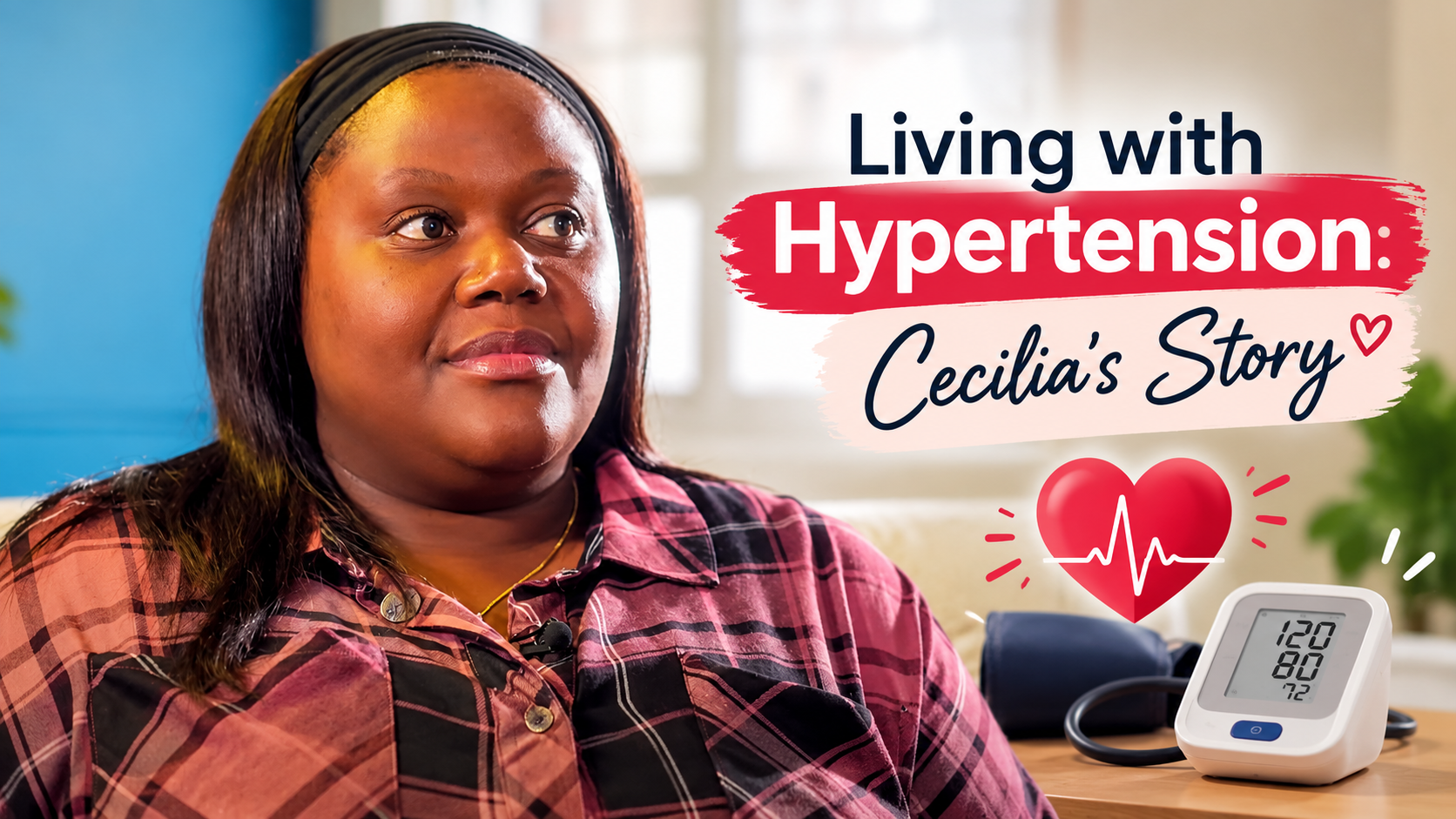
A motivating account of the silent problem of hypertension, the difficulties of stroke recovery, and the need for family support, rehabilitation and ongoing medical treatment.
Patient Information.
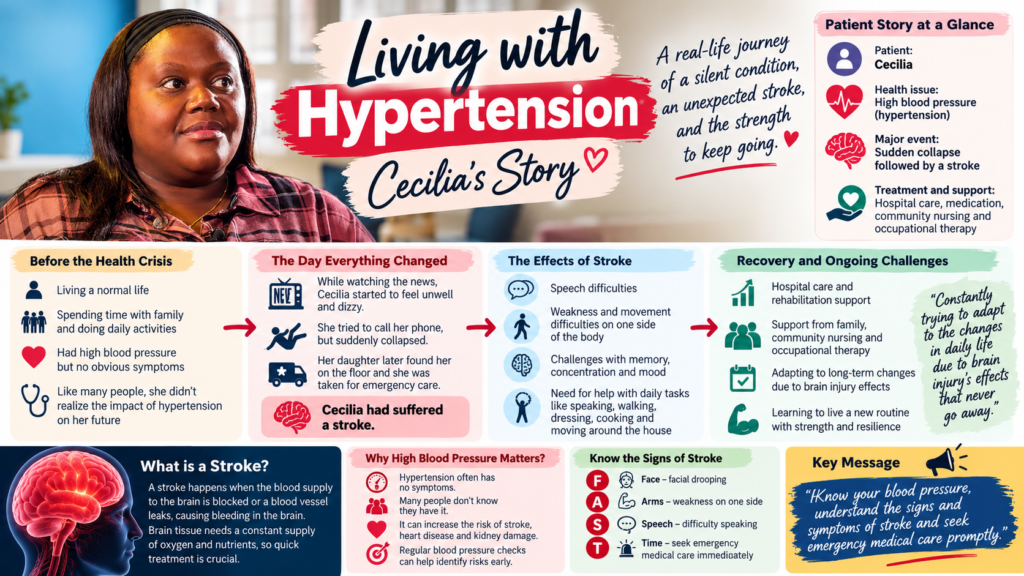
Patient: Cecilia
Health condition: Hypertension and stroke
Major event: Sudden collapse followed by a stroke
Reported effects: Difficulty speaking and reduced mobility on one side of the body
Treatment and support: Hospital care, blood pressure medication, community nursing, and occupational therapy
Ongoing challenge: Living with the lasting effects of brain injury and adjusting to changes in daily life
Key message: Know your blood pressure, recognise stroke symptoms, and seek medical help without delay.
A Normal Life Before an Unexpected Health Crisis.
Cecilia’s story is a warning that a serious health issue doesn’t have to be preceded by a warning. As with many people, she had not understood the impact of having a condition like high blood pressure upon her future.
One problem with hypertension is that it frequently occurs without any symptoms. Blood pressure can be high without making any of the following changes: working, spending time with family, or taking care of daily activities.
Many people don’t have any pain or discomfort that would indicate something is wrong.
Reading a tale such as Cecilia’s, one can readily imagine that a regular checkup on her health may have altered the circumstances. But without all her medical conditions it would be wrong to say that a specific check or treatment would definitely have prevented her stroke.
Her experience is one of the reasons why it’s crucial to take blood pressure seriously before you have a medical emergency.
The World Health Organization estimates that hypertension contributes to stroke, heart disease and kidney damage. Most individuals living with the condition are unaware of their condition as they are not experiencing symptoms, such as pain.Most people with the condition don’t know they’re affected because they don’t have symptoms (such as pain).
The message to readers is pretty simple: If you feel fine, it’s good, but it shouldn’t replace blood pressure checks.
The Day Things Changed by Steven L. McKenzie and Heather Baldock.
When Cecilia started to feel unwell and dizzy, she was watching the news, similar to what is described in the video. She tried to call her cell phone, but she fell unconscious. Her daughter later discovered her lying on the floor.
It’s hard to fathom how a family might feel in such a situation. It seems like just another day, and the next, one of your loved ones is on the floor in need of emergency medical care.
Cecilia had suffered a stroke.
The event made her realize that her health was serious and changed her life.
There are many causes of dizziness and it does not necessarily indicate a stroke. Sudden dizziness, with other neurological symptoms, such as weakness, trouble speaking, loss of balance, however, should never be overlooked.
There are two types of stroke: one in which the blood supply to the brain is blocked, and one in which a blood vessel leaks, causing blood to pool causing a stroke. Brain tissue requires constant oxygen and nutrition, so delays in treatment can cause them to be seriously injured.
Cecilia’s experience illustrates the importance of being able to recognize a medical emergency promptly. Do not wait to see if someone feels better when stroke symptoms are present which can be dangerous.
To diagnose and understand the consequences.
When Cecilia came to in hospital, her speech was impaired and she was unable to use one side of her body.
These changes can be very upsetting for people who have always coped with everyday life on their own.
The need for help may suddenly arise during tasks such as speaking, walking, dressing, cooking, or walking around the house. Tasks that they could easily do can become challenging, and the individual might require time to adjust to a completely different routine.
A stroke can impact the way you move, as well as memory, concentration and communication, mood and self-confidence. The kind of symptoms that occur will depend on the region of the brain damaged and the size of the damage.
Cecilia’s story reminds readers of the humanity of a disease, which is usually talked about by medical statistics only.
Each stroke diagnosis comes with a person whose life will change and family members who have to re-structure their lives.
Keep in mind that everyone recovers from stroke in their own unique way. Some people may recover much of their prior functional capabilities, others may have permanent disabilities, and require continued support.
This depends on the individual and there is no set recovery time, so not to compare one persons effort with another.
Knowing the relationship between hypertension and stroke.
High blood pressure puts extra pressure on the blood vessels. With chronic high blood pressure, it can cause damage to blood vessels and lead to cardiovascular issues.
There are two kinds of strokes.
Ischaemic stroke: A blood vessel bringing blood to the brain is blocked, most commonly due to a blood clot.
Haemorrhagic stroke – a blood vessel bursts, leading to bleeding in or close to the brain.
High blood pressure is an important risk factor for both cardiovascular disease and stroke. But not all strokes are due to high blood pressure and it is important to identify the cause of an individual’s stroke by medical evaluation.
This is important because a personal story can be used to show the potential hazards of hypertension without specifically proving how hypertension was responsible for each part of a specific medical event.
The lesson to be learned is that early identification and management of blood pressure is a risk factor.
Depending on the individual’s reading and medical condition, a healthcare provider might suggest changes in lifestyle, prescribed medication or both.
Treatment, Medication and Long-Term Care.
In the video Cecilia tells us that she is still on medication for her blood pressure and pain after her stroke. She also speaks of the permanent effects of brain damage which have kept her out of work.
Her experience is an example of the aftermath of a stroke.
High blood pressure may be a long-term condition that needs treatment. Even if a person feels better, their blood pressure could still be high without treatment. Prescribed medicines can help lower the risk of the heart when taken properly.
Those who had had a stroke might require extra treatment to lower the chance of a second stroke. The health care provider might check blood pressure, cholesterol, diabetes, heart disease, and other factors that could be a risk.
Treatment should be tailored to the specific patient. Doses of medicines can differ from one person to another.
Blood pressure medication takers should always adhere with their clinician’s directions and not discontinue or adjust the dose just because their blood pressure is better.
It’s not a failure to treat if this is a long-term treatment. It’s often a crucial component of good health and the prevention of additional issues.
A focus on rehabilitation: Rebuilding Everyday Independence.
Cecilia’s story is about the help she has received from community nurses and occupational therapists.
This is one of the phases that she has gone through that shows the value of rehabilitation following a stroke.
Occupational therapists assist individuals to gain, regain or modify the skills required to complete their daily activities. This can include practicing daily activities, using assistive equipment, ensuring safety at home, and finding alternative ways of doing things.
Other rehab staff can assist with cognitive, speech, strength, swallowing, and balance issues with walking.
Recovery can be challenging as improvement may not occur rapidly. Sometimes a task will be easier and other times it will be harder due to discomfort or fatigue.
Encouragement and practical support from family members can be helpful; but don’t assume that they are to be done on the patient’s behalf.
The aim is to provide the maximum independence possible, while at the same time taking into account the person’s limitations, preferences, safety.
Cecilia’s story shows us that there is more to rehabilitation than just getting a person back to work. Also, it’s about enabling them to be a more valued part of everyday life with confidence and dignity.
The importance of Emotional Support and Family Support.
More than one person is involved in a stroke. Family members can suddenly find themselves organizing medical appointments, assisting with daily activities and dealing with uncertainty about the future.
Cecilia’s daughter was instrumental in the discovery of her after she collapsed. This is a good reminder of how rapidly family members can get involved in a medical emergency.
Emotional support is just as important as physical support during recovery. Someone might be upset with their mobility, communication and/or independence being affected. They may also be worried about their survival or how their illness is affecting their family.
Listening, respecting and giving time for recovery might make a difference.
It is also important that caregivers are supported. Taking care of a family member following a stroke can be physically and emotionally exhausting; families should consult healthcare professionals for advice when they don’t know how to help.
A New Purpose through Community Support.
A highlight of Cecilia’s story is that she is also part of support groups. She was able to relate to others who were in similar situations, and eventually started volunteering to help others.
This is a good reminder that life following a serious illness isn’t just about recovery.
Those who have suffered from the same health issues may know the frustration, uncertainty and emotional challenges that are involved more than those who have not.
Peer support can offer a feeling of belonging, practice encouragement and experience sharing opportunities.
Does not stand in for medical treatment or professional rehabilitation. Rather, it can augment the individuals with a sense of not being lonely.
There’s a positive side to Cecilia’s story, as she shows herself willing to help others. Her life has been impacted by the struggles that she had to go through but she has found means to enrich the lives of others.
People do not react to sickness in the same manner and no one should feel compelled to make a difficult experience a positive one. However, Cecilia’s story demonstrates that connection and purpose can continue to be significant during recovery.
The lesson is that Readers can learn from Cecilia’s story.
Here are some key learning points from this patient story.
Monitor blood pressure regularly – hypertension can be asymptomatic, which is why it is important to measure blood pressure properly.
Sudden weakness, trouble talking, facial droop, vision problems or trouble walking may be signs of stroke and should be evaluated in an emergency.
Medications and follow-up visits may be an important factor in controlling hypertension and lowering cardiovascular risk levels.
Rehabilitation is a serious process and will take time, possibly with the assistance of medical professionals and changing your lifestyle.
Keep family and community in mind: Practical support, understanding, and peer support can help to make the experience less isolating.
The lessons follow sound medical advice but cannot ensure that all strokes are preventable. The goal is to educate individuals on their risks and decision making for their health.
Expert Perspective: What Does the Medical Evidence Say?
Cecilia’s story brings to attention the need to recognize hypertension at an early stage from a preventive health point of view.
According to the World Health Organization, high blood pressure can be treated with lifestyle changes and, if needed, drugs. Some lifestyle changes that are relevant include reducing excess salt, balanced diet, physical activity, maintaining a healthy weight, and avoiding tobacco.(1)
Early treatment of the stroke and rehabilitation are also crucial for individuals with a stroke. Depending on the type of stroke, its severity and the patient’s general health, a different type of care may be necessary.(2)
Several easy recommendations are available for readers to act on:
Have a blood pressure check if you haven’t had one in a while.
If you’ve been diagnosed with high blood pressure, ask your healthcare provider what your target is.
- Follow instructions for taking prescribed medications.
- Consult with healthcare provider about an appropriate exercise and nutrition regime.
- Know the warning signs of stroke, and instruct others on the warning signs.
These recommendations are based on good medical advice, and do not constitute a diagnosis made by the writer of the text, nor do they make a claim regarding the outcome of Cecilia’s case if circumstances had been other than they were.
Frequently Asked Questions.
1. What is hypertension?
Hypertension is a sustained high blood pressure. It raises the risk of stroke, heart disease and renal damage.
2. Is it possible for high blood pressure to have no symptoms?
Yes. Many people who have hypertension feel normal and that is why it is important to take blood pressure readings regularly.
3. Can high blood pressure cause a stroke?
Yes. Strokes may have multiple causes, but it is a significant risk factor for stroke.
4. Is dizziness a sign of a stroke?
There are a lot of other causes of dizziness. If someone suddenly becomes weak, has trouble talking, vision problems or balance problems, they need immediate medical evaluation.
5. Is it possible to recover from a stroke?
Recovery varies. For some, their activities become the same as before the injury, for others, they require continued rehabilitation and/or assistance.
6. Are lifestyle changes an alternative to blood pressure drugs?
Not necessarily. Lifestyle changes may help control your blood pressure, but you may still need medication. Always consult a qualified health care provider for treatment.
Call for assistance from the emergency services at once. Call 112 in India for emergencies. Do not delay in deciding whether the symptoms will improve, even if they have gone after a few minutes.
In conclusion, this book tells the story of strength, awareness, and hope.Finally, this book is a story of strength, awareness, and hope.
Cecilia’s trip is a reminder that high blood pressure is not just a number on a medical report. If left untreated, hypertension can lead to significant problems including problems with independence, family life, long-term health and wellbeing.
Her experience also demonstrates some of the difficulties that often arise after stroke; rehab, taking medicines, adapting your lifestyle and ongoing assistance.
However, her efforts at assisting those around her provide an uplifting message. When recovery is not a full return to life as before it can be a journey of connection, dignity and purpose.
Not everything is avoidable with health and no prevention is 100% effective. The only thing we can do is take sensible steps to understand our risks, get medical advice and act on warning signs quickly.
Take a blood pressure reading if it’s been a while since you last had one.
Ever had high blood pressure or a family member have high blood pressure as a routine checkup? What did you do to improve your health after?
Leave your story in the comments. You might help someone else to seek advice or take a preventive action because of what you say.
+2 Sources
FreakToFit has strict sourcing guidelines and relies on peer-reviewed studies, educational research institutes, and medical organizations. We avoid using tertiary references. You can learn more about how we ensure our content is accurate and up-to-date by reading our editorial policy.