

















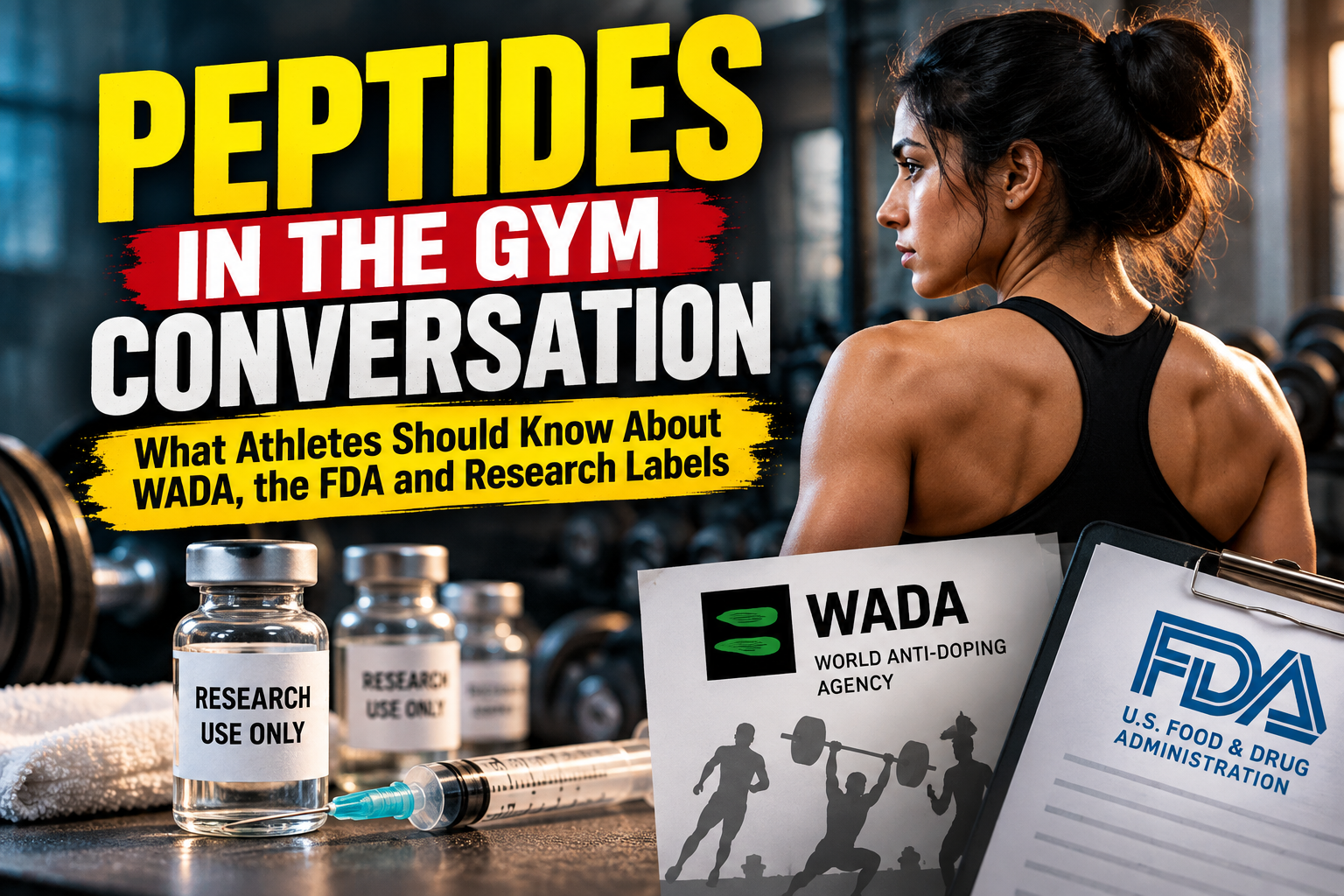
Spend ten minutes in a lifting forum or scrolling fitness content and you will run into peptides. They get mentioned alongside creatine, collagen and sleep trackers, usually with an acronym and a confident claim attached. For anyone who trains seriously, and especially anyone who competes, the gap between that online chatter and the actual rules is wide enough to end a season.
This guide is not about whether peptides work. It is about what they are, how regulators classify them, and why a “research use only” label means exactly what it says.
![Image]() First, what is a peptide?
First, what is a peptide?
Peptides are short chains of amino acids. If a protein is a long sentence, a peptide is a short phrase built from the same alphabet. Your body makes many of them naturally, and they work as chemical messengers that help regulate things like hunger, blood sugar and hormone release.
That natural role is what makes them interesting to scientists. It is also why the word gets stretched in fitness marketing. A protein shake contains peptides in the nutritional sense, broken down during digestion. The compounds discussed in gym forums are something different: synthetic molecules, often designed in laboratories, that are sold in vials rather than tubs.
Related Stories
 Unified Strength: The Powerhouse Playbook for Winning Gym Competitions as a Team
 What to Look For When Buying Used Fitness Equipment
![Image]() Most of the peptides you hear about are not approved drugs.
Most of the peptides you hear about are not approved drugs.
A small number of peptide-based medicines have gone through full clinical trials and earned regulatory approval for specific conditions. They are prescribed by doctors, made to pharmaceutical standards and supplied with official labelling.
Most of the names that circulate in training circles are not in that group. They have been studied mainly in cell cultures and animal models, with little or no controlled human data. A 2026 review of approved and unapproved peptides in sports medicine summed up the situation plainly: promising results in animal research, but a shortage of rigorous human safety evidence. Early lab findings are a starting point for science, not a green light for anyone.
![Image]() What “research use only” really means.
What “research use only” really means.
When a supplier labels a peptide research use only, it is selling a chemical for laboratory study. That means cell work, analytical testing and other research by qualified people. The label tells you the product has not been evaluated for safety or effectiveness in humans and is not intended for human or veterinary use.
The FDA has taken a close look at several of these compounds when they were proposed for use by compounding pharmacies. A number of popular research peptides appear on the agency’s list of certain bulk drug substances that may present significant safety risks, with concerns that include possible immune reactions and a lack of adequate safety information. That list is worth reading for anyone who assumes that “widely discussed” means “well understood”.

![Image]() Why competitive athletes should pay extra attention.
Why competitive athletes should pay extra attention.
For tested athletes, the stakes go beyond health questions. The World Anti-Doping Agency publishes an updated Prohibited List every year, and the 2026 Prohibited List applies across Olympic sports and the many federations that follow the World Anti-Doping Code.
Two sections matter most for peptides:

- S0, non-approved substances. This category covers any pharmacological substance that is not approved by a government health authority for human therapeutic use. It is deliberately broad, which means an unapproved research compound can be prohibited at all times even if it is not named individually. BPC-157, one of the most talked-about research peptides, is listed there by name as an example.
- S2, peptide hormones, growth factors and related substances. This section covers compounds that influence growth hormone, red blood cell production and similar pathways, including a range of growth hormone releasing peptides.
Anti-doping rules work on strict liability. An athlete is responsible for any prohibited substance found in their sample, regardless of how it got there or what the label claimed. “I thought it was just a recovery peptide” is not a defence. If you are subject to testing, the safest step is to check any substance with your national anti-doping organisation before it goes anywhere near your training plan.
![Image]() Quality is a separate problem.
Quality is a separate problem.
Even setting the rules aside, the research peptide market has a quality question. Vials are not manufactured under drug regulations, so the only reliable check is independent testing. For laboratories that buy these compounds for legitimate study, the standard is a certificate of analysis, or COA, from a third-party lab. A useful COA confirms the compound’s identity, usually by mass spectrometry, reports its purity by HPLC, and ties the result to a specific batch number and test date.
Reputable research suppliers are clear about what they sell and who it is for. NextGenPeps, for example, supplies peptides labelled for research use only and posts third-party testing documentation for its
compounds. That kind of transparency is what researchers should look for, and it also illustrates the point: a research supplier is not a pharmacy, and a vial on a lab bench is not a treatment.
![Image]() The takeaway for people who train.
The takeaway for people who train.
Fitness is built on things you can control: programming, sleep, nutrition and consistency. Peptides sold for research sit outside that toolkit. They are unapproved, lightly studied in people, flagged by regulators, and in many cases prohibited in sport.
If a coach, influencer or training partner brings them up, the right questions are simple. Is this an approved medicine? What does WADA say about it? What does my doctor say? If the answers are “no”, “prohibited” and “I have not asked”, that tells you everything you need to know.
![Image]() Research use only.
Research use only.
The compounds mentioned in this article are sold strictly for laboratory research. They are not intended for human or veterinary use, and this article is not medical advice or an endorsement of any substance. Athletes should consult their anti-doping organisation and a qualified healthcare professional before using any product.
+1 Source
FreakToFit has strict sourcing guidelines and relies on peer-reviewed studies, educational research institutes, and medical organizations. We avoid using tertiary references. You can learn more about how we ensure our content is accurate and up-to-date by reading our editorial policy.
- Safety and Efficacy of Approved and Unapproved Peptide Therapies for Musculoskeletal Injuries and Athletic Performance; https://pubmed.ncbi.nlm.nih.gov/41966639/