
















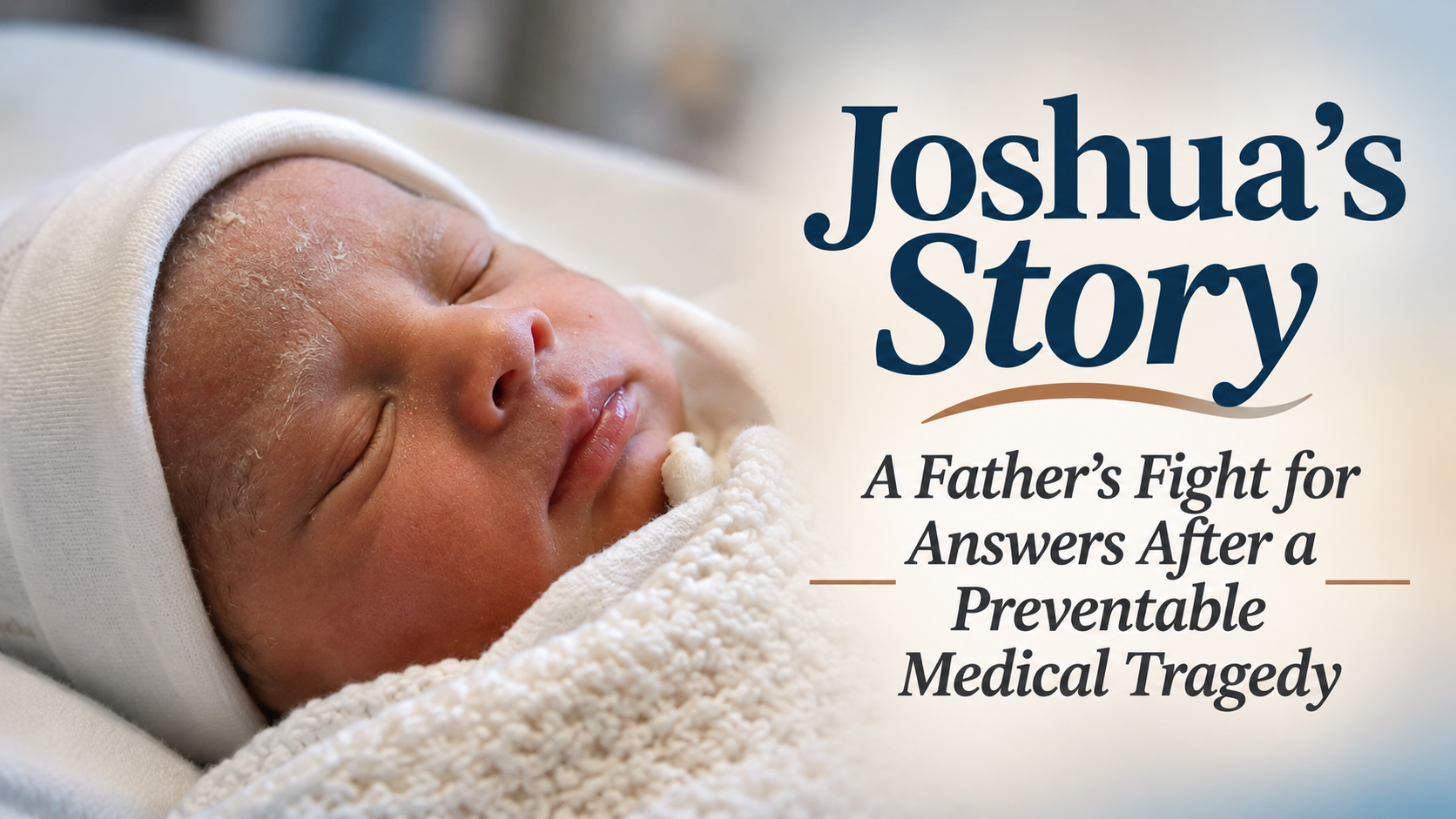
Informações do paciente.
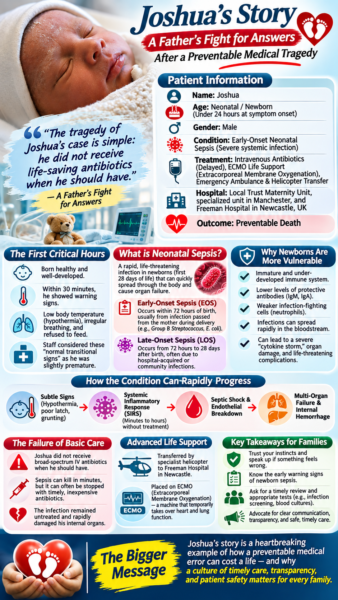
- Nome: Joshua
- idade: Neonatal / Newborn (Under 24 hours at symptom onset)
- Gênero: homem
- Condition: Early-Onset Neonatal Sepsis (Severe systemic infection)
- Treatment: Intravenous Antibiotics (Delayed) , ECMO Life Support (Extracorporeal Membrane Oxygenation), Emergency Ambulance & Helicopter Transfer
- Hospital: Local Trust Maternity Unit, specialized unit in Manchester, and Freeman Hospital in Newcastle, UK
- Resultado: Preventable Death
Some of the most difficult experiences in life are those that result in questions that families have that they never thought they would have to ask. Parents’ drives to a maternity unit to greet a baby should be filled with only the best of positive emotions—hopes, anticipation and a fresh beginning. But when systemic failures and a basic clinical oversight break that joy, the fallout can be an unimaginable nightmare.
Joshua’s tale is a classic and true account of a family completely taken aback by tragedy; a father’s tireless quest to uncover the truth in an institutional hospital cover-up; and a powerful reminder of the urgent need for a global culture change in healthcare, a culture defined by transparency and a complete absence of cover-ups. The facts behind every investigation report are a family’s life forever changed. This deep dive brings back into focus Joshua’s journey, unpacks the pathological nature of the rapid progression to early onset neonatal sepsis, examines the systemic vulnerabilities in the wake of independent investigations, and offers practical guidance for the parents of a child experiencing clinical sepsis.(1)
When Instinct is in opposition to the Medical Script.
This pregnancy was the second for the family and they were over the moon to learn that they were having a little boy. All was going well until a normal delivery appeared to be in the cards. On a Monday morning, the father came to the local hospital just in time. Joshua was born healthy, well developed and vibrant.
The relief that his dad felt at his son’s arrival was instant: “Thank goodness, he’s just a perfect, healthy, beautiful little baby boy.”
However that was only 30 minutes.
Almost immediately, Joshua’s physiological status went sideways. His body temperature was abnormally low, his breathing was definitely irregular, and he refused to latch or feed. As a slightly premature baby, his attending maternity staff brushed them aside and told the parents these were all normal “transitional” signs of a baby.
Although the parents trusted in the specialized training of the staff, after the next day, it was clear that Joshua was having an urgent systemic problem. He fell and was taken by special ambulance transfer to a specialist neonatal intensive care unit, at Manchester.
The Critical Hour: The Pathological Reality of Neonatal Sepsis.
The incoming medical staff at the special center in Manchester were blunt. After examining the terrified parents they made a terrible diagnosis – all Joshua had was an overwhelming, advanced infection resulting from neonatal sepsis.
Pathological Vulnerability of the Newborn.
Sepsis is a rapid progression of a life threatening systemic inflammatory response syndrome (SIRS) triggered by a bacterial, viral, or fungal infection that occurs in the early neonatal period, defined as the first 28 days of life. These infections have been divided into two separate pathological entities by clinicians:
Histórias relacionadas
 Cecilia’s Journey of Strength: Her fight with hypertension and life after stroke.
 Andrew Sheldrick’s Patient Story: A Mother’s Fight for Medication Safety
- Early-Onset Sepsis (EOS): Occurs within 72 hours of birth; usually occurs from vertical transmission through the maternal genito-urinary tract during delivery and/or labor. The main pathogens causing the disease are Group B Streptococcus (GBS) and Escherichia coli (E. coli).
- Late-Onset Sepsis (LOS): Onset 72 hours to 28 days after birth, usually due to nosocomial (hospital-acquired) infection or community-acquired infection, and is often a result of exposure to indwelling medical devices or healthcare workers.
Newborn infants have a very undeveloped, unsuspecting immune system. They suffer from a reduction of circulating endogenous immunoglobulin (IgM, IgA), and have impaired neutrophil function. If a newborn is infected with an aggressive pathogen, his/her immune system doesn’t have the resources to contain the infection. The bacteria multiply rapidly and readily invade the blood-brain barrier, causing an intense cytokine storm that results in extensive endothelial damage, microvascular clotting and destruction of the systemic organs.
Subtle Signs (Hypothermia, poor latch, grunting)
│
▼
(Minutes to hours without treatment)
Systemic Inflammatory Response Syndrome (SIRS)
│
▼
Septic Shock & Endothelial Breakdown
│
▼
Multi-Organ Failure & Internal Hemorrhage
The Failure of Basic Care.
The tragedy of Joshua’s case is quite simple, and bleak: His care team utterly failed to give him broad-spectrum intravenous antibiotics when they should have done. Sepsis can kill in minutes, but it can be stopped by inexpensive standard IV antibiotics if doctors respond immediately to the first signs of the condition.
The father reflected, as he did without enjoyment, that Joshua might have had only basic, active care in the first hour of his life, and that his body would have defeated the pathogen, and he’d still be here today. On the contrary, the infection remained untreated and ate away his internal organs.
Empty Rooms and Futile Bypass Machines.
They took Joshua to Freeman hospital in Newcastle by a specialist helicopter team, as they could not provide him with the treatment he needed here in Manchester. The aim was to put him on a tertiary treatment, known as ECMO (Extracorporeal Membrane Oxygenation), or an external heart and lung machine that temporarily replaces a baby’s cardiovascular and respiratory function.
However, the infection had already resulted in irreversible systemic damage. At the time, the doctors were unaware that Joshua’s left lung was more damaged than anyone realized, and it started bleeding profusely. Lead consultant sits parents down, to have a conversation no mother or father should ever have to endure: “Look, if we try this operation, it’ll be futile. We just worry it will make him suffer more.”
It was decided to switch off ECMO machine. The consultant was dismissed to allow privacy to the family, and came back 20 minutes later. Parents knew their baby boy was gone when the doctor nodded his head.
They had never seen their son without all of the plastic tubes, tape, and large equipment before. To his father he was simply a nice sleeping baby. They bid each other goodbye in the hardest and most painful moment of the dad’s life.
Uncovering the curtain over an institutional cover up.
A clinical pursuit of the truth is the path opened up by grief to Joshua’s father.The pursuit of the truth is an unstopping, clinical obsession that comes out of grief for Joshua’s father. He couldn’t help but have a frightening thought: If Joshua was so explicitly bad off, if he was exhibiting textbook symptoms and was left to go downhill until he collapsed, was this an isolated incident, or were other babies being broken by that same system?
The parents retrieved the official medical records, and discovered a wall of lies. There were huge, unbridgeable differences between what was entered by the midwives in the notes and what the parents had seen at the bedside. Symptoms were missing and timelines of care were changed.
The father started to reach out to other local grieving parents and a sinister pattern started to emerge. It was the same in several families: when the babies were in trouble, they were not called by the doctors, when they collapsed they were left to collapse, and the truth of subsequent internal investigations was covered up.
Worst of all, important medical records weren’t just lost by chance. Within that hospital, one person chose to do something that is calculated, it is thought-through, that will be easier to destroy or hide the evidence, than for the families to find out what had actually happened.
The “Lethal Mix” Exposed by Independent Review.
Early in 2013 the father arranged a meeting with the then UK Health Secretary Jeremy Hunt. In a state of realisation that there were systemic problems and hidden deaths, Hunt accepted to start a comprehensive independent external investigation.
The final published report was terrible. It officially found a “lethal mix of failures” in the hospital trust that directly caused the deaths of mothers and babies that could have been prevented.
The Scale of the Failures.
Total Casualties: It was revealed in the investigation that 16 babies and 3 mothers lost their lives as a result of the shockingly poor clinical care provided.
Preventability Rate: The report said 11 of those people would have almost certainly lived if they had been given basic competent medical care (3:34).
The Ultimate Tragedy: Unbelievably, six of those baby deaths occurred after Joshua’s death.
For years, the hospital’s top management team had stonewalled claims of any problems. They used statistics in a general way to create illusions of a safe, good maternity unit. This was the first time the independent report has explicitly labelled this as an ongoing cover up and for more than a week it was the number one national headline in England!
Expert Opinions: Why Healthcare Systems Must Change Their Culture.
These tragedies keep repeating and it is essential to understand the structural culture of modern medical institutions. In fact, the horror of Joshua’s case is that there was a human error and that the hospital was not prepared to learn from it, say leading patient safety experts.
Decades ago other high-consequence industries such as commercial aviation, nuclear energy, and oil drilling understood that humans have a history of making mistakes when stressed. These industries created systems that make it easy for people to raise their hands and to say a human error right away without fear of destroying their professional lives. This enables the system to form patches, which will help them avoid committing the same error again.
It’s all upside down in healthcare. It is an industry that they have built a very systemic culture around that is a lot of blame and punishment and really doesn’t like to admit that they have made a mistake. This means that staff have to cover up errors and ensures that those same fatal errors will continue to be made.
A genuine risk exists that an institution’s executive might interpret the facts differently, use the statistics for institutional self-congratulation, and not ask what the facts mean. A school that doesn’t admit and quantify its issues will never produce the action necessary to change the issues. In healthcare, honesty and transparency are essential in tackling structural issues and saving lives.
Essential Safety Checklist for New Parents.
Although it’s not the parent’s job to diagnose the clinical condition, parents should be able to recognize early onset neonatal infections and escalate care for their child. Don’t take a second opinion from someone that isn’t from your own intuition.
- Watch for Sudden Behavioral Changes: The onset of sepsis is often not dramatic. If your baby’s temperature suddenly drops (feels cold to the touch), if her breathing is unusual or fast, if she has a weak or unusual cry, if she is very floppy or lethargic, or if she refuses to feed, follow her instincts.
- Demand Specific Sepsis Evaluations: If your baby is not behaving normally and staff offer a dismissive response such as “It’s just a normal transition” be direct and specific. Directly ask: “Have you done a complete septicemia assessment and what are the specific clinical clues that you are not having a systemic infection at this time?
- Act Without Delay: When at home and seeing your newborn’s health deteriorate, do not wait for a call back from your family doctor or routine appointment. Call 111 for fast or 999 in case of emergency, in the UK. Call 112 for urgent neonatal response unit in India.
- Double Check Records: Always confirm your medical charts, discharge documents and timelines. If there is a discrepancy between what has occurred at the bedside and what has been documented, document it immediately, and flag it with a note on the case.
Perguntas frequentes.
1. What exactly caused Joshua’s death?
Joshua died from advanced neonatal sepsis. His care team missed clear early warning signs (low temperature, breathing issues, feeding refusal) and completely failed to administer broad-spectrum antibiotics during the first hours of his life, allowing a highly treatable infection to turn fatal
2. How common was this issue at the hospital mentioned?
It was highly systemic. The independent investigation ordered by Health Secretary Jeremy Hunt revealed an ongoing cover-up that hid the preventable deaths of 16 babies and 3 mothers under that specific trust’s care
3. Why are high-level hospital statistics sometimes misleading to patients?
Hospital management teams often use macro-data to paint a reassuring picture of patient safety (3:57). By clustering metrics or omitting specific adverse outcomes, executives can hide dangerous, localized clinical failures beneath positive average scores.
4. What is the clinical timeline requirement for treating suspected newborn sepsis?
International medical consensus mandates that broad-spectrum intravenous antibiotics should be administered within one hour of a suspected diagnosis. Any delay significantly increases the risk of mortality.
The Lifesaving Takeaway.
A newborn with a sudden decrease in temperature, irregular breathing or failure to eat must be treated right away by a medical professional. Do not be afraid to go against the grain of what the medical staff say or what the institution may be comfortable with due to politeness.Never be afraid to do what you feel right as a parent, even if it’s not what the institution or medical staff will say. The critical factor in any case of such an infection is early intervention with standard antibiotics, the difference between a safe recovery and a preventable tragedy. Always check physical labels and always get a doctor’s approval for any health decisions.
+1 de origem
A FreaktoFit tem diretrizes rígidas de sourcing e conta com estudos revisados por pares, institutos de pesquisa educacional e organizações médicas. Evitamos o uso de referências terciárias. Você pode aprender mais sobre como garantimos que nosso conteúdo seja preciso e atualizado, lendo nosso política editorial.