

















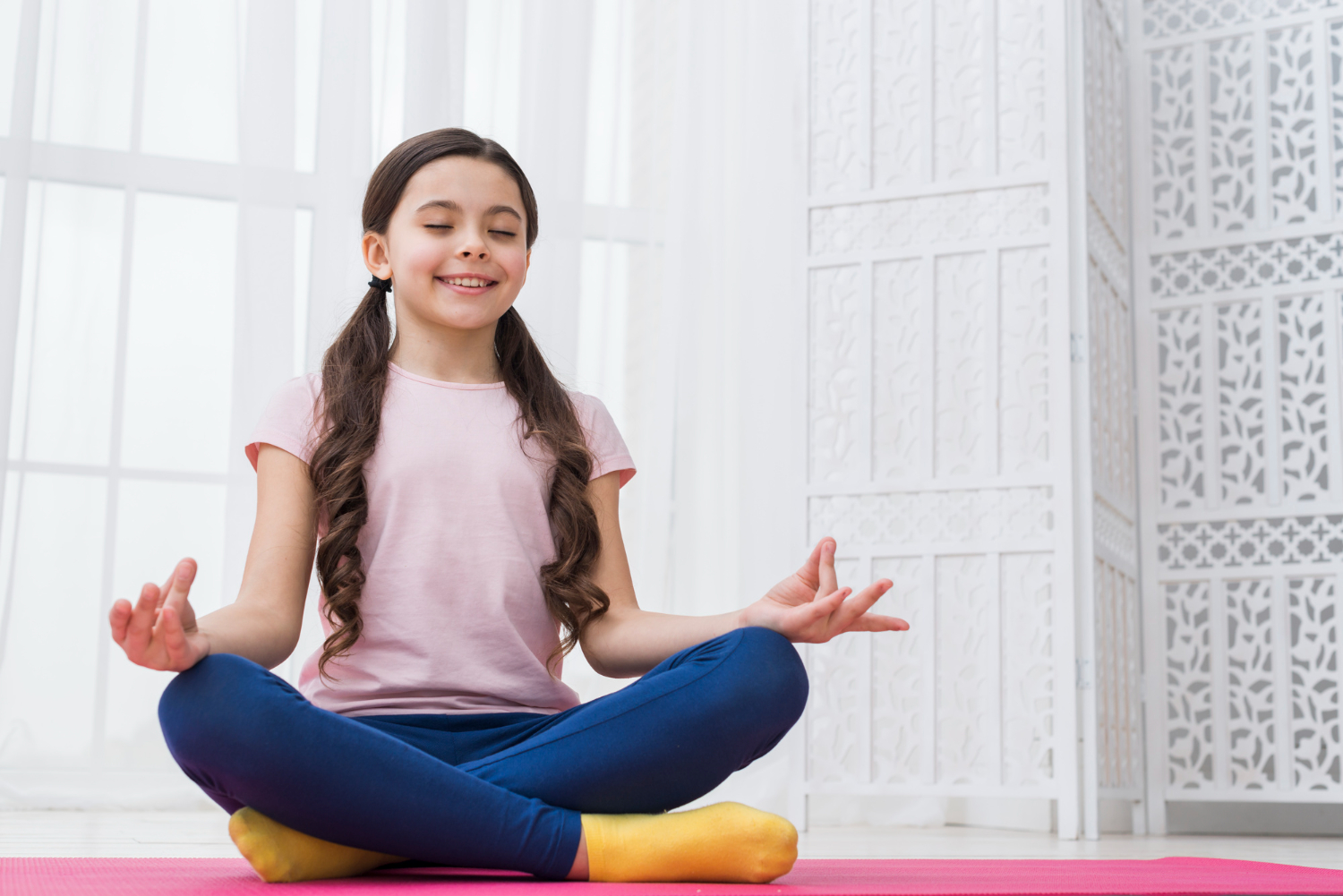
Super Brain Yoga is a simple yet powerful technique that activates specific energy points in the body to improve cognitive function, memory, and overall brain health. This practice helps balance the brain’s hemispheres, boosting focus, attention, and learning capacity. Particularly beneficial for children, Super Brain Yoga supports cognitive development, making it easier for young learners to absorb and retain information.
In this video, we demonstrate five targeted brain exercises that enhance the language learning ability of multilingual children, which is especially relevant in diverse linguistic environments like India. These exercises not only stimulate neural pathways but also improve mental clarity, helping children switch between languages with greater ease. Integrating these exercises into daily routines offers long-term benefits for memory retention and brain health, making it a valuable tool for academic success and overall cognitive development.
What Is the Science Behind Super Brain Yoga?
Super Brain Yoga is commonly described as a combination of physical movement, breathing, and focused attention. The traditional technique involves touching the earlobes while performing a controlled squat. Its proponents believe that this movement stimulates specific energy points and supports communication between different parts of the brain.
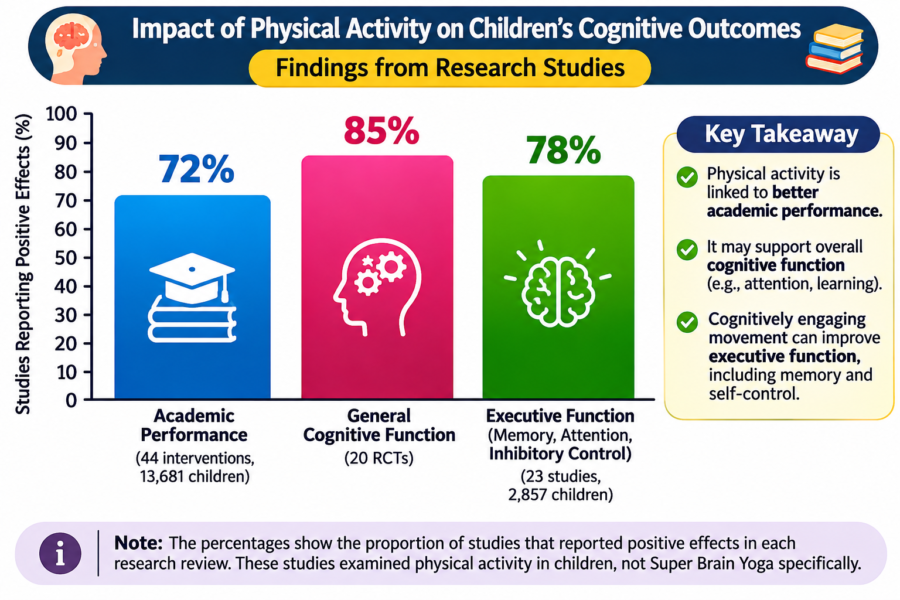
From a scientific perspective, physical activity can influence several aspects of brain health. Movement increases blood circulation, supports general physical well-being, and may contribute to attention and mood regulation. Activities that combine movement with concentration can also encourage children to practise body awareness and follow instructions.(1)
قصص ذات صلة
 أفضل 11 يوغا يوجا أستخدمها كراكب دراجة لتحسين المرونة والتعافي
 أفضل وضعيات اليوجا لتخفيف آلام الأعصاب في عرق النسا
ومع ذلك، فهي important to distinguish between the potential benefits of physical activity and claims specifically made about Super Brain Yoga. There is currently insufficient high-quality scientific evidence to establish that this particular exercise improves intelligence, balances the brain’s hemispheres, activates specific energy points, or produces measurable improvements in memory and language learning.(2),(3)
Parents and educators can introduce it as a gentle movement activity, but it should not be considered a proven treatment for learning difficulties or a replacement for established educational methods.
How to Perform Super Brain Yoga for Children?
Super Brain Yoga is generally demonstrated as a simple exercise involving ear holding and squatting. Children should practise it slowly, under adult supervision, and only if they can perform the movements comfortably.
- Ask the child to stand upright with their feet approximately shoulder-width apart.
- Instruct them to place their left hand across the chest and gently hold the right earlobe using the thumb and index finger.
- Next, ask them to bring their right hand across and hold the left earlobe, with the right thumb positioned in front of the left thumb.
- Keep the arms comfortably positioned in front of the chest.
- Ask the child to inhale gently and slowly bend their knees into a comfortable squat.
- Encourage them to exhale while returning to the standing position.
- Repeat the movement a few times, depending on the child’s comfort and ability.
The exercise should never involve forced breathing, deep squats, or uncomfortable pressure on the ears. Younger children may need a simplified version without the squatting movement.
5 Brain Exercises to Support Language Learning in Children.
Children who grow up in multilingual environments often use more than one language at home, at school, and in their communities. Regular language practice, listening activities, reading, and interactive games are important for developing communication skills.
The following five activities can be incorporated into a child’s daily routine to encourage attention, listening, memory, and language practice.
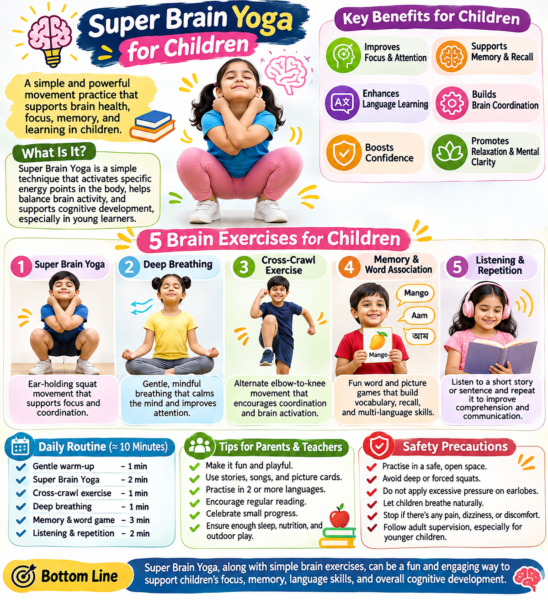
1. Super Brain Yoga.
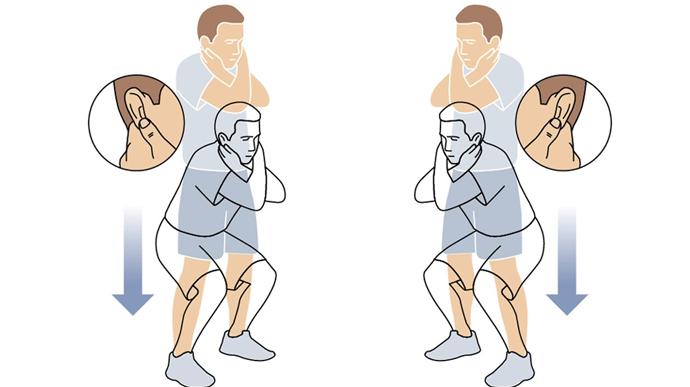
This traditional exercise combines a simple squatting movement with coordinated hand placement on the opposite earlobes.
Children can practise the movement slowly while following an adult’s instructions. It provides an opportunity to practise coordination, movement control, and concentration.
For multilingual children, parents can give simple instructions in different familiar languages. For example, they can ask the child to stand, squat, inhale, and exhale using Bengali, Hindi, or English.
The language switching activity provides an opportunity to practise vocabulary and listening comprehension. Any language-learning benefit comes from the instruction and practice, not from a proven special effect of the yoga الحركة.
2. Deep Breathing Exercise.

Deep breathing is a simple relaxation activity that can help children become more aware of their breathing patterns.
Ask the child to sit comfortably with their back supported. Encourage them to breathe gently through the nose and allow the abdomen to move naturally as they inhale and exhale.
Practise for one or two minutes without forcing the breath or holding it.
Parents can make this activity more interesting by asking children to count their breaths in different languages. For example, they can count from one to five in English and then repeat the same sequence in Bengali or Hindi.
This combines a calming activity with number recognition, pronunciation, and listening practice.
3. Cross-Crawl Exercise.

Cross-crawl is a simple coordination exercise in which children alternately touch one elbow towards the opposite knee.
How to perform it:
- Ask the child to stand comfortably with their feet slightly apart.
- Encourage them to lift the right knee.
- Bring the left elbow gently towards the right knee.
- العودة إلى وضع البداية.
- Repeat with the opposite arm and leg.
- Continue alternating slowly for approximately 30–60 seconds.
This activity encourages balance, coordination, and awareness of body movement.
To include language practice, ask children to name the body parts involved in each movement. They can identify the elbow, knee, left side, and right side in different languages.
4. Memory and Word Association Game.
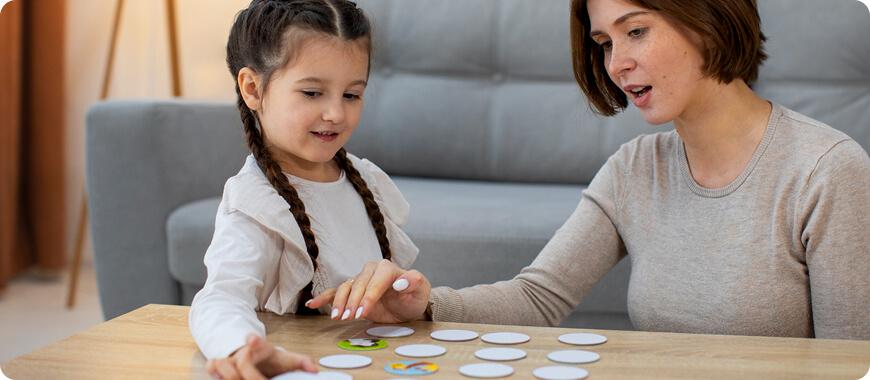
Memory games are useful for encouraging children to recall information, recognize words, and develop vocabulary.
For this activity, prepare a few picture cards showing familiar objects, animals, fruits, or household items.
How to play:
- Show the child five picture cards.
- Ask them to name each object in one language.
- Repeat the activity using another familiar language.
- Turn the cards face down.
- Ask the child to recall the objects they saw.
- Gradually increase the number of cards as their confidence improves.
For example, a child may identify a mango as “aam” in Hindi, “aam” in Bengali, and “mango” in English.
This activity supports vocabulary development, recall, and the ability to connect words with their meanings.
5. Listening and Repetition Exercise.
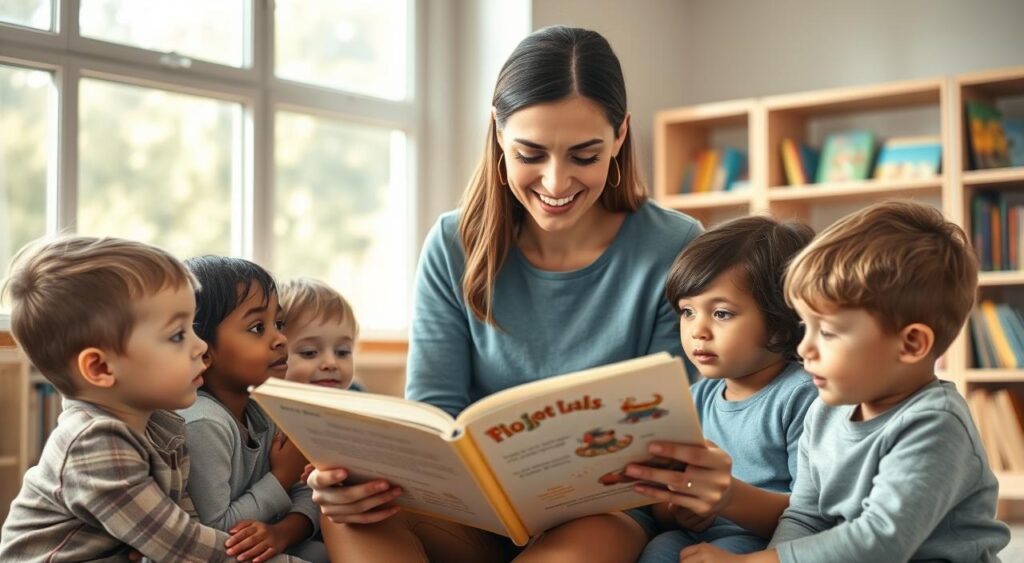
Listening and repetition activities help children practise pronunciation, understand sentence structures, and remember spoken information.
Parents or teachers can read a short story, nursery rhyme, or a few simple sentences aloud.
Ask children to listen carefully and repeat the sentences in their own words. You can also introduce a familiar story in two different languages and encourage children to identify similar words and expressions.
For example, read a short story in English and ask the child to explain what happened in Bengali or Hindi.
This activity encourages active listening, comprehension, vocabulary development, and confidence in communication.
Benefits of Super Brain Yoga and Brain Exercises for Children.
Although the specific cognitive benefits of Super Brain Yoga have not been established through strong clinical research, combining gentle movement with educational activities can support several aspects of a child’s development.
1. Encourages Concentration: Activities that require children to follow instructions and complete movements in sequence provide opportunities to practise attention and task engagement.
2. Supports Body Coordination: Exercises such as squatting and cross-crawling involve controlled movements. Practising them can help children develop movement awareness and coordination.
3. Promotes Relaxation: Gentle breathing and mindful movement can provide a short break from demanding schoolwork and may help children feel calmer.
4. Encourages Language Practice: Word games, storytelling, and multilingual counting offer children opportunities to hear, remember, and use different languages.
5. Builds Confidence: Completing simple activities and learning new words can help children feel more confident about participating in classroom discussions and everyday conversations.
6. Makes Learning Interactive: Combining movement, pictures, sounds, and storytelling can make educational activities more engaging, particularly for younger children.
Why Is Language Development Important for Multilingual Children?
In countries such as India, many children grow up using two or more languages. They may speak one language with family members, another with friends, and a different language in the classroom.
Multilingualism provides children with opportunities to communicate with different communities and understand diverse cultures. However, developing proficiency in multiple languages requires regular exposure and meaningful practice.
Children learn languages through several interconnected processes, including:
- Listening to conversations and recognizing familiar sounds.
- Learning new words and understanding their meanings.
- Practising pronunciation and sentence formation.
- Reading age-appropriate stories and educational material.
- Participating in conversations with parents, teachers, and peers.
- Recalling vocabulary and using it in different situations.
Activities such as storytelling, rhyming games, picture identification, and word association can make this learning process enjoyable.
Parents should also remember that mixing words from different languages is common among multilingual children. It does not automatically indicate a language disorder or learning difficulty.
How to Include Brain Exercises in a Child’s Daily Routine?
Consistency and enjoyment are more important than the duration or intensity of these activities. Children do not need long or complicated exercise sessions to benefit from opportunities for movement and learning.
Here is an example of a simple 10-minute routine:
| نشاط | مدة |
|---|---|
| Gentle warm-up | 1 دقيقة |
| Super Brain Yoga, if comfortable | 2 دقيقة |
| Cross-crawl exercise | 1 دقيقة |
| التنفس اللطيف | 1 دقيقة |
| Memory and word association game | 3 minutes |
| Listening and repetition | 2 دقيقة |
Parents can adjust the routine according to the child’s age, physical ability, and attention span.
It is also helpful to combine these activities with outdoor play, adequate sleep, nutritious meals, reading, and regular conversations.
Safety Precautions While Practising Super Brain Yoga.
Children should always perform physical activities in a safe and comfortable environment. Although the movements involved in Super Brain Yoga are relatively simple, certain precautions are important.
- Ensure that the child has enough space to move without hitting furniture or other objects.
- Avoid forcing the child to squat deeply.
- Do not pull, pinch, or apply excessive pressure to the earlobes.
- Allow children to breathe naturally without holding their breath.
- Stop immediately if the child experiences dizziness, pain, breathlessness, or discomfort.
- Modify the activity for children with balance difficulties, joint problems, or physical limitations.
- Supervise younger children throughout the activity.
Children with existing medical or mobility concerns should follow advice from an appropriate healthcare professional before beginning unfamiliar exercises.
Super Brain Yoga should never replace professional assessment, speech and language therapy, educational support, or treatment for developmental concerns.
Tips for Parents and Teachers.
Parents and teachers تلعب دورًا مهمًا in creating an environment where children feel comfortable exploring different languages and learning new skills.
Here are some practical suggestions:
- Make learning playful: Use flashcards, colourful pictures, storytelling, and simple movement games.
- Encourage regular reading: Read short stories in the languages the child is learning.
- Practise without pressure: Allow children to make mistakes while learning new words and pronunciations.
- Use everyday conversations: Introduce new vocabulary during activities such as cooking, shopping, and playing.
- Celebrate progress: Appreciate effort and participation rather than expecting perfect performance.
- Provide enough rest: Adequate sleep is important for children’s overall health, learning, and development.
- Encourage physical activity: Include age-appropriate outdoor play and movement throughout the day.
The goal is to create a positive learning environment in which children can develop communication skills, curiosity, and confidence naturally.
الأسئلة المتداولة.
1. What is Super Brain Yoga for children?
Super Brain Yoga is a traditional movement technique that involves holding opposite earlobes while performing gentle squats. It is promoted as an exercise for concentration and mental alertness, although strong scientific evidence supporting its specific cognitive benefits in children is currently limited.
2. Does Super Brain Yoga improve children’s memory?
There is insufficient high-quality research to confirm that Super Brain Yoga directly improves memory. However, combining physical activity with memory games, storytelling, and regular learning activities can help children practise recall and attention.
3. How many times should children practise Super Brain Yoga?
Children can try a few gentle repetitions as part of a short movement routine, provided they are comfortable. There is no scientifically established ideal frequency or number of repetitions. Adult supervision is recommended.
4. Can Super Brain Yoga help multilingual children learn languages?
Super Brain Yoga has not been proven to accelerate language learning. However, combining movement with multilingual counting, storytelling, listening exercises, and word association games can provide enjoyable opportunities to practise different languages.
5. Is Super Brain Yoga safe for all children?
Most healthy children can try gentle, modified movements, but the exercise should never cause pain, dizziness, or discomfort. Children with balance difficulties, mobility limitations, or medical concerns should receive appropriate guidance before practising it.
الخلاصة.
Super Brain Yoga is a simple movement activity that can be introduced into children’s daily routines alongside other age-appropriate brain exercises. While its specific claims about improving intelligence, memory, and brain function are not yet supported by strong scientific evidence, combining gentle movement with breathing, storytelling, memory games, and multilingual activities can make learning more engaging. For the best developmental support, encourage children to stay physically active, sleep well, read regularly, and explore different languages in a positive and stimulating environment.
+3 مصادر
لدى Freaktofit إرشادات صارمة بشأن المصادر وتعتمد على الدراسات التي راجعها الأقران ومعاهد البحوث التعليمية والمنظمات الطبية. نتجنب استخدام المراجع من الدرجة الثالثة. يمكنك معرفة المزيد حول كيفية ضمان دقة المحتوى الخاص بنا وتحديثه من خلال قراءة سياسة التحرير.
- Children’s Physical Activity, Academic Performance, and Cognitive Functioning: A Systematic Review and Meta-Analysis; https://pmc.ncbi.nlm.nih.gov/articles/PMC7372103/
- Does Physical Activity Improve Cognition and Academic Performance in Children? A Systematic Review of Randomized Controlled Trials; https://pubmed.ncbi.nlm.nih.gov/33887743/
- Effects of cognitively engaging physical activity interventions on executive function in children and adolescents: a systematic review and meta-analysis; https://pubmed.ncbi.nlm.nih.gov/39246315/