










































 Workout

 Meditation


 Podcast
 E-book

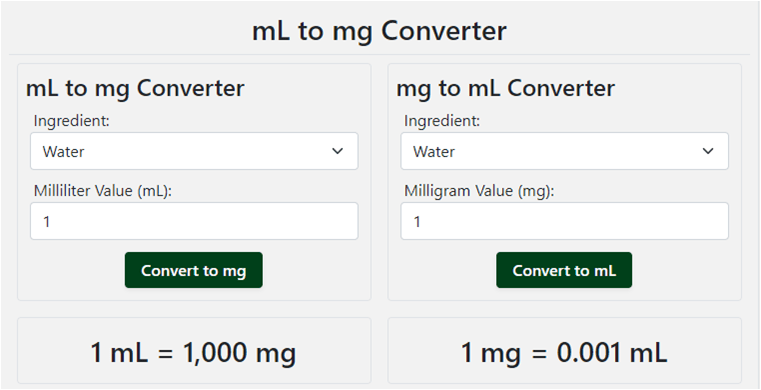
In the world of measurements, it’s important to have a clear understanding of different units and how they relate to one another. One common conversion that often arises in various fields, including medicine, chemistry, and cooking, is the conversion from milliliters (mL) to milligrams (mg). This conversion is essential for accurate dosing, formulation, and understanding of the concentration of substances. In this article, we will delve into the fundamentals of converting( mL to mg Converter) and explore its practical applications.
The Relationship Between mL and mg.
Before we dive into the conversion process, let’s establish the relationship between milliliters (mL) and milligrams (mg). Milliliters measure volume, representing the amount of space occupied by a liquid, while milligrams measure mass, representing the weight of a substance. This fundamental difference highlights the importance of the conversion process when transitioning between these two units.
Understanding Density.
To convert mL to mg Converter, one crucial factor to consider is density. Density is the mass of a substance per unit volume. Different substances have different densities, which affect the conversion between mL and mg. For example, the density of water is 1 g/mL, meaning that 1 mL of water weighs 1 gram or 1000 mg.
Converting mL to mg Converter: To convert mL to mg Converter, you need to know the density of the substance in question. Once you have the density value, you can use the following formula:
Related Stories
 Northern Ireland Moves to Make Porn Depictions of Choking Illegal
 Available Training Accoutrements for Microsoft AZ-400 Test
Mass (mg) = Volume (mL) × Density (mg/mL)
Using this formula, you can convert any given volume in mL to its equivalent mass in mg. It is important to ensure that the density value you use corresponds to the specific substance or solution you are working with.
Practical Applications.
The mL to mg Converter conversion finds applications in various fields:
- Medicine and Pharmacy: Healthcare professionals often need to convert liquid medication doses from mL to mg Converter to ensure accurate administration to patients. This is crucial in fields such as pediatrics and critical care.
- Chemistry: In chemical experiments, converting mL to mg Converter is necessary to measure precise quantities of reagents, solvents, and substances in laboratory settings.
- Cooking and Nutrition: Some recipes or dietary guidelines provide ingredient measurements in mL, while nutritional information may be expressed in mg. Converting between the two units allows for accurate portioning and dietary analysis.
- Manufacturing and Quality Control: Industries such as pharmaceuticals, cosmetics, and food and beverage rely on mL to mg Converter conversion for product formulation, quality control, and ensuring consistency in manufacturing processes.
Bottom Line.
Understanding the conversion from milliliters (mL) to milligrams (mg) is essential for a wide range of applications, from medicine to chemistry and everyday life. By grasping the relationship between volume and mass and considering the density of the substance in question, you can convert mL to mg Converter accurately. Whether you are a healthcare professional, chemist, chef, or simply someone interested in precise measurements, mastering this conversion will enhance your ability to work with different units of measurement effectively.