

















The deadlift is an exercise with a multitude of variations that can be adapted to various training objectives. The Romanian deadlift or Romanian deadlift in English is one of those variants and is great for developing muscle mass and strength although it requires great technical mastery due to the joints involved.
What is the Romanian deadlift?
Although it may surprise us, explaining what the Romanian deadlift consists of or what exercise we are referring to is important when there are nomenclatures to call this exercise that can lead to confusion : deadlift with rigid legs or deadlift with semi-rigid legs.
Of these two ways of calling the Romanian deadlift, the one that would be technically more correct is the deadlift with semi-rigid legs since during the Romanian deadlift the knees must maintain a slight flexion.
Technically, the stiff-legged deadlift, that is, with the knees locked, is a different exercise from the Romanian deadlift (although some people confuse the two) but actually trying to do a deadlift like that would increase the stress on the lumbar spine so I prefer to make the essential clear: the Romanian deadlift is one and is performed with a slight knee bend as we will see in this article.
Related Stories
 How to Take Care of Your Health With Wall Sit Exercise?
 Turkesterone Vs. Ecdysterone: Know The Key Similarities Between Them
What muscles are involved in the Romanian deadlift?
Mainly, all the muscles of the posterior chain that extend the hip : biceps femoris (especially the long head), semitendinosus and semimembranosus, although spinal extensor muscles such as longissimus, iliocostalis and spinousus also participate, without forgetting to mention all those muscles that are responsible for of maintaining a fixed posture and holding the bar: trapezius, biceps or latissimus dorsi.
How it is performed?
We start from the bottom to the top, from the feet to the head.
Correct foot position.
The feet are placed hip-width apart with the toes facing forward. During the movement we must shift our weight towards our heels to maintain a stable center of gravity.

Correct knee position.
This is where confusion and errors occur the most. In the Romanian deadlift, the knees must maintain a slight flexion of between 15º and 20º at the beginning of the movement. Blocking them will not allow correct movement of our pelvis, so our lumbar spine will be rounded, increasing the pressure on our intervertebral discs. As we said at the beginning, in the deadlift with rigid legs this exercise is performed with the knees locked but the control must be maximum and the depth limited so as not to put our spine in check.
Correct position of our pelvis and lumbar spine.
Before starting the movement, we must place our pelvis in a neutral position , maintaining our natural lordotic curvature. During the movement our hips must be pushed back while our shoulders are pushed forward, so maintaining our physiological curvatures is essential to execute the movement safely.

Correct position of our head.
A common mistake is wanting to look forward throughout the movement. If we do this, we will hyperextend our cervical spine which is not correct. Instead of looking ahead, we should look slightly in front of our feet, with our head aligned with our spine.
Not everything that is recommended is to prevent injuries, that too, but in this case excessive hyperextension of the neck will cause greater pelvic anteversion that will make it difficult to fully activate the hamstrings, the target muscles that we want to work on.
The Romanian deadlift step by step.
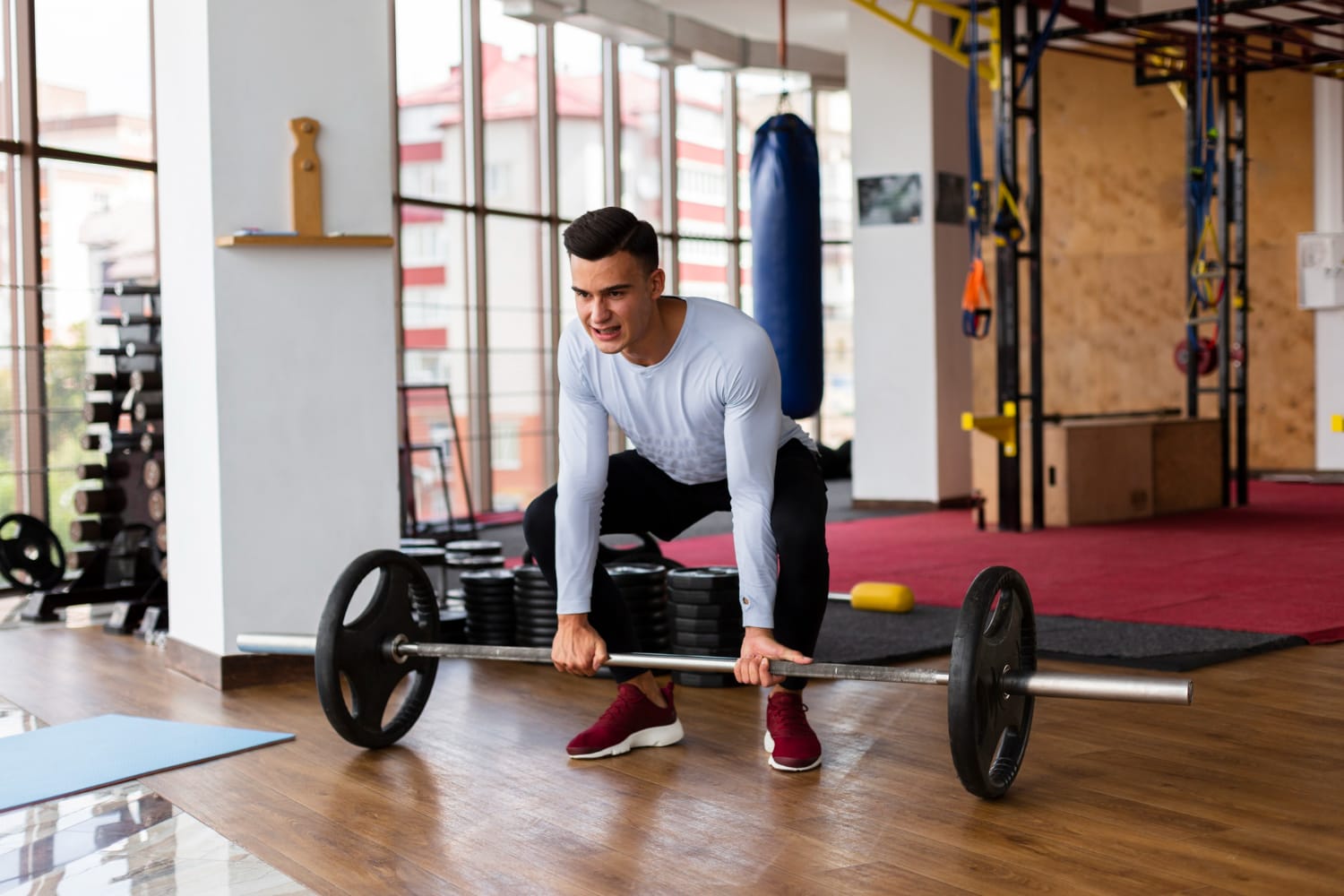
- The movement starts from the top, holding the bar at shoulder width or slightly higher.
- Feet hip-width apart and toes facing forward.
- Head relaxed, chest up and right at the beginning of the movement, knees at 15º-20º of flexion.
- The movement begins by pushing the hips back as the bar descends our thighs to approximately just below the kneecaps. During movement we remember to maintain the alignment of our spine by maintaining natural lordosis and kyphosis in the lumbar and cervical spine respectively.
- At this point we will notice the stretch in our hamstrings and we will begin to extend our hips as the bar rises in contact with our thighs.
- By fully extending the hips and returning to our initial position, we strongly contract the glutes.
How to include it in our training?
Due to the very nature of the exercise, performing it at low repetitions with the weight that this implies can be risky . Sets of eight or more repetitions work well. A suitable cadence would be 2:1 or even 3:1, that is, slow and controlled eccentric phases and explosive concentric phases as long as we can maintain control.
It is one of the exercises that best represents the hip dominant pattern , so it should be present in most training programs, just like knee dominant exercises such as the squat .
Let’s not forget that the hamstrings also have a function on the knee, so we must also train this function with knee flexion exercises such as the femoral curl .
Point To Ponder.
- Romanian Deadlift versus Conventional Deadlift: The conventional deadlift is more about overall strength and requires more movement whereas the Romanian deadlift isolates and stresses the posterior chain -hamstrings and glutes in particular.
- Mobility Requirement: This exercise should not only strengthen but also requires good hamstring flexibility and hip mobility, and hence it is a dual purpose movement.
- Grip Strength Advantage: You can also strengthen your grip when holding the bar in various reps and which can be transferred to other exercises such as the pull-ups and the deadlifts.
- Injury Prevention: RDLs strengthen the posterior chain and decrease the hamstring pull injury and lower back pain, which is useful with athletes and runners.
- Mistake: A lot of lifters will allow the bar to become displaced of their thighs- the bar should be positioned near the body to distribute the load properly and provide safety.
Expert Personal Interview.
I interviewed Strength and Conditioning Specialist and Coach Arjun Mehta to find out why the Romanian deadlift should be part of every program:
The Romanian deadlift would be my pick of a single exercise that needs to be implemented to make hamstrings of athletes bulletproof. It actually teaches the hip hinge and spares the spine unlike the traditional deadlift. It is gold to the runners, football players and even the casual lifters.
Physiotherapist Dr. Neha Kapoor added meanwhile:
The majority of my lower back pains patients have weak glutes and hamstrings. One of the safest, yet the most effective methods of correcting this imbalance is the Romanian deadlift. It helps the posterior chain to become stronger and prevents the repetition of injuries when done well.
Frequently Asked Questions.
The RDL is done with a moderate bend on the knees (1520 o ) which safeguards the spine and is effective in hamstring training. The knees are stiff in the deadlift and the stress is put on the lower back.
Yes, but they must begin with light weights or perhaps with a stick so they can master the form of the hip hinge before trying to work with heavy loads.
Most lifters can work 2 times a week. Combining it with squats and other lower-body exercises will develop a balanced program on the leg and posterior chain.
Bottom Line.
The Romanian Deadlift is an exercise that is not only a strength training but also a base to a strong posterior chain, better athletic performance and injury prevention. With the proper technique and practice of always making it a part of your program, you will have sturdier hamstrings, glutes, and a strong lower back.
The RDL must be one exercise that you cannot afford to do without in your training program to achieve long-term strength, improve your posture, and improve your performance in sports.