

















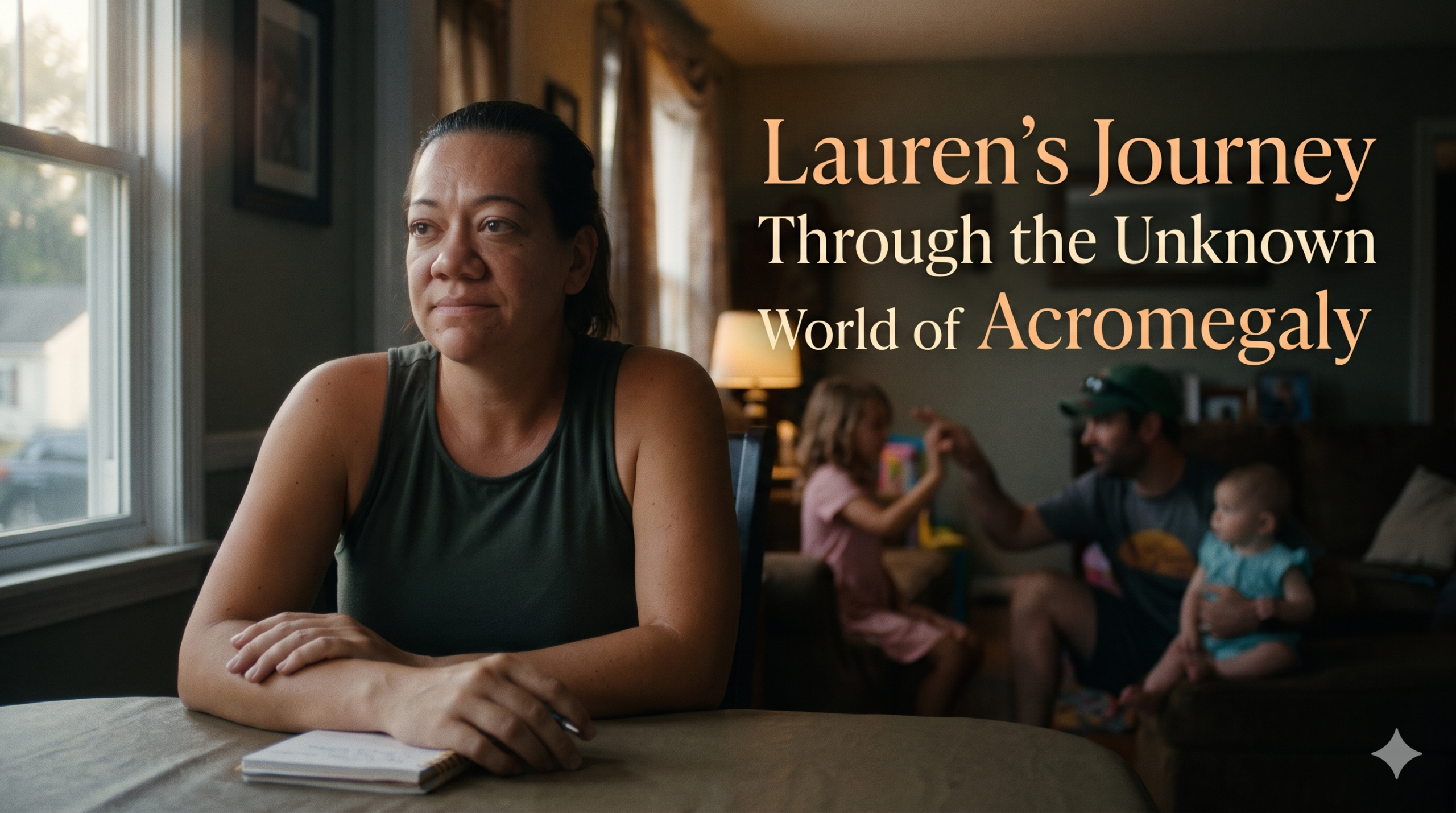
The human body is a complex machine, the workings of which are managed by a hidden chemical communication network. This system works in perfect harmony most of the time and contributes to the control of such aspects as our sleep patterns and metabolism. However, sometimes, a small change takes place in the brain, changing the course of a life forever. For a school teacher and feeing mother in Easley, South Carolina, that change came like an invisible invader—a silent tumor that warped her body, tested her mind and, when it finally came to light, the extent of human resilience.(1)
Lauren’s story isn’t just a medical case study, it’s a deeply human one of health and the heartbreaking frustration of being told you may be fine, when you’re clearly not. It’s about the power of love and community in the face of a scary diagnosis.
The Metamorphosis.
The film is set in 2016, when Lauren is enjoying the familiar, but tired, happiness of being pregnant with her first child. Her path to motherhood was fraught with the typical challenges that come with pregnancy and childbirth, just like millions of women around the world. She was surprised when she was diagnosed with gestational diabetes, but it was readily controlled by routine medical treatment. After the birth of her oldest daughter, Elena, things returned to their proper place in the universe. The diabetes disappeared, the meds were put away, and Lauren got into the wonderful mess of being a lower elementary Montessori teacher and a toddler.
However, there was a slow change in her busy, happy life, beneath the surface.
Cerita terkait
 Andrew Sheldrick’s Patient Story: A Mother’s Fight for Medication Safety
 Joshua’s Story: A Father’s Fight for Answers After a Preventable Medical Tragedy
The changes have been rapid since Lauren got pregnant with her second daughter Payton in 2021. When a woman is pregnant, her body changes in many ways and this is an ideal disguise for a rare and stealth disease. Lauren started to see odd changes that couldn’t be explained. Her shoes were tight – very tight. After a decade of life she and her husband Ryan had created, her wedding band no longer fit into her knuckle.
Lauren’s Early Symptom Progression.
sang treatment of gestational diabetes resembles that of pregestational diabetes.The treatment of gestational diabetes is similar to treatment for pregestational diabetes.
She was so tired that nothing could make her feel better after sleeping. She would look in the mirror, and there would be ongoing acne and something she didn’t recognize in her skin; it was oiliness. She suffered from sudden sweating spells that made her uncomfortable and make her feel hot and sweaty all the time.
She shared these worries with her health care providers and got the same positive but very dismissive answers. They would say with a kind smile, “You’re pregnant!”. “Extra weight can easily make your feet wide, your fingers can easily swell, it is all natural.”
With the help of some expert advice, Lauren put her fears aside. She attributed it to the effects of a second pregnancy at a mid-30s age. However, man’s instinct can be a strong one. The discomforts of carrying a child were nothing new to Lauren, and she knew that what she was feeling was more. Her body was growing—it was growing with life, and more.
The Crashing World.
But it was a shockingly terrifying ending to the medical gaslighting when Lauren’s oldest child was roughly three years old. As much as Lauren tried to move her body and live a healthy life, she couldn’t get it to work. She was putting on weight very quickly, and was both inflamed and was having trouble losing weight.
In search of answers, she went to her GP. First suspicions were a slow thyroid, but the lab blood panel indicated a much more dire emergency. The A1C is a measure of her blood sugar that reflects the last three months, and was measured at a staggering 9.5%. Her triglyceride level had even increased to the 4000s, which was even more alarming, as she was immediately at risk for acute pancreatitis and cardiac events.
The doctor sounded very formal and distant on the phone. “Go to the hospital straight away,” he said sternly. You are in diabetic ketoacidosis.
Emergency Lab Metrics.
When a person doesn’t get enough insulin, the blood becomes dangerously acidic and this can be life threatening (DKA). One day, Lauren awakes and finds herself in the sterile, flashing white lights of the Intensive Care Unit (ICU). It was a shocking, painful, and traumatic event, and the medical system that often blames in on the individual for not doing enough. Lauren remembers a doctor at the hospital treating her very harshly and telling her to stop eating any carbohydrates, sugar, and to do more exercise.
Lauren admits that she was doing her best at the time. But my body wasn’t there, it wasn’t reacting like it should react.
For people with rare diseases, it is a familiar travesty–patients are often held responsible for symptoms over which they have no control. But Lauren was at a disadvantage and an endocrine system that was working against her, and she was treated as if she was just undisciplined.
Unmasking the Monster.
Lauren’s epiphany in medicine happened when she came across a sharp-eyed endocrinologist. He knew he was going to have to wrestle with the tough answers when the 30-year-old female patient with no prior history of type 1 diabetes entered with what was a sudden and severe DKA. He started to gradually work through all the possible combinations of autoimmune diabetes, both typical and atypical, which are all blood tests.
When those tests continually came back negative, the endocrinologist looked closely at Lauren’s physical features. He observed the enlarged hands, the altered facial contours, the experience of a quick somatic growth. On a brilliant clinical suspicion, he ordered a growth hormone test, and a test for Insulin-like Growth Factor 1 (IGF-1).
The results were extremely high. Since Lauren was already pregnant at the time of her initial screening, there was a temporary mathematical ambiguity; pregnancy by itself can raise growth hormones as a result of the activity of the placenta. But the specialist was on his guard. Payton was retested right after birth. This time, it wasn’t just that the numbers were high, they’ve jumped much higher.
During July 2021 Lauren was referred for a specific MRI of her brain. Their worst fear was realized when they looked into the imaging and saw a large macro-adenoma, a benign but serious tumour located right on her pituitary gland.
It’s a pea-sized gland at the base of the brain, known as the “master gland,” which produces hormones that regulate growth, metabolism and reproduction. Lauren’s tumour was compelling her pituitary to produce an endless stream of growth hormone that was causing her problems. This in turn caused her liver to begin secreting an enormous amount of IGF-1, which caused the tissues and bones in her body to swell and thicken.It became known as a disease: Acromegaly.
The doctor’s announcement was devastating when dispensing the news, crushing both Lauren and Ryan. When the world collapsed was like that,” says Lauren. At the time I had a newborn baby, a 2-year-old, and I really thought it was a death sentence.
Understanding Acromegaly.
First, one has to have a working knowledge of the medical truth behind the mountain that Lauren had to climb. It is a very rare chronic condition, affecting only one in every 60,000 people. The progression is very slow and gradual and the average time from the onset of symptoms to the correct diagnosis is about 5-10 years.
Clinicians, such as Dr. Wenyu Huang, MD, PhD, an endocrinologist at Northwestern Medicine, shed light on the unspoken dangers of this delay. No one can predict how much worse an adult body could become when growth hormone is left to itself for usia and years without medical attention.
When the bones mature, they are no longer able to increase in length, and therefore increase in thickness. Patients have permanent structural changes:
- Hands, feet, forehead and jaw are enlarged.
- The internal organs (mainly the heart) grow to life-threatening sizes, which may lead to heart failure.
- Severe sleep apnea occurs when soft tissues block the airway.
- Severe metabolic changes occur, such as significant blood pressure elevation, hypercholesterolemia, Diabetes tipe 2 and increased risk for malignant colorectal tumors.
Lauren’s physical changes were also clearly evident. When she looked at pictures of herself from college, she didn’t even recognize herself in the picture herself and Ryan first fell in love. Her fingers and feet had increased two and a half sizes.
To a young woman, the psychological burden of this change in body was very great.
Simple things such as going to the store to buy shoes became emotional land mines. Lauren admits on the screen that it’s a kind of nightmare. For women, there aren’t really cute, stylish shoes at size 10.5 wides or size 11.
Dr. Huang says that acromegaly has a multifaceted impact on a person. There’s the disease burden, the physical pain, the headaches, the visual changes, the joint changes, Then there’s the social and psychological one. When there is a change in physical appearance, patients may regress, become withdrawn from friends and isolate themselves from the world, often falling into severe depression and anxiety. Last, but not least, there’s the cost factor, with periodic specialist appointments, the need for numerous brain MRIs and lifetime maintenance drugs costing a fortune.
Treatment at the Battlefield.
After being diagnosed, Lauren needed to shift from the shock of reality, and now in the battle mode of fighting the tumor. Transsphenoidal pituitary surgery is the “gold standard” first-line treatment in the modern medical environment for a growth-hormone-secreting macro-adenoma. This is a delicate procedure and requires a highly skilled neurosurgeon to access the base of the brain through the nasal passages and the sphenoid sinus to be able to remove the tumor without injuring other neurological structures.(2)
Lauren bravely went under the knife. The surgery was technically successful, but there was a heart-wrenching condition. The surgeon exited the operating room and gave Ryan some hard news. The tumor was very complex in structure and had completely encased Lauren’s carotid artery—the main artery that carries blood to the brain. It was not safe to take out all the micro cells. The surgeon was able to remove a majority of the mass but a small portion remained.
The first few weeks of recovery were long and arduous, but as time went on the heavy fog of illness gradually began to clear. Lauren saw her level of energy rising. She appeared to have a chance at stable clinical remission for a few weeks. She did not need to take her medications every day, and her biochemistry got sorted out.
However, rare diseases are not easy to understand. As part of her regular follow-up MRI in 2023, it was discovered that the tumor itself had started to regrow.
Treatment Course Over Time.
2021: Frontline Debulking Surgery, Brief Remission, 2023: Tumor Regrowth, First Generation Injections (Failed), Second Generation Therapy (Success).
“It was a gut punch,” Ryan recalls. The emotional impact was too much for Lauren. “It was just as if I was 0 to 10 again,” she says.
A treatment plan was begun to stop the tumor from renewing itself aggressively, with medical therapy beginning with monthly injections of first generation somatostatin analogs (SSAs) that mimic the body’s natural hormones that inhibit the growth of the tumor. Unfortunately, despite months of painful injections, Lauren’s blood work didn’t budge. She failed to go back down to a safe range of growth hormone and IGF-1 levels.
When medical treatment (first-line treatment) is ineffective, the cutting-edge of pharmacology needs to be used when managing a patient with acromegaly. It was the endocrinologist who made the important decision to switch the medications Lauren was taking to a second-generation somatostatin receptor ligand. This advanced therapeutic approach is designed to bind to a wider range of somatostatin receptors in the brain, providing more therapeutic benefit to a larger patient population with tumors that are chemically resistant to other therapies.
But clinical trials show that just 15% to 20% of patients who don’t work well with these first line drugs will do well on this second line treatment. But Lauren was among the few who had the good fortune: I was very pleased with how the medicine worked. Her growth hormone and IGF-1 levels returned to normal physiologic levels. Her bones and tissues grew out of control, but that was finally stopped.
Architecture of Support.
It was the indomitable structure of human connection that held up Lauren’s spirit and preserved her physical body. There is no one who lived alone with a chronic condition and Lauren’s strongest weapon was her husband, Ryan.
Ryan was an unyielding beacon of strength during the endless series of terrifying blood tests, exhausting ICU stays and high stakes brain surgeries. He went to nearly every doctor’s appointment, as a second pair of ears when the medical jargon became overwhelming.
I know that she’s got a lot of stress on her, Ryan says softly. So we both have to deal with it together, “we both have to take it on as a team.
For Lauren, Ryan was a very important dose of relief from the psychological horror of her diagnosis. That’s how she puts it: “He’s the antidote to my anxiety. He always says it’s going to be okay, that if anything does come up, we will work it out together.
The second major turning point in Lauren’s healing journey was her decision to leave the doors of her local clinic and enter the amazing world of the acromegaly community around the world. Life-changing opportunity to travel to Phoenix, Arizona to attend an international acromegaly conference.
When she was able to roll into a room with folks who had her exact physical characteristics, who knew the agony of shoe shopping, and who knew the terror of being diagnosed with DKA in the ICU, it was an emotional moment for her.
Lauren’s eyes shine as it was truly a wonderful and validating experience. “Being able to meet other people like me, who have been down the same roads.”
These specialized support groups are very valuable, both clinically and emotionally, as Dr. Huang explains. They help ensure that rare disease patients know that they are not alone as a person in the universe. In this safe space, patients are able to share freely practical coping skills, emotional strategies and important information about top doctors and cutting-edge treatments.
Lauren became a survivor and an advocate when she joined this community. Now she’s a strong ally for the newly diagnosed, and her experiences to help them navigate the dark first few months of their diagnosis. Her lessons cure her own suffering and help another to find a way to survive.
Life After Treatment.
However, today, Lauren’s life is no longer shadowed by her tumor, but lit up by the light of her recovery. Her medical team is still monitoring her condition, and her advanced maintenance injections keep the disease at bay, while her metabolic markers are stable.
Once lying in an ICU bed wondering if she will make it to see her daughters grow and develop, the woman is now well. She has returned to her physical prime and is starting to see her energy levels return as well. Every morning she wakes up to do what she loves: teach her beloved Montessori students, and wander around with Elena and Payton, and enjoy walks through Easley downtown with Ryan.
pertanyaan yang sering ditanyakan.
1. What are the earliest physical warning signs of acromegaly?
Because acromegaly is an exceptionally slow-moving illness, the earliest physical shifts are highly insidious and often blamed on other life events. The most common initial indicators include a gradual expansion of the hands and feet, which patients typically notice when their wedding rings become painfully tight or they suddenly need to buy larger, wider shoe sizes. Other common early signs include persistent, unexplained fatigue, severe oily skin, deep acne, sudden skin tags, and severe, excessive sweating that occurs independently of physical exertion or room temperature.
2. Why is the diagnosis of acromegaly so frequently delayed?
According to expert clinical data highlighted by specialists like Dr. Wenyu Huang, MD, PhD, the average delay between the true onset of symptoms and an accurate diagnosis spans five to ten years. This occurs because the skeletal and soft tissue changes advance so gradually that the patient and their loved ones rarely notice the shifts day-to-day. Furthermore, as seen in Lauren’s case, these symptoms are often easily hidden behind more common conditions, such as the natural swelling, hormonal skin shifts, and deep physical exhaustion associated with pregnancy or metabolic weight gain.
3. What long-term health risks occur if acromegaly is left unmanaged?
If a pituitary macro-adenoma is left untreated, the chronic overproduction of growth hormone and serum IGF-1 carries a very high risk of serious morbidity. Over time, it can cause severe organomegaly—most notably cardiomegaly, which significantly elevates a patient’s risk for early congestive heart failure. It also leads to severe sleep apnea due to soft tissue overgrowth in the airway, structural joint degeneration, permanent hypertension, high cholesterol, secondary diabetes, and an increased risk of malignant gastrointestinal tumors.
4. How do second-generation somatostatin analogs differ from first-generation treatments?
When a patient’s tumor proves chemically resistant to frontline, first-generation somatostatin analogs, specialized endocrinologists often pivot to next-line, second-generation options. While first-generation therapies target a narrow selection of somatostatin receptors on the tumor cell surface, second-generation somatostatin receptor ligands cast a much wider net.
They bind to a broader spectrum of receptor subtypes scattered across the brain and tumor cells. Clinical studies indicate that roughly 15% to 20% of patients who fail to achieve biochemical control on first-generation drugs respond successfully to these advanced, second-generation options, achieving stable hormonal ranges and halting tumor progression.
garis bawah.
Lauren’s journey highlights how a rare condition like acromegaly can silently transform a person’s body and health, often going undiagnosed for years. Her experience emphasizes the importance of recognizing unusual symptoms, seeking specialist medical evaluation, and advocating for proper diagnosis. Despite severe complications, tumor regrowth, and challenging treatments, Lauren’s resilience, supportive family, medical advances, and connection with the acromegaly community helped her regain control of her life. Her story is a powerful reminder that early diagnosis, persistent medical care, and hope can make a life-changing difference.
+2 sumber
FreaktoFit memiliki pedoman pengadaan yang ketat dan bergantung pada studi peer-review, lembaga penelitian pendidikan, dan organisasi medis. Kami menghindari penggunaan referensi tersier. Anda dapat mempelajari lebih lanjut tentang bagaimana kami memastikan konten kami akurat dan terkini dengan membaca Kebijakan Editorial.
- Prevalence of clinical signs, symptoms and comorbidities at diagnosis of acromegaly: a systematic review in accordance with PRISMA guidelines; https://pmc.ncbi.nlm.nih.gov/articles/PMC10397145/
- A Consensus on the Diagnosis and Treatment of Acromegaly Comorbidities: An Update; https://pubmed.ncbi.nlm.nih.gov/31606735/