



















Menumbuhkan gigi bungsu dapat menyebabkan berbagai rasa sakit, sakit telinga adalah salah satunya yang dapat menyebabkan beberapa masalah. Masalah telinga atau sakit telinga mungkin berhubungan dengan sendi temporomandibular atau kebijaksanaan yang terkena mungkin karena gigi. Anda tahu mengapa? Nah, gigi bungsu Anda terletak dekat dengan telinga Anda.
Bisakah gigi bungsu yang tumbuh menyebabkan sakit telinga?
Jadi, jawaban sederhana untuk pertanyaan ini adalah “ya”, rasa sakit atau ketidaknyamanan pada gigi bungsu Anda dapat berdampak negatif pada telinga Anda dan menyebabkan sakit telinga yang parah.
Telah diamati bahwa sebagian besar orang gagal memahami asal usul sakit telinga. Melalui blog ini sekarang akan memberi Anda gambaran yang jelas tentang bagaimana gigi bungsu yang terkena dampak bisa menjadi alasan yang mungkin di baliknya. Jadi, lain kali ketika Anda Rasa sakit atau tidak nyaman di telinga Anda, jangan ragu untuk menghubungi kantor gigi terdekat.
| Baca sekarang: Bagaimana cara merawat gigi tanpa dokter gigi? |
Apa saja gejala gigi bungsu yang terkena?
Sekarang, ketika Anda tahu bahwa gigi bungsu Anda adalah penyebab sakit telinga,(1) Perlu pemahaman yang jelas tentang tanda-tanda gigi bungsu yang terpengaruh. Kami telah memberikan gejala-gejala ini dalam poin-poin di bawah ini;
Cerita terkait
 Pembakaran rumput: penyebab, gejala, pengobatan, pencegahan, dan cara mengobati di rumah
 Apakah kembung creatine akan hilang?
- Gusi bengkak.
- kemerahan pada gusi Anda.
- sakit rahang.
- Pembengkakan abnormal di sekitar rahang.
- Mengalami masalah bau mulut.
- Memiliki rasa tidak enak yang terus-menerus di mulut Anda.
- Pergi melalui ketidaknyamanan karena tidak dapat membuka mulut dengan mudah.
Jika Anda melihat salah satu gejala yang disebutkan di atas, jangan ragu untuk membuat janji dengan dokter gigi. Dia memberi Anda cara yang efektif untuk menghilangkannya. Selalu ingat bahwa jauh lebih baik mencabut gigi bungsu Anda daripada menderita rasa sakit dan masalah.
Selain menyebabkan sakit telinga, gigi bungsu yang terkena juga dapat menyebabkan kerusakan pada gigi yang berdekatan, kerusakan gigi, penyakit gusi, kista, penyakit TMJ, dll. Jadi jangan pernah mengabaikan gigi bungsu yang terkena jika Anda ingin memastikan kesehatan mulut Anda.
How Does a Growing Wisdom Tooth Cause Ear Pain?
Wisdom teeth are the last molars located at the back of your mouth. They usually emerge during late adolescence or early adulthood, although the timing varies from person to person.
When a wisdom tooth grows, it may not have enough space to emerge properly. This can cause pressure, inflammation, gum irritation, or infection around the affected tooth.
But how does this dental problem cause ear pain?
The answer lies in the network of nerves connecting different areas of your face, jaw, and head.
The trigeminal nerve is responsible for carrying sensory information from several facial structures, including the teeth and jaw. Pain originating from an affected wisdom tooth can sometimes be perceived in nearby areas, including the ear. This phenomenon is known as referred pain.
Additionally, inflammation around the wisdom tooth may affect the surrounding jaw muscles and temporomandibular joint (TMJ), contributing to discomfort near the ear.
Therefore, if you experience ear pain along with wisdom tooth discomfort, a dental examination may help identify the underlying cause.
What Is an Impacted Wisdom Tooth?
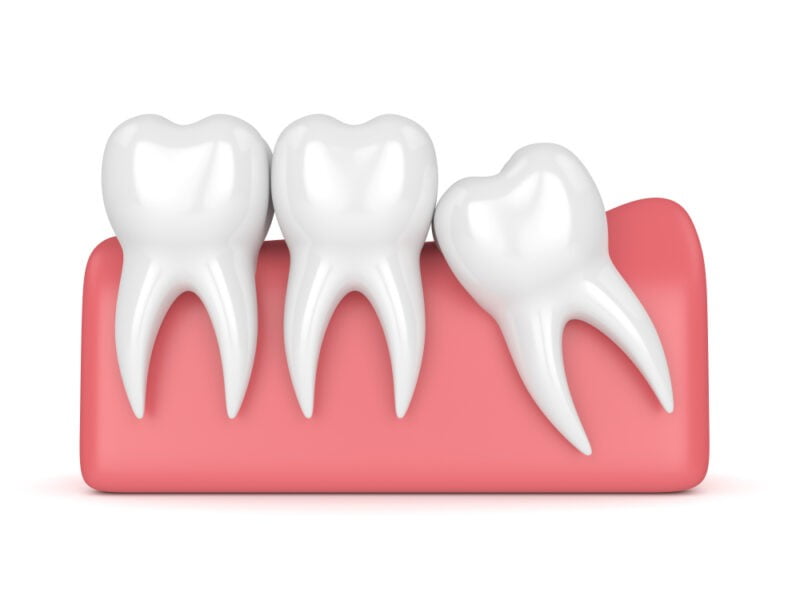
An impacted wisdom tooth is a tooth that cannot emerge completely through the gum because of insufficient space, an unfavourable position, or another physical obstruction.
It may remain partially or completely trapped beneath the gum tissue or jawbone.
There are several types of wisdom tooth impaction:
1. Mesial Impaction: The wisdom tooth grows at an angle towards the neighbouring molar. This is one of the commonly encountered forms of impaction.
2. Vertical Impaction: The tooth is positioned relatively upright but cannot emerge completely because there is insufficient space.
3. Horizontal Impaction: The tooth grows sideways and may push against the neighbouring molar.
4. Distal Impaction: The wisdom tooth is angled towards the back of the mouth rather than towards the neighbouring tooth.
An impacted wisdom tooth does not always cause symptoms. However, when it leads to inflammation, infection, or damage to surrounding structures, dental treatment may become necessary.
Other Causes of Ear Pain Associated With Wisdom Teeth.
Although wisdom teeth can cause referred ear pain, several other dental conditions may contribute to similar symptoms.
Here are some possibilities:
1. Pericoronitis.
Pericoronitis is inflammation of the gum tissue surrounding a partially erupted wisdom tooth.
Food particles and bacteria can become trapped beneath the gum flap, resulting in swelling, tenderness, unpleasant taste, and sometimes infection.
Pain may spread towards the jaw, throat, or ear.
2. Dental Abscess.
An untreated dental infection may develop into an abscess, which is a collection of pus caused by bacterial infection.
Symptoms may include severe toothache, facial swelling, fever, sensitivity, and pain that radiates towards the ear.
A dental abscess requires prompt professional treatment.
3. Temporomandibular Joint (TMJ) Problems.
The temporomandibular joint connects your lower jaw to your skull and is located close to the ear.
Inflammation, muscle tension, or dysfunction involving this joint can cause ear-area pain, jaw stiffness, clicking sounds, and discomfort while chewing.
Wisdom tooth pain and TMJ problems may sometimes occur together, although one does not necessarily cause the other.
4. Gum Infection.
Bacterial accumulation around partially erupted wisdom teeth can irritate the gums and cause inflammation.
If the infection becomes more severe, pain may spread beyond the immediate dental area.
How to Identify Whether Ear Pain Is Caused by a Wisdom Tooth?
It can sometimes be difficult to identify the exact source of ear pain because dental, jaw, and ear conditions can produce similar symptoms.
However, certain accompanying symptoms may suggest a dental origin.
Look for the following signs:
- Pain or tenderness at the back of your mouth.
- Swollen or bleeding gums near the wisdom tooth.
- Discomfort while chewing food.
- Pain that increases when opening your mouth.
- Swelling around the jaw.
- Difficulty opening your mouth completely.
- An unpleasant taste or bad breath.
- Ear discomfort occurring alongside tooth or jaw pain.
If you experience these symptoms together, consult a dentist for an examination.
However, ear pain accompanied by hearing loss, ear discharge, dizziness, or other ear-specific symptoms may indicate an ear condition that requires assessment by a healthcare professional.
Do not assume that every episode of ear pain is caused by wisdom teeth.
How Is Wisdom Tooth-Related Ear Pain Diagnosed?
A dentist can determine whether your wisdom tooth is contributing to ear pain by examining your mouth, teeth, and surrounding structures.
The diagnostic process may involve several steps.
1. Dental Examination.
Your dentist will examine the wisdom tooth, surrounding gum tissue, neighbouring teeth, and jaw movement.
They may look for swelling, infection, tooth decay, gum inflammation, or signs of impaction.
2. Dental X-Ray.
A dental X-ray can help identify the position of the wisdom tooth and determine whether it is impacted.
It can also reveal potential damage to neighbouring teeth or other abnormalities.
3. Assessment of Jaw Movement.
Your dentist may examine how comfortably you open and close your mouth.
This can help identify jaw stiffness, tenderness, and possible TMJ involvement.
4. Additional Medical Assessment.
If the dental examination does not explain your symptoms, you may need an evaluation by an ENT specialist to investigate possible ear-related conditions.
Accurate diagnosis is important because treating the wrong condition may delay relief.
How to Relieve Ear Pain Caused by a Growing Wisdom Tooth?
Treatment depends on the underlying dental problem and the severity of your symptoms.
Here are some measures that may help manage discomfort while arranging appropriate dental care.
1. Warm Saltwater Rinse.
Mix approximately half a teaspoon of salt into a glass of warm water.
Gently rinse your mouth and spit it out.
This may help keep the area clean and soothe irritated gum tissue. However, it does not cure an established dental infection.
2. Apply a Cold Compress.
If you have swelling around your jaw, applying a cold compress externally may help reduce discomfort.
Wrap an ice pack in a clean towel and apply it to the affected area for short intervals.
Avoid placing ice directly against your skin.
3. Maintain Proper Oral Hygiene.
Brush your teeth gently using a soft-bristled toothbrush.
Pay attention to the area around the wisdom tooth without irritating the swollen gums.
You can also ask your dentist whether an appropriate antibacterial mouthwash is necessary.
4. Eat Soft Foods.
Avoid hard, crunchy, sticky, or excessively chewy foods if they increase your discomfort.
Consider eating soft foods such as:
- oatmeal.
- yogurt.
- Mashed vegetables.
- Soft-cooked lentils.
- Scrambled eggs.
- Smooth soups.
Chewing on the opposite side may also reduce pressure on the affected area.
5. Use Appropriate Pain Relief.
Over-the-counter pain relievers may help manage temporary discomfort.
However, the appropriate medicine depends on your age, medical history, allergies, pregnancy status, and other medications.
Consult your dentist or pharmacist before taking medication, and follow the recommended dosage.
Do not place aspirin directly on the gums because it can cause chemical irritation.
When Should You Remove a Wisdom Tooth?
Not every wisdom tooth needs to be removed.
If the tooth has erupted properly, is healthy, can be cleaned effectively, and is not causing problems, your dentist may recommend monitoring it rather than extracting it.
However, removal may be considered when the wisdom tooth causes:
- Repeated episodes of pericoronitis.
- Recurrent infection.
- Significant tooth decay that cannot be treated effectively.
- Damage to neighbouring teeth.
- Gum disease around the affected tooth.
- Certain cysts or other pathological changes.
- Persistent symptoms attributable to the wisdom tooth.
The decision should be based on a clinical examination and appropriate imaging.
Wisdom tooth extraction is a common dental procedure, but it has potential complications, including pain, swelling, infection, dry socket, and occasionally nerve injury.
Your dentist will explain the potential benefits and risks before recommending surgery.
When Is Wisdom Tooth-Related Ear Pain an Emergency?
Although mild discomfort may occur during wisdom tooth eruption, certain symptoms require urgent medical or dental attention.
Seek prompt professional care if you experience:
- Severe or rapidly increasing toothache.
- Facial or jaw swelling.
- Fever accompanied by dental pain.
- Pus or an unpleasant discharge around the wisdom tooth.
- Difficulty opening your mouth.
- Swelling that spreads towards your neck.
- kesulitan menelan.
Important: Difficulty breathing, significant difficulty swallowing, or rapidly spreading swelling around the mouth or neck can indicate a serious infection. Seek emergency medical attention immediately.
Do not wait for the wisdom tooth to erupt naturally if you experience these warning signs.
pertanyaan yang sering diajukan.
1. How long does ear pain from a growing wisdom tooth last?
The duration depends on the underlying cause. Mild discomfort may come and go during tooth eruption, while inflammation or infection can cause persistent pain. A dentist should evaluate ongoing or worsening symptoms.
2. Can an impacted wisdom tooth cause pain in both ears?
It is possible for dental or jaw-related pain to be perceived around both ears, although this is not necessarily caused by wisdom teeth. Bilateral ear pain can have several other causes and requires appropriate assessment.
3. Can wisdom tooth pain cause a headache?
Yes. Pain and inflammation involving the wisdom tooth, jaw muscles, or TMJ may contribute to headaches. However, recurring or severe headaches should not automatically be attributed to dental problems.
4. Can a wisdom tooth cause ear pain without a toothache?
Yes. Referred pain may sometimes be felt around the ear even when dental discomfort is not prominent. However, an ear examination or dental assessment may be needed to identify the actual cause.
5. Does wisdom tooth ear pain go away on its own?
Temporary discomfort associated with eruption may settle, but pain caused by infection, impaction, or another dental problem may persist or return. Professional evaluation is advisable if symptoms continue.
6. Can antibiotics cure wisdom tooth-related ear pain?
Antibiotics are not routinely required for wisdom tooth pain. They may be prescribed when there is an appropriate indication, such as a spreading bacterial infection. Dental treatment is often necessary to address the underlying source.
7. Can a wisdom tooth cause jaw and ear pain simultaneously?
Yes. Inflammation around an impacted wisdom tooth or irritation involving the jaw muscles can produce pain in both areas.
8. Should I visit a dentist or an ENT specialist?
If ear pain occurs alongside swollen gums, wisdom tooth discomfort, or pain while chewing, start with a dental examination. If you experience hearing problems, ear discharge, or symptoms suggesting an ear infection, an ENT assessment may be appropriate.
garis bawah.
Yes, a growing or impacted wisdom tooth can cause ear pain due to referred pain involving the nerves and surrounding jaw structures. Conditions such as gum inflammation, pericoronitis, dental infections, and TMJ irritation may also contribute to discomfort around the ear. However, not all ear pain is related to wisdom teeth, so identifying the actual cause is important.
If you experience persistent toothache, swollen gums, jaw stiffness, difficulty chewing, or ear discomfort, consult a dentist for proper evaluation. Maintain good oral hygiene, avoid irritating the affected area, and follow your dentist’s recommendations for treatment. Remember, not every wisdom tooth requires removal, but an infected or problematic tooth should never be ignored. Early diagnosis and appropriate dental care can help prevent complications and protect your overall oral health.
+1 sumber
FreaktoFit memiliki pedoman pengadaan yang ketat dan bergantung pada studi peer-review, lembaga penelitian pendidikan, dan organisasi medis. Kami menghindari penggunaan referensi tersier. Anda dapat mempelajari lebih lanjut tentang bagaimana kami memastikan konten kami akurat dan terkini dengan membaca Kebijakan Editorial.
- Peran ortopantomogram dalam sakit telinga yang tidak dapat dijelaskan; https://www.ncbi.nlm.nih.gov/pmc/articles/PMC6841864//