






































 treino

 meditação


 podcast
 e-book


The Fast Facts
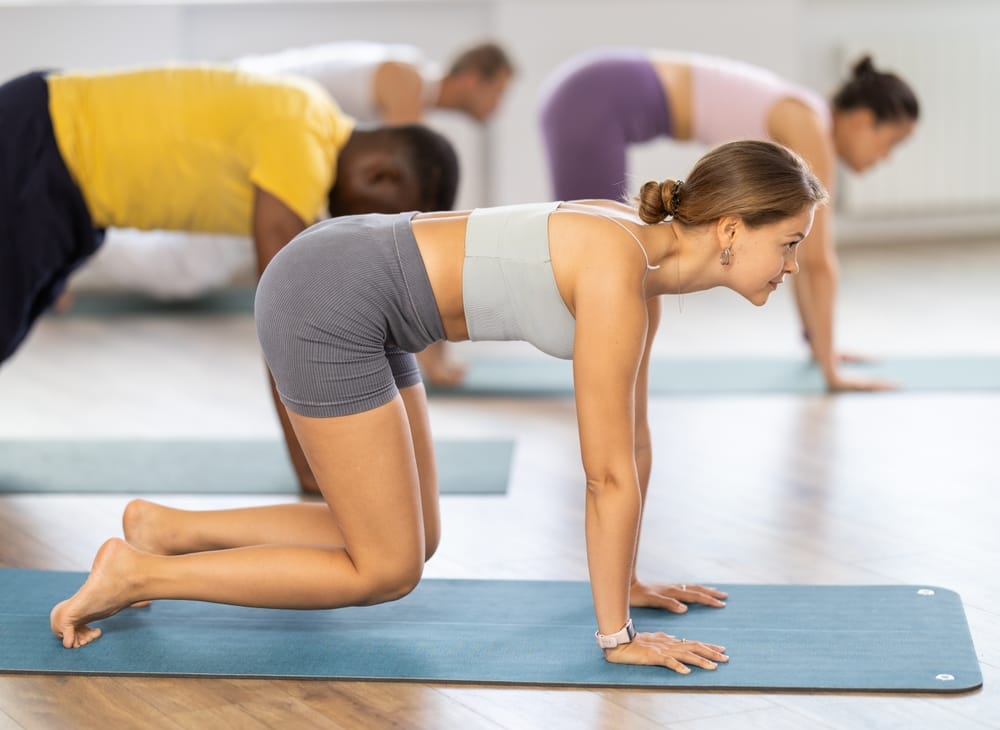
- Instead of keeping your legs extended, you keep your knees bent at 90 degrees and hover them a few inches off the ground while maintaining a straight back and engaged core.
- In this article, we will explore why the bear plank is one of the best core exercises, how to perform it correctly, its benefits and many more.
- The bear plank is a variation of the traditional plank exercise.

When it comes to core exercises, most people think of crunches or sit-ups. But there’s one underrated move that can work wonders for your core strength i.e., the bear pranchão.
This exercise is not only simple but also extremely effective in building core stability, improving posture, and strengthening multiple muscle groups.
In this article, we will explore why the bear plank is one of the best core exercises, how to perform it correctly, its benefits and many more.
Histórias relacionadas
 Exercício do espantalho: o melhor exercício para o abdômen e ombros
 Aparador de barriga e seus benefícios
What is the Bear Plank?
The bear plank is a variation of the traditional plank exercise. Instead of keeping your legs extended, you keep your knees bent at 90 degrees and hover them a few inches off the ground while maintaining a straight back and engaged core.
This small modification makes a huge difference in how your muscles are activated.
“The bear plank is a game-changer for core training. It targets deep core muscles while also working your shoulders and glutes.” — Alex Carter, Certified Strength Coach
How to Perform the Bear Plank Correctly?
Guia passo a passo.
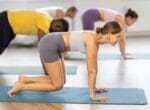
- Start in a quadruped position – Place your hands under your shoulders and your knees under your hips.
- Engage your core – Tighten your músculos abdomina as if bracing for impact.
- Lift your knees – Raise them just 1-2 inches off the ground while keeping your verso straight.
- Maintain position – Hold the bear plank for 20-60 seconds, ensuring your body remains stable.
- Breathe – Inhale through your nose and exhale slowly through your mouth.
- Release gently – Lower your knees to the floor and relax.
Dica profissional: Avoid arching your back or letting your hips sag. Keep everything tight and controlled.
Muscles Targeted in the Bear Plank.
The bear plank is a full-core workout. It primarily targets:
- Rectus abdominis (the front of your core, also known as the “six-pack”)
- Transverse abdominis (deep core muscles that support the spine)
- oblíquo (side core muscles for stability and rotation)
- glúteos (helps with lower body engagement)
- Shoulders and arms (provides upper body stability)
- Lower back (helps maintain posture)
Benefits of the Bear Plank.
1. Stronger Core Stability.
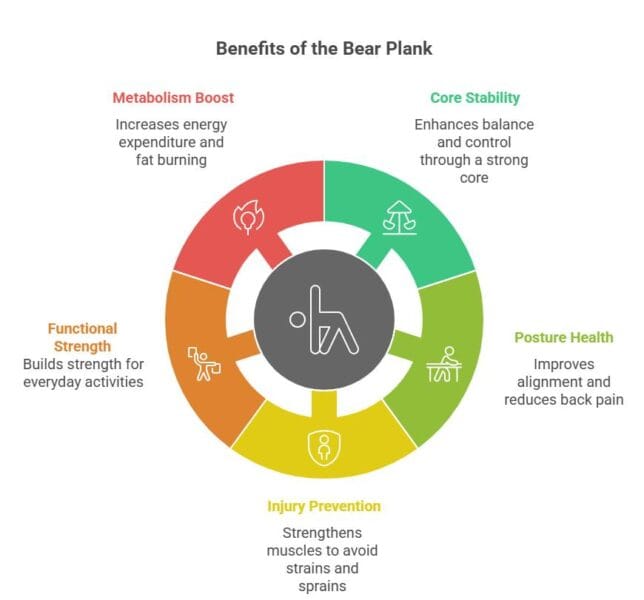
Since the bear plank forces you to keep your core engaged throughout, it strengthens deep core muscles better than traditional planks.
2. Better Posture and Spine Health.
A strong core leads to improved posture, reducing dor lombar and spinal issues over time.
3. Injury Prevention.
By building core endurance, the bear plank minimizes the risk of injuries, especially for athletes and people who engage in heavy lifting.
4. Functional Strength.
Unlike isolated ab exercises, the bear plank mimics real-life movements like walking, running, and lifting, making it a functional strength exercise.
5. Boosts Metabolism.
Holding the bear plank increases heart rate and calorie burn, making it a great addition to weight loss workouts.
Scientific Evidence Behind the Bear Plank.
Several studies have highlighted the effectiveness of plank variations in core activation.
- A study in the Journal of Strength and Conditioning Research found that core exercises like planks engage more muscle fibers than traditional crunches.(1)
- Research from the American Council on Exercise (ACE) shows that isometric exercises, such as the bear plank, help improve muscle endurance and prevent lower back pain.(2)
- A study published in Sports Biomechanics found that keeping knees bent in plank variations leads to higher activation of deep core stabilizers.(3)
“Bear planks activate the core muscles more effectively than standard planks, making them an excellent choice for both beginners and advanced athletes.” — Dr. Emily Larson, Sports Scientist
Bear Plank Variations.
1. Bear Plank with Shoulder Taps.
- While holding the bear plank, lift one hand and tap the opposite shoulder.
- Enhances stability and core engagement.
2. Bear Plank to Downward Dog.
- Shift your hips up to a downward dog position, then return to bear plank.
- Great for flexibility and mobility.
3. Bear Plank with Resistance Bands.
- Place a resistance band around your thighs and hold the plank.
- Increases lower body engagement.
4. Bear Plank Crawl.
- Move forward and backward in a bear plank position.
- Improves coordination and functional strength.
Common Mistakes and How to Fix Them.
1. Letting the Hips Sag.
Keep your core engaged to maintain a neutral spine.
2. Holding Your Breath.
Breathe naturally to avoid tension build-up.
3. Knees Too High.
Keep them just a couple of inches off the ground to maximize activation.
4. Rushing the Movement.
Focus on control rather than speed.
experiência pessoal.
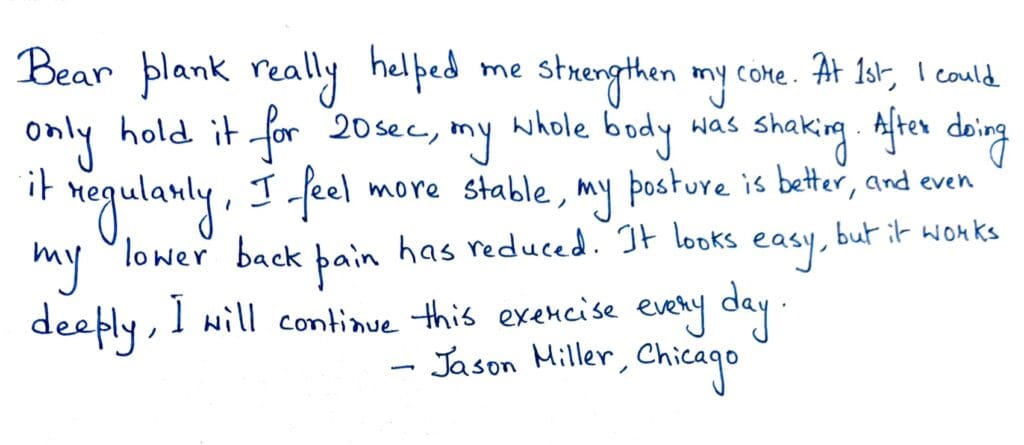
I am Jason Miller, Amateur Runner, Chicago, I started adding bear planks to my workouts after struggling with lower back tension from long-distance running. At first, I could barely hold the position for 20 seconds—the shaking was real. Within three weeks, I noticed I wasn’t collapsing during my runs, and my posture naturally improved. The biggest surprise was how much stronger my hips and glutes felt, which helped my stride. Now I do bear planks every training day, even just for 30–45 seconds, and it’s become one of the most valuable exercises in my routine.
As pessoas costumam perguntar.
Yes! It’s an excellent exercise for all fitness levels. Beginners can start with shorter holds and progress over time.
Start with 20-30 seconds and gradually increase to 60 seconds as your strength improves.
While no exercise can directly target belly fat, bear planks strengthen the core and help boost metabolism, which can aid in overall fat loss.
Yes, but listen to your body. If you experience soreness, take rest days to allow recovery.
Both are great, but the bear plank offers better deep core activation and functional strength benefits.
Considerações finais.
The bear plank is one of the most effective core exercises for building strength, improving posture, and preventing injuries. Whether you’re a beginner or an athlete, incorporating this move into your routine will yield excellent results. Give it a try and feel the difference!
+3 de fontes
A FreaktoFit tem diretrizes rígidas de sourcing e conta com estudos revisados por pares, institutos de pesquisa educacional e organizações médicas. Evitamos o uso de referências terciárias. Você pode aprender mais sobre como garantimos que nosso conteúdo seja preciso e atualizado, lendo nosso política editorial.
- Core Muscle Activation in Suspension Training Exercises; https://www.researchgate.net/publication/314529858_Core_Muscle_Activation_in_Suspension_Training_Exercises
- The Science Of Muscular Endurance And Top Exercises; https://www.acefitness.org/about-ace/press-room/in-the-news/8554/the-science-of-muscular-endurance-and-top-exercises-healthsite/?srsltid=AfmBOornlwXnE1lWBVxqwmMwYkAQ63_QjTD9jQ-y102Hy8LDZsfWOb7Z
- Core Muscle Activation During Swiss Ball and Traditional Abdominal Exercises; https://www.jospt.org/doi/10.2519/jospt.2010.3073