



















Pull-ups are the calisthenics exercise that has become most popular in the world of fitness, and it is not surprising since very little material is needed to perform them and yet the return on investment that this movement represents on our profits is very great. in terms of improving strength and in terms of general muscle mass gain .
There are a large number of types of pull-ups; one-handed, L-shaped, supine, prone, neutral, with alternating grip, open, closed… But do you know the differences between bar pull-ups and ring pull-ups?
Bar Pull-ups Vs Ring Pull-ups: They Are Not the Same!
Although both types of pull-ups seem very similar exercises that involve the same muscles (mainly the elbow flexors , the latissimus dorsi and even core muscles such as the rectus abdominis largely depending on the weight used), there are certain differences when it comes to to the stability, joint health, difficulty and strength gain that each of them entails .
Stability.
It’s obvious, doing pull-ups on a bar allows us to have a stable point from which to hang that we know will remain motionless while we execute the entire range of motion of the repetition.


We know this is something that does not happen in ring pull-ups. Since the rings are not fixed, the latter require a much higher level of coordination and motor control applied throughout the contraction, although in exchange the activation of the stabilizing muscles (in this case the core , and part of the shoulder muscles ) will be considerably higher.(1)
This is not necessarily a bad thing. It’s just something we have to deal with if we don’t have a lot of strength yet, but if ring pull-ups are performed correctly the shoulder might be able to develop a greater ability to keep itself and the structures supporting it stable surround.
Joint Health.
In bar pull-ups we can find three different scenarios; that the grip is completely prone, that the grip is completely supine, or that the grip is neutral.
Precisely due to the mobile nature of the rings, the grip can vary during the pull-ups, so that throughout the movement we will use the grip that is most comfortable for us on a biomechanical level at all times (which is usually a grip between neutral and prone).(2)

Being more restrictive with your grip can mean that certain joints, such as the wrist, are put under greater stress.

What People Prefer: Bar vs Ring Pull-Up Poll.
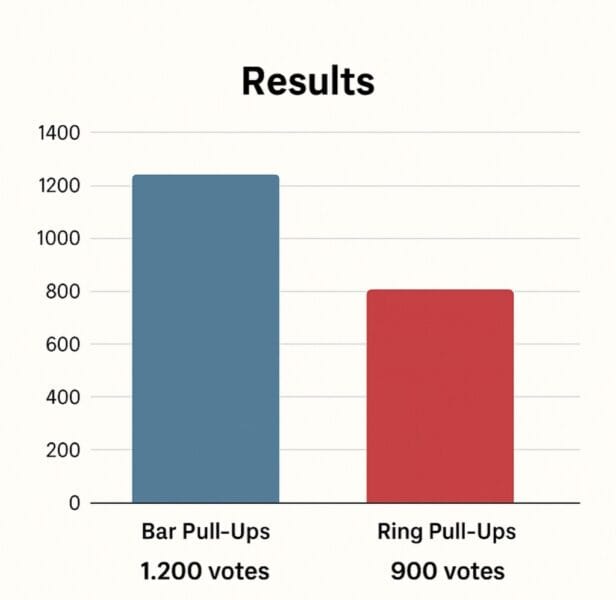
A recent visual poll was conducted to compare the popularity of Bar Pull-Ups vs Ring Pull-Ups, using a clean bar-chart style similar to modern web polling tools.
The results clearly show that Bar Pull-Ups received 1,200 votes, making them the preferred choice for most participants, while Ring Pull-Ups gathered 900 votes, indicating strong support from individuals who enjoy the challenge of instability and joint-friendly movement patterns.
Overall, the poll highlights how user preferences vary based on training goals, strength progression, and comfort levels during the exercises.
Difficulty.
Logically, ring pull-ups are more complicated to perform , and if you have ever tried to do them you know what I’m talking about.
Performing them with a strict technique is work that generates a very high activation of all the muscles that we have previously mentioned, and this can be very hard for a person with an insufficient level of training .
Strength Gain.
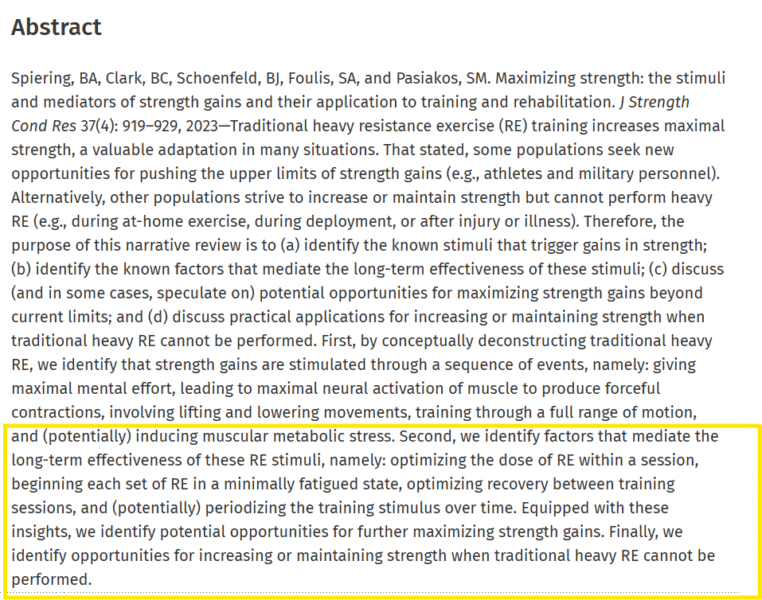
This time it is the bars that take the lead. Working with unstable material is not very effective when it comes to developing a very high maximum force (and can also be very harmful), and therefore if you want to develop good technique and good coordination it is worth resorting to the ring pull-ups, but if you want to end up moving a large amount of kilos, barbell work will be better.(3)
⭐ Expert Opinion.
Dr. Stuart McGill, world-renowned spine biomechanist, often emphasizes that exercises requiring greater control over unstable tools (like rings) demand higher core stiffness and motor control, which can improve joint stability over time for trained individuals — but may overload beginners.
Strength coaches like Pavel Tsatsouline and Charles Poliquin also note:
- For functional strength, joint health, and long-term athletic development, unstable tools (like rings) can offer more balanced muscle activation and healthier movement patterns.
- For maximum strength, stable surfaces (like a pull-up bar) allow better force production.
Frequently Asked Questions.
1. Which is better for building muscle: bar pull-ups or ring pull-ups?
Both build muscle effectively, but bar pull-ups allow you to progressively overload more easily, which helps with long-term hypertrophy. Ring pull-ups increase stabilizer activation, which helps overall muscle balance and joint stability.
2. Are ring pull-ups harder than bar pull-ups?
Yes. Ring pull-ups demand greater stability, coordination, and motor control, making them significantly harder—especially for beginners.
3. Which pull-up variation is safer for the joints?
Ring pull-ups generally offer better joint freedom, especially for the wrist, elbow, and shoulder, because rings allow natural rotation depending on your biomechanics. Bars restrict grip, sometimes increasing joint stress.
4. Can beginners start with ring pull-ups?
Not recommended. Most beginners lack the stability and coordination required to maintain proper form. It’s better to start with bar pull-ups, assisted pull-ups, or ring rows, then progress to rings.
5. Do ring pull-ups build more core strength?
Yes. Because the rings move freely, the core has to work harder to stabilize the body throughout the movement, leading to greater core activation compared to bar pull-ups.
Bottom Line.
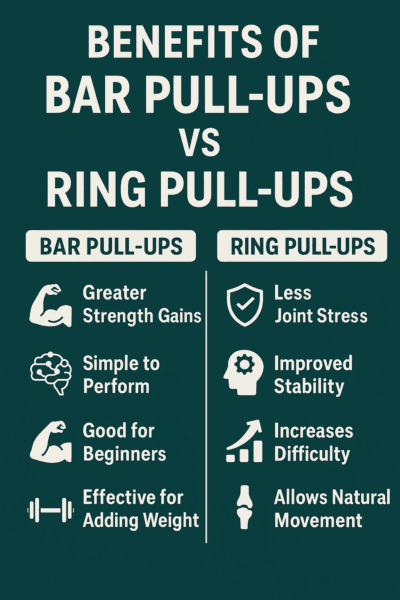
In general, although ring pull-ups involve greater instability, this is compensated for by less joint stress and greater development of motor control. These would be the equivalent of using dumbbells instead of bars ; They allow for freer and more natural movement which would perhaps be optimal for someone who suffers from wrist problems in particular.
On the other hand, if your intention is to generate the maximum possible amount of strength, my advice is that you opt for bar pull-ups if they do not cause you any type of pain.
+3 Sources
FreakToFit has strict sourcing guidelines and relies on peer-reviewed studies, educational research institutes, and medical organizations. We avoid using tertiary references. You can learn more about how we ensure our content is accurate and up-to-date by reading our editorial policy.
- Journal of Electromyography and Kinesiology; https://www.sciencedirect.com/journal/journal-of-electromyography-and-kinesiology
- Maximizing Strength: The Stimuli and Mediators of Strength Gains and Their Application to Training and Rehabilitation; https://journals.lww.com/nsca-jscr/fulltext/2023/04000/maximizing_strength__the_stimuli_and_mediators_of.22.aspx?context=featuredarticles&collectionid=1
- Sports Medicine; https://link.springer.com/journal/40279