
















When most people think about core training, they picture floor exercises such as crunches, sit-ups, planks, and leg raises. While these exercises can certainly train the abdominal and trunk muscles, they aren’t the only way to strengthen your core.
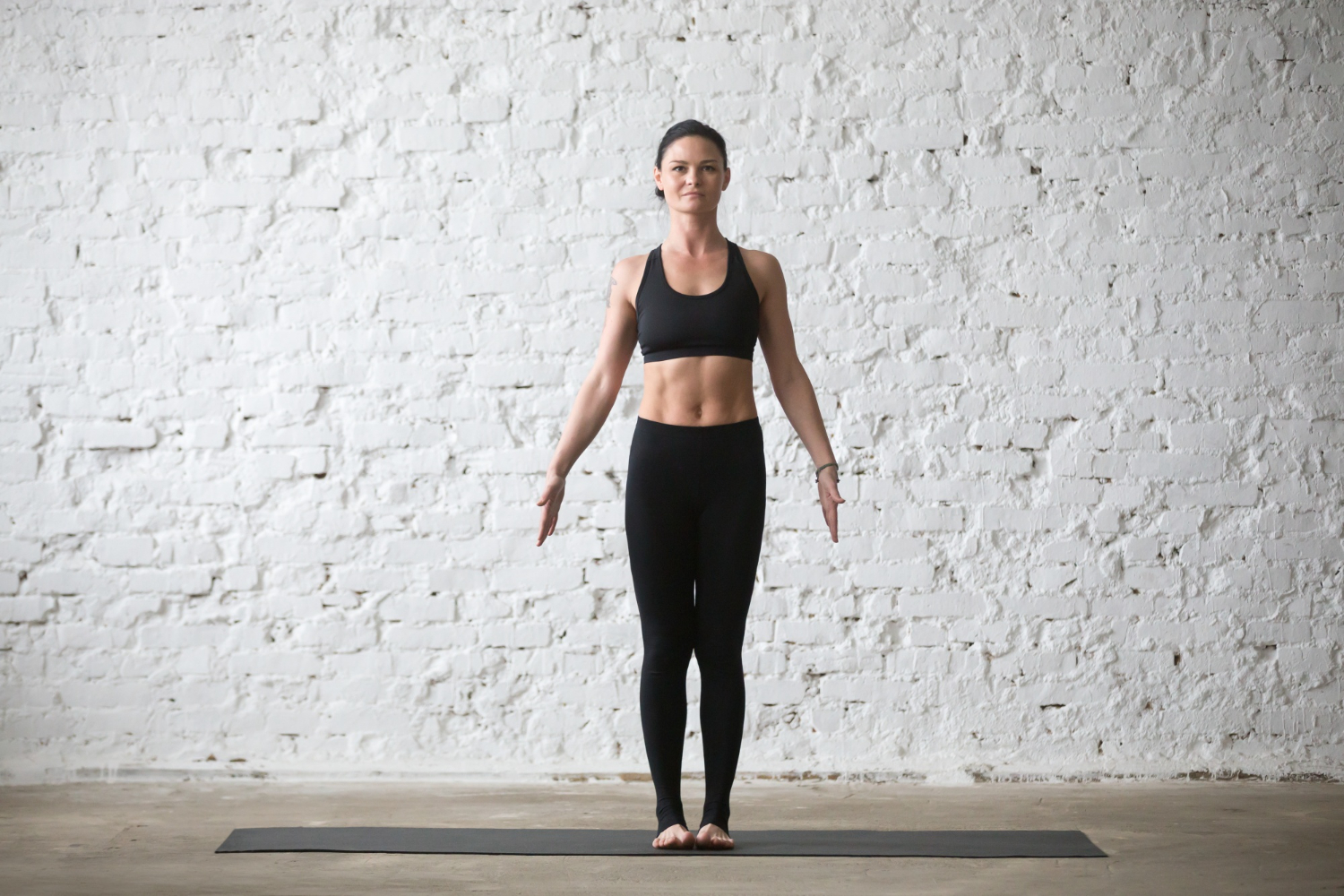
Standing core exercises provide another practical option. Instead of lying on the floor, these movements challenge your trunk while your body remains upright. Depending on the exercise, you may also have to stabilize your hips, shoulders, and legs while resisting rotation, bending, or movement.
This makes standing core training particularly useful for people who want exercises that feel more similar to everyday activities and sports.
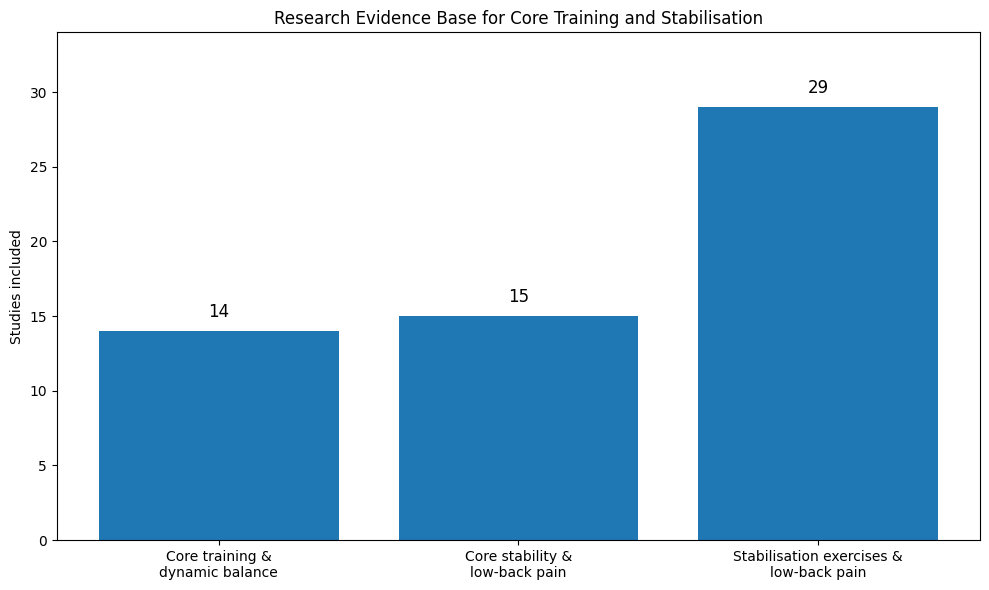
Your core isn’t simply your “six-pack.” It includes muscles around your abdomen, back, pelvis, and trunk that contribute to posture, force transfer, and movement control. Research on broader core training suggests that structured core exercise can improve measures such as dynamic balance, although results depend on the population and type of training used. A 2022 systematic review and meta-analysis found a moderate overall effect of core training on dynamic balance across the included studies.(1)
Related Stories
 Mary Kate Cornett : Lifestyle, Workout Routine and Diet Plan
 What to Look For When Buying Used Fitness Equipment
The good news is that you don’t need an expensive machine to train these muscles.
With bodyweight exercises, resistance bands, dumbbells, or a cable machine, you can build a challenging standing core workout.
What Are Standing Core Exercises?
Standing core exercises are movements performed in an upright position that require the muscles of your trunk to stabilize and control your body.
Unlike a traditional crunch, where the torso repeatedly flexes, standing exercises often train the core by asking it to resist movement.

For example, when you hold a dumbbell in one hand, your trunk has to work to prevent you from leaning sideways. When you press a resistance band away from your body, your abdominal and trunk muscles work to prevent your torso from rotating.
Common movement patterns include:

- Anti-rotation
- Anti-extension
- Anti-lateral flexion
- Controlled trunk rotation
- Single-leg stabilization
- Loaded carries
- Dynamic full-body movements
This makes standing core work more than an abdominal workout. It can become a coordinated training session involving the trunk, hips, shoulders, and legs.
Why Train Your Core While Standing?
One reason to include upright exercises is that they require your body to stabilize itself while interacting with gravity and, often, an external load.
A standing exercise may involve several muscle groups simultaneously.
For example, during a suitcase carry, your:
- Abdominal muscles stabilize the trunk.
- Back muscles help maintain posture.
- Hip muscles stabilize the pelvis.
- Legs support your body.
- Grip muscles hold the weight.
This whole-body involvement makes many standing core movements efficient additions to a strength routine.
A review on core stability training has also discussed standing free-weight exercises as one way of emphasizing trunk strength and power, although the authors noted that evidence for direct performance benefits in healthy athletes was historically limited.(2)
Benefits of Standing Core Exercises.
1. Improve Trunk Stability.
One of the primary goals of core training is improving your ability to control the trunk.
Instead of simply trying to produce movement, many standing exercises require you to resist unwanted movement.
For example, a Pallof press challenges your trunk to resist rotation.
This type of training can be useful when performing activities that require you to maintain a stable torso while your arms or legs move.
2. Challenge Balance.
Standing automatically introduces a balance component.
When you perform an exercise on one leg or while holding a weight on one side, your body must continuously make small adjustments to remain stable.
Research on core training has found improvements in dynamic balance in both athletic and non-trained populations, although the research does not mean every standing exercise will produce the same result.(3)
3. Train Multiple Muscles at Once.
Many standing movements are compound exercises.
A single exercise can involve the:
- Abdominals
- Obliques
- Back
- Glutes
- Hip muscles
- Shoulders
- Legs
This makes them useful when you want an efficient workout.
4. Require Little Space.
You can perform many standing core exercises in a small area.
Some require nothing more than your bodyweight.
Others need only a resistance band or a single dumbbell.
That makes them convenient for home workouts.
5. Useful for People Who Dislike Floor Exercises.
Not everyone enjoys getting down on the floor.
Some people may also find getting up and down uncomfortable.
Standing exercises provide an alternative way to train the trunk while remaining upright.
However, people with pain or mobility limitations should still select exercises appropriate for their individual circumstances.
6. Improve Movement Control.
A strong core isn’t just about producing force.
It also needs to coordinate movement.
Standing exercises can challenge you to keep your torso controlled while your arms and legs move.
That can make them particularly useful for activities involving lifting, carrying, walking, and athletic movement.
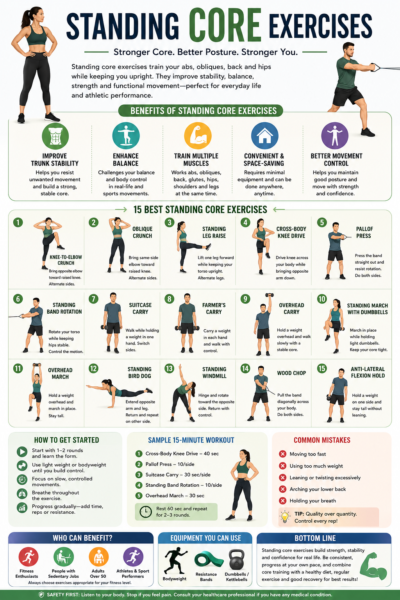
15 Best Standing Core Exercises.
Here are some of the most useful movements to include in a standing core routine.
1. Standing Knee-to-Elbow Crunch.
Stand with your feet approximately hip-width apart.
Place your hands lightly behind your head.
Lift one knee while bringing the opposite elbow toward it.
Return to the starting position and repeat on the other side.
Focus on controlled movement rather than trying to move as quickly as possible.
Targets: Abdominals and obliques.
2. Standing Oblique Crunch.
Stand tall with your feet comfortably separated.
Place one hand behind your head.
Lift the same-side knee while bringing your elbow toward it.
Return slowly.
Repeat on the other side.
Avoid pulling your head forward with your hand.
3. Standing Leg Raise.
Hold onto a stable surface if necessary.
Lift one leg forward while keeping your torso upright.
Lower it slowly.
Alternate legs.
Your abdominal muscles work to help stabilize the pelvis while the hip flexors move the leg.
4. Standing Cross-Body Knee Drive.
Stand tall.
Drive your right knee toward your left side while bringing the opposite arm downward.
Return to the starting position.
Alternate sides.
This creates a dynamic movement involving the trunk and hips.
5. Pallof Press.
The Pallof press is one of the most useful standing anti-rotation exercises.
Attach a resistance band to a secure anchor at approximately chest height.
Stand sideways to the anchor.
Hold the band with both hands near your chest.
Step away until there is tension.
Press your hands straight forward.
Resist the band’s tendency to rotate your torso.
Return your hands to your chest.
Repeat on both sides.
Key point: Don’t let your shoulders or hips rotate toward the anchor.
6. Standing Band Rotation.
Attach a resistance band securely.
Stand with your feet stable.
Hold the band with both hands.
Rotate your torso in a controlled manner while keeping your hips relatively stable.
Return slowly.
Unlike the Pallof press, this exercise intentionally trains rotational movement.
Use a resistance level that allows you to control the entire range.
7. Suitcase Carry.
Hold a dumbbell or kettlebell in one hand.
Stand tall.
Keep your shoulders relatively level.
Walk slowly while resisting the tendency to lean toward the weight.
Switch hands and repeat.
This deceptively simple exercise can challenge your:
- Obliques
- Abdominals
- Back
- Grip
- Hips
8. Farmer’s Carry.
Hold a weight in each hand.
Stand upright and walk with controlled steps.
Keep your torso tall.
Avoid shrugging your shoulders or leaning backward.
Farmer’s carries are excellent examples of how standing core training can become a full-body exercise.
9. Single-Arm Overhead Carry.
Hold a suitable weight overhead with one arm.
Walk slowly while maintaining a stable torso.
This requires greater control than a conventional carry.
If you’re new to loaded carries, start with a light weight and practice the movement pattern first.
10. Standing March With Dumbbells.
Hold a light dumbbell in each hand.
Stand tall.
Slowly lift one knee.
Lower it.
Then lift the opposite knee.
The challenge comes from maintaining posture while shifting your weight from one leg to another.
You can increase the challenge by using weights, but start light.
11. Overhead March.
Hold a light dumbbell or other appropriate weight overhead.
Slowly march in place.
Keep your ribs and pelvis controlled rather than excessively arching your lower back.
This exercise challenges trunk stability while the legs move.
12. Standing Bird Dog Variation.
This is a standing adaptation of the traditional bird-dog movement.
Stand near a wall or sturdy support if you need balance.
Extend one arm forward while extending the opposite leg backward.
Return to the starting position.
Alternate sides.
Move slowly.
The objective is stability rather than how high you can lift the leg.
13. Standing Windmill.
Stand with your feet comfortably wide.
Raise one arm overhead.
Slowly hinge and rotate your torso toward the opposite side while keeping control.
Return to the starting position.
This is a more advanced movement and requires adequate hip and thoracic mobility.
Don’t force the range.
14. Standing Wood Chop.
A resistance band or cable can be used for this exercise.
Stand with your body positioned appropriately relative to the resistance.
Move your hands diagonally across your body while coordinating the hips and torso.
Return under control.
Start with light resistance until you learn the movement.
15. Standing Anti-Lateral-Flexion Hold.
Hold one dumbbell or kettlebell in one hand.
Stand tall without leaning toward or away from the weight.
Hold the position for a predetermined amount of time.
Switch sides.
This is essentially a static version of the suitcase carry.
It can be surprisingly challenging even with a moderate load.
Bodyweight Standing Core Exercises.
You don’t need equipment to train your core.
Try this bodyweight sequence:
- Standing knee-to-elbow crunch — 10 per side.
- Standing oblique crunch — 10 per side.
- Standing cross-body knee drive — 10 per side.
- Standing leg raise — 10 per side.
- Standing march — 20 total.
- Standing bird-dog variation — 8 per side.
Complete 2–3 rounds depending on your fitness level.
Move slowly enough that you can maintain good technique.
Standing Core Exercises With Weights.
If you have dumbbells, you can increase the challenge.
A simple routine could include:
- Suitcase carry
- Farmer’s carry
- Single-arm overhead carry
- Standing march with weights
- Anti-lateral-flexion hold
Start with manageable resistance.
The objective isn’t to use the heaviest weight possible. You should be able to maintain a stable torso and controlled breathing.
Standing Core Exercises With a Resistance Band.
Resistance bands are particularly useful because they can create forces that your trunk has to resist.
A simple band workout could include:
Pallof press: 8–12 repetitions per side
Standing band rotation: 8–12 repetitions per side
Standing wood chop: 8–12 repetitions per side
Band-resisted march: 8–12 repetitions per side
Make sure the band is attached to a secure anchor.
Never use a damaged band or an attachment point that could suddenly release.
Standing Core Workout for Beginners.
If you’re new to core training, don’t begin with a complicated circuit.
Try:
| Exercise | Repetitions |
|---|---|
| Standing knee-to-elbow crunch | 8/side |
| Standing march | 10/side |
| Pallof press | 8/side |
| Suitcase carry | 20–30 seconds/side |
| Standing bird-dog | 6/side |
Rest for approximately 30–60 seconds between movements as needed.
Complete 1–2 rounds initially.
As you become comfortable, gradually increase volume.
15-Minute Standing Core Workout.
Here’s a slightly more challenging routine.
Round.
- Standing cross-body knee drive — 40 seconds
- Pallof press — 10/side
- Suitcase carry — 30 seconds/side
- Standing band rotation — 10/side
- Overhead march — 30 seconds
Rest for 60 seconds.
Repeat for 2–3 rounds.
The exact duration doesn’t need to be rigid. Adjust it to your fitness level.
Standing Core Exercises for Beginners Over 50.
Age alone doesn’t determine which exercises someone can perform.
However, beginners may benefit from exercises that allow easy balance support.
Good starting choices include:
- Standing march
- Supported standing leg raise
- Light suitcase carry
- Pallof press
- Standing knee lift
Perform them near a wall or sturdy support if balance is a concern.
If you have osteoporosis, significant joint problems, neurological conditions, cardiovascular disease, or another medical condition, ask your healthcare professional about appropriate exercise selection.
Are Standing Core Exercises Better Than Crunches?
Not necessarily.
They’re simply different.
Crunches emphasize repeated spinal flexion.
Standing exercises often challenge the core through stabilization, balance, rotation, anti-rotation, and loaded movement.
A well-rounded program can include several approaches.
You don’t have to choose one exercise category exclusively.
How Often Should You Train Your Core?
For most healthy adults, core exercises can be incorporated into a broader strength-training program several times per week.
The current Physical Activity Guidelines for Americans recommend that adults perform muscle-strengthening activities involving all major muscle groups on at least 2 days per week.
You don’t necessarily need a separate “core day.”
Instead, include two or three core movements at the end of a strength workout or incorporate them into a short standalone session.
How to Make Standing Core Exercises Harder.
Once an exercise becomes easy, progress gradually.
You can increase difficulty by:
- Adding resistance
- Increasing duration
- Increasing repetitions
- Slowing the movement
- Using unilateral loading
- Adding controlled balance challenges
- Increasing range of motion when appropriate
Don’t increase everything at once.
For example, if you’re comfortable carrying a 5-kg dumbbell for 30 seconds, you might first increase the duration to 40 seconds rather than immediately doubling the weight.
Common Mistakes to Avoid.
Going Too Fast.
Speed can make an exercise look impressive while reducing control.
Slow down.
Using Excessive Weight.
Heavy weights aren’t necessary for effective core training.
If you have to lean, twist, or hold your breath excessively, the resistance may be too high.
Overarching the Lower Back.
During overhead movements, some people compensate by pushing their ribs forward and excessively arching the lower back.
Instead, maintain a comfortable, controlled torso position.
Neglecting Breathing.
Try to breathe throughout the movement.
Avoid routinely holding your breath, especially if you’re new to resistance training.
Training Only the “Six-Pack”.
The rectus abdominis is only one component of your core.
Include movements that challenge the:
- Obliques
- Deep abdominal musculature
- Spinal stabilizers
- Hip muscles
Expecting Core Exercises to Burn Belly Fat.
This is an important misconception.
Standing abdominal exercises can strengthen your core, but they cannot specifically remove fat from your abdomen.
Fat loss occurs through overall energy balance and is influenced by diet, activity, genetics, sleep, and other factors.
Safety Tips.
Standing core exercises are generally accessible, but good technique matters.
Before beginning:
- Start with a short warm-up.
- Choose manageable resistance.
- Maintain a stable stance.
- Use controlled movements.
- Keep breathing.
- Stop if you experience sharp pain.
If you have persistent back pain, abdominal pain, recent surgery, a hernia, significant balance problems, or another medical condition, seek individualized exercise guidance before starting a new core program.
Frequently Asked Questions.
1. Do standing core exercises work?
Yes. They can strengthen the abdominal and trunk muscles while also challenging balance, stability, and coordination.
2. What is the best standing core exercise?
The Pallof press, suitcase carry, and farmer’s carry are excellent choices because they challenge the core to stabilize the body against external forces.
3. Can standing core exercises reduce belly fat?
They can strengthen your abdominal muscles, but they cannot specifically burn belly fat. Overall fat loss requires a combination of appropriate nutrition and regular physical activity.
4. Can I do standing core exercises every day?
You can perform light core movements frequently, but challenging resistance exercises generally need recovery time. For most people, 2–4 focused core sessions per week is sufficient.
5. Are standing core exercises good for beginners?
Yes. Exercises such as standing marches, knee-to-elbow crunches, and supported leg raises are good starting options.
6. Can I do standing core exercises without equipment?
Yes. Many exercises, including standing crunches, knee drives, marches, and standing leg raises, require no equipment.
7. Are standing core exercises better than crunches?
Neither is universally better. Standing exercises emphasize stability, balance, and whole-body coordination, while crunches primarily involve repeated trunk flexion. Both can have a place in a balanced program.
8. Can standing core exercises help improve balance?
They can. Exercises performed while standing, particularly unilateral movements and loaded carries, require the body to maintain stability and may contribute to better balance and movement control.
9. How long should a standing core workout be?
A 10–20-minute session can be enough when the exercises are performed with good technique and appropriate intensity.
10. Should I feel standing core exercises in my abs?
You may feel your abdominal muscles working, but not every effective core exercise produces a strong “burn.” Focus more on controlled movement and stable posture than on how much your muscles burn.
Bottom Line.
Standing core exercises are a practical way to train the muscles around your abdomen, back, pelvis, and trunk without spending your entire workout on the floor.
Exercises such as Pallof presses, suitcase carries, farmer’s carries, standing marches, knee-to-elbow crunches, and standing rotations can challenge your core through stabilization, balance, controlled movement, and resistance.
The best routine isn’t necessarily the hardest one. Choose exercises that you can perform with good technique and progress gradually.
Research on core training supports improvements in outcomes such as dynamic balance, although evidence varies according to the population, exercise type, and training program.
For general fitness, combine core training with regular aerobic activity and strength exercises for the rest of your body. The current U.S. Physical Activity Guidelines recommend at least 150–300 minutes of moderate aerobic activity per week for adults, along with muscle-strengthening activity on at least two days per week.
Ultimately, a strong core isn’t just about visible abdominal muscles. It’s about developing the strength and control needed to support movement in everyday life and exercise.
+3 Sources
FreakToFit has strict sourcing guidelines and relies on peer-reviewed studies, educational research institutes, and medical organizations. We avoid using tertiary references. You can learn more about how we ensure our content is accurate and up-to-date by reading our editorial policy.
- Effects of core training on dynamic balance stability: A systematic review and meta-analysis; https://pubmed.ncbi.nlm.nih.gov/35976032/
- A Systematic Review of the Effectiveness of Core Stability Exercises in Patients with Non-Specific Low Back Pain; https://pubmed.ncbi.nlm.nih.gov/35949382/
- An update of stabilisation exercises for low back pain: a systematic review with meta-analysis; https://pubmed.ncbi.nlm.nih.gov/25488399/