



















In English and in the world of fitness, a phrase that says Lift Heavy or Go Home is very popular , which we translate as lift heavy or go home. Does this mean that if we don’t lift heavy weights it’s not worth training? Is lifting heavy weights really better than doing high repetitions with low weights? I personally have an opinion on this, but first let’s see what the studies say.
The most important study that we can find regarding the weights used and the number of repetitions is this 2016 meta-analysis that compared the results of lifting heavy (weights above 65% of a maximum repetition ) with lifting light (weights less than 65%).(1)
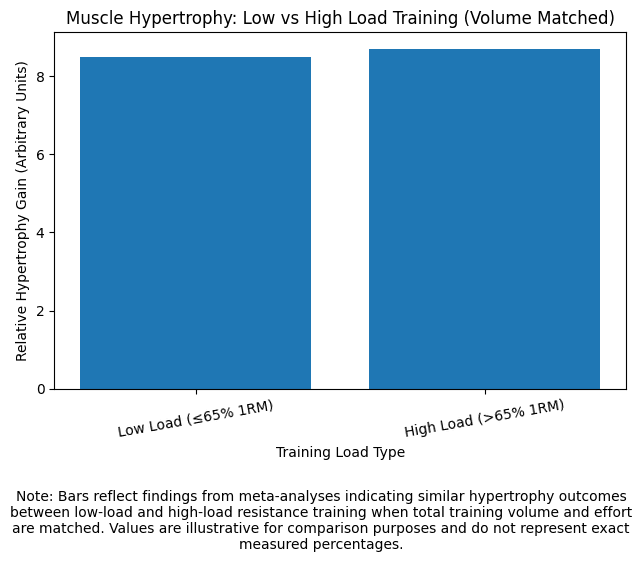
After analyzing hundreds of studies with hundreds of patients, it was concluded that both groups obtained more or less the same gains in terms of hypertrophy, even though there were some experiments in which light weight individuals did up to 100 repetitions. per exercise. Imagine if the weights used were low in some cases that patients were able to do up to one hundred repetitions in a row.
Training With Heavy Weights in the Gym is Not Always Worth It.
Meta-analysis is that the weight used is not as important as the total volume of the training. That is, the weights used by the number of repetitions and series. According to experts, as long as the training volume is similar, the hypertrophy results will also be similar.
Related Stories
 How To Do Shrugs in a Squat Rack?
 Yoga for Back Pain: How Yoga, Qi Gong, and Tai Chi Helped Me Find Lasting Relief
Therefore we would obtain the same hypertrophy if we do three chest sets of twelve repetitions with 100 kilos of weight as if we do seven sets of three repetitions with 170 kilos. In both cases the volume is similar and the results will also be similar.
So do I have to lift heavy?
No, or rather, not always. If your goal is to gain muscle mass there is no reason to lift maximum weights or very close to your maximum repetition.
To begin with, the studies conclude that in terms of hypertrophy the results will be similar, but the risk of training heavy is also very high. The closer to your maximum repetition you are working, the worse the technique will be and the greater the chances of making an involuntary movement that ends in injury. It is simply an unnecessary risk.

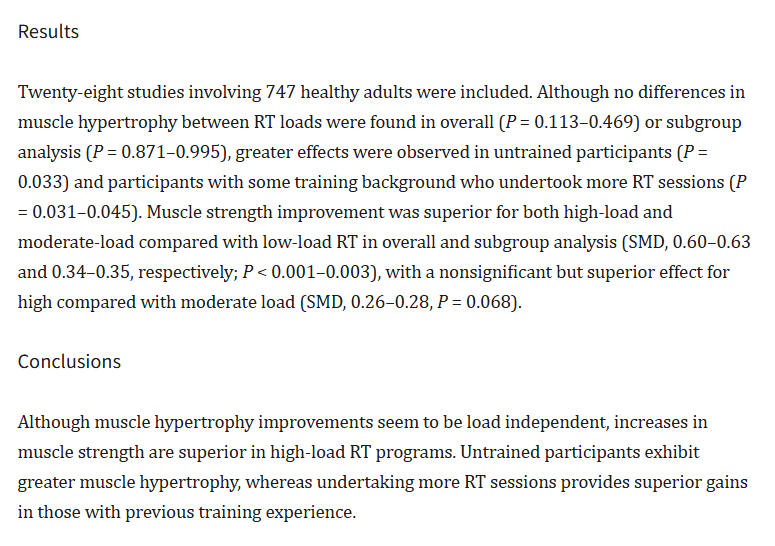
The only case in which I do recommend pulling heavy is when you train for a strictly strength sport such as powerlifting or weightlifting . As we can see in this study from October 2015, although the results in terms of hypertrophy, again, are similar in strength if differences are noted. In it, people who used high weights gained more strength in both their torso and legs.
There is a Strength vs Hypertrophy: The Two Are Not the same.
This is where a number of gym-goers falter.

Hypertrophy = muscle size.
Strength = the capacity to exert the greatest force.
Intensive exercise enhances the efficiency of the neural system – your nervous system is more efficient at recruiting the motor units and producing force. This is the reason why powerlifters are loaded with heavy weights.(2)
However, when you are interested in aesthetics, or overall fitness, or long-term joint health, then you might not need to be intent on pursuing maximal loads.
Indeed, moderate exercise (615 reps/set) can be said to be the hybrid between two extremes of hypertrophy and joint stress management.
Injury Risk and Joint Stress.
Joint longevity is one of the largest ignored aspects in heavy lifting.
Heavy loads increase:
- Spinal compression.
- Tendon stress.
- Ligament strain.
- Exhaustion of the central nervous system.
Experienced lifters can handle these risks due to good technique, however, beginners and intermediate lifters resort to loss of form as weights rise.
There often comes the chronic joint discomfort, lower back pain and shoulder discomfort as a result of the ego-oriented heavy lifting, without proper recovery or technique.
That does not imply that heavy lifting is hazardous.
It implies that heavy lifting will need:
- Technical mastery.
- Proper warm-up.
- Progressive adaptation.
- Recovery management.
In the absence of them, risk is augmented.
The Psychological Factor.
It has a psychological aspect as well.
- Heavy lifting can be:
- Intimidating.
- Stressful.
- Mentally exhausting.
Not all people like max-effort efforts.
And adherence matters.
A program you like and can maintain over time will always give greater long-term outcomes than a perfect program you fail to maintain after 8 weeks.
When It Makes Sense To Train Heavy.
The heavy training is suitable in cases when:(3)
- Maximum strength is the number one objective.
- You are an Olympian lifter or a power lifter.
- You wish that you should stimulate neural drive.
- Your level of strength is organized strength.
Periodically it can also be applicable in periodized programs to provoke adaptation.
Nevertheless, heavy lifting is not required to be a year-round undertaking.
Most of the successful athletes cycle phases:
- Strength phase.
- Hypertrophy phase.
- Deload phase.
- Conditioning phase.
This will avoid burnout and overuse injuries.
Other Workout Techniques that Develop Muscle.
Assuming that heavy lifting is not required in hypertrophy, what should be used instead?
Research supports:
Moderate Repetition Ranges( 6-15 reps).
The conventional bodybuilding line is still very effective.
High Reps Close to Failure.
It is possible to induce growth even with 20-30 sets of rep which are taken to fatigue.
Time Under Tension.
Reduced speed of eccentric cycles enhances mechanical tension.
Rest-Pause Sets.
Brief rest periods enhance the metabolic stress.
Drop Sets.
Loss of weight and maintenance of a set prolongs muscle fatigue.
These methods enable the stimulation of the muscle without the load on the joints in the maximal position.
Load is Important but Recovery Matters More.
Recovery is another important issue.
Heavy lifting demands:
- Increased interval between sessions.
- Increased recovery of the nervous system.
- Higher sleep quality.
- Proper nutrition.
- Higher training frequency with less systemic fatigue may frequently be made possible by moderate-load training.
To most recreational lifters, this leads to an increased amount of productive training in the long run.
What About Older Adults?
Research has always indicated that moderate resistance exercising is highly effective in:
- Bone density.
- Muscle retention.
- Balance.
- Functional capacity.
In aging populations, heavy maximal loading is not crucial in keeping the strength and muscle.
Actually, security and reliability will be much more significant.
Practical Recommendations.
If your goal is hypertrophy:
- Train 3–5 times per week.
- Apply moderate and light loads.
- Focus on total weekly volume.
- Exercise in proximity to muscular fatigue.
- Maintain proper technique.
- Progress gradually.
In case you would want to aim at maximum strength:
- Include heavy loads (80–90% 1RM).
- Adhere to progressive periodization.
- Monitor recovery closely.
Bottom Line.
Training with heavy weights in the fitness center can yield great strength and muscle gains for plenty individuals, it’s not continually the maximum suitable technique for anybody. Factors which include individual dreams, fitness stage, injury records, and personal choices must be considered whilst figuring out the simplest schooling regimen. Incorporating a number of sporting events and training modalities tailored to 1’s unique needs and limitations can lead to higher average outcomes and reduce the danger of damage. Ultimately, the key is to find a balanced technique to strength schooling that aligns with one’s targets and promotes lengthy-time period health and health.
+3 Sources
FreakToFit has strict sourcing guidelines and relies on peer-reviewed studies, educational research institutes, and medical organizations. We avoid using tertiary references. You can learn more about how we ensure our content is accurate and up-to-date by reading our editorial policy.
- Muscular adaptations in low- versus high-load resistance training: A meta-analysis; https://pubmed.ncbi.nlm.nih.gov/25530577/
- The Effects of Low-Load Vs. High-Load Resistance Training on Muscle Fiber Hypertrophy: A Meta-Analysis; https://pmc.ncbi.nlm.nih.gov/articles/PMC7706639/
- Resistance Training Load Effects on Muscle Hypertrophy and Strength Gain: Systematic Review and Network Meta-analysis; https://pmc.ncbi.nlm.nih.gov/articles/PMC8126497/