


















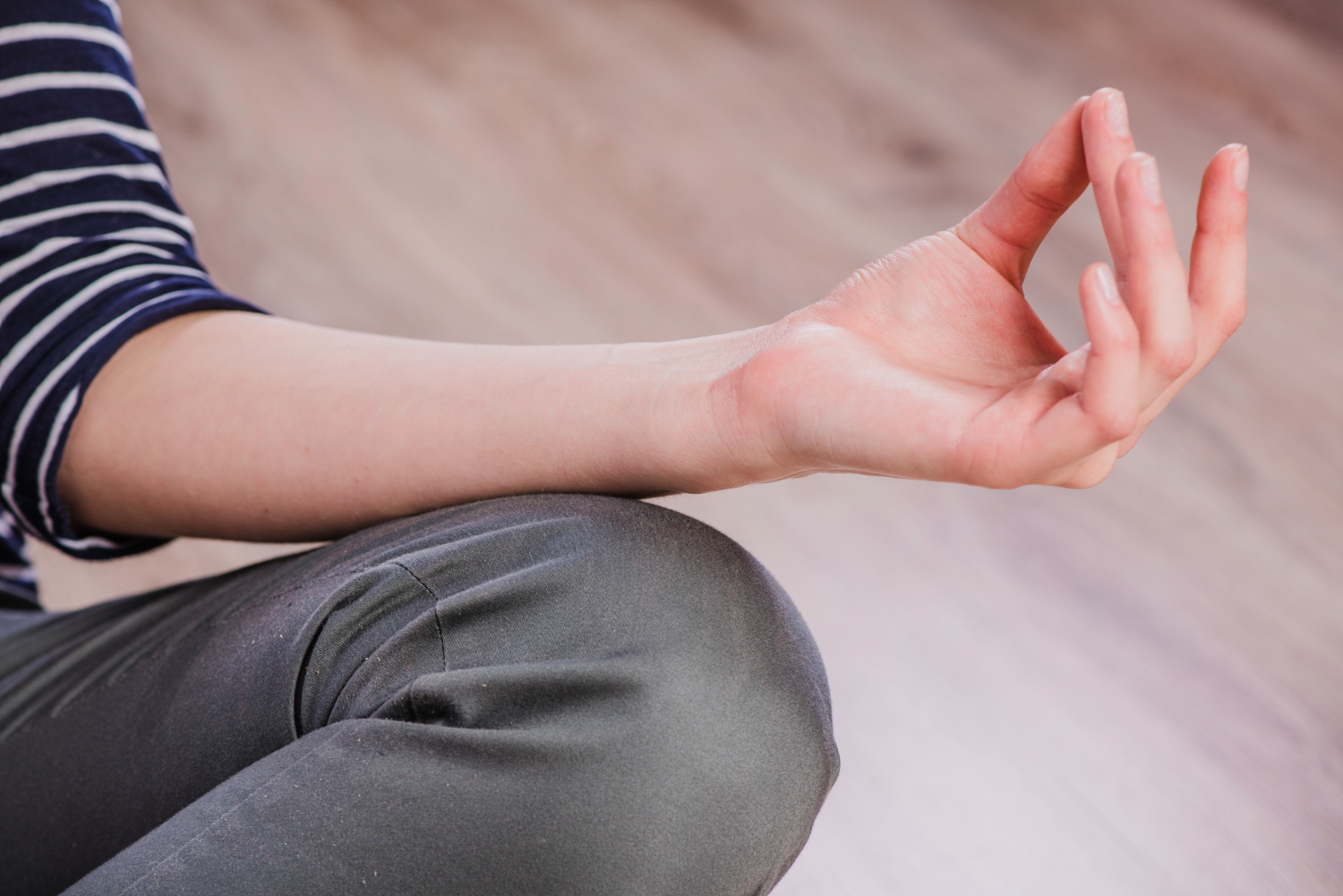
Surabhi Mudra is a traditional yogic hand gesture often described as the “wish-fulfilling mudra” or a gesture associated with abundance, balance, and inner awareness. It is a relatively complex hand position because the fingers of both hands interlock or connect in a specific pattern while the thumbs remain separated. Traditional yoga sources associate the practice with meditation, concentration, elemental balance, and spiritual development.
Unlike physical yoga poses, Surabhi Mudra does not require stretching the whole body or performing demanding movements. It can generally be practiced while sitting comfortably, making it accessible as part of meditation, breathing exercises, or a quiet mindfulness routine.
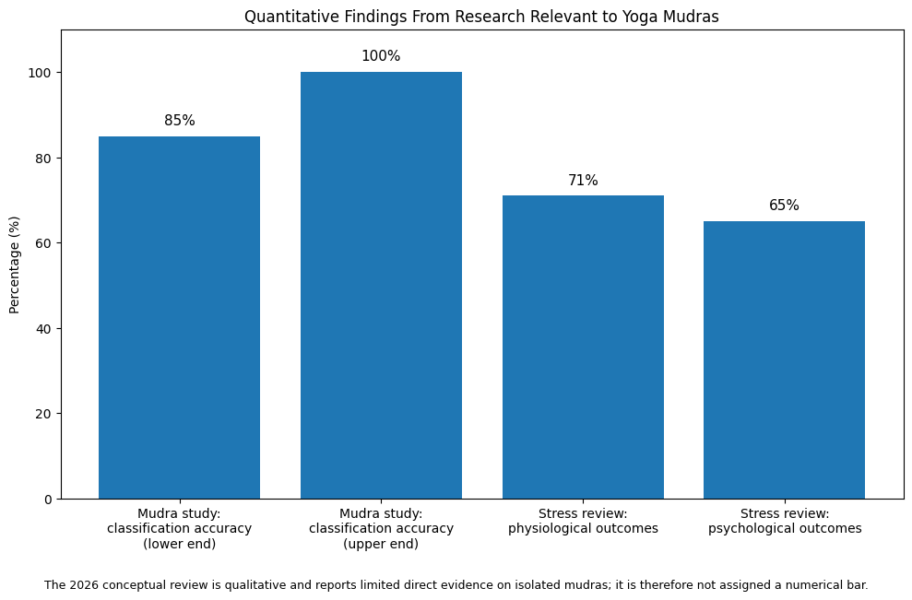
However, an evidence-based discussion requires an important distinction. There is currently very little direct scientific research examining Surabhi Mudra itself. Research on yoga mudras more broadly is still limited, and many studies combine mudras with meditation, breathing exercises, or other yoga practices. A 2026 conceptual review concluded that direct evidence for isolated mudra practices remains scarce, although research on gestures and broader yoga practices provides possible explanations for effects on attention, emotional regulation, and autonomic activity.
Therefore, Surabhi Mudra is best presented as a traditional contemplative practice, rather than as a medically proven treatment for a specific disease.
Related Stories
 7 Magnificent Yoga Poses To Improve Concentration
 Agni Mudra: Benefits, Side Effects, How To Do And Precautions
What Is Surabhi Mudra?
Surabhi Mudra is a hand gesture used in certain yoga and meditation traditions.
The word Surabhi is associated with the sacred or wish-fulfilling cow in Indian mythology. Traditional descriptions connect Surabhi with nourishment, abundance, and fulfillment. This symbolism contributes to the mudra’s popular name, the Wish-Fulfilling Mudra.
In traditional yoga interpretations, mudras are not merely hand positions. They are considered symbolic gestures that can help direct attention and support meditation.
Modern explanations often associate Surabhi Mudra with balancing the five elements or the Ayurvedic doshas. These claims belong to traditional philosophical systems and should not be interpreted as established physiological mechanisms.

A practical way to approach the mudra is therefore to use it as a physical anchor for concentration and meditation.
How to Do Surabhi Mudra?
Because the finger arrangement can initially feel confusing, practice slowly rather than forcing the fingers into position.

Step 1: Sit Comfortably.
Sit in a comfortable position.
You can use:
- Sukhasana
- A cross-legged seated position
- A meditation cushion
- A chair
You don’t need to sit in a difficult yoga posture.
Keep your spine comfortably upright without creating unnecessary tension.
Step 2: Relax Your Shoulders.
Allow your shoulders to drop naturally.
Relax your jaw and face.
Take several comfortable breaths.
Step 3: Bring Your Hands Forward.
Bring both hands in front of your chest or abdomen.
Keep the palms facing each other.
Step 4: Connect the Fingers.
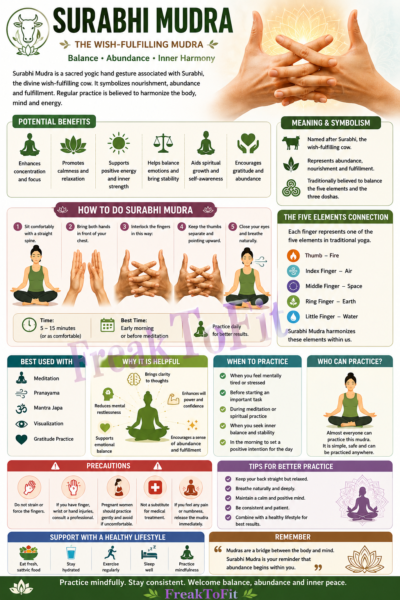
The commonly described Surabhi arrangement involves connecting corresponding fingers of opposite hands in a cross-pattern.
One commonly taught method is:
- Touch the tip of the right ring finger to the tip of the left little finger.
- Touch the tip of the left ring finger to the tip of the right little finger.
- Bring the middle fingers toward the opposite index fingers.
- Keep the thumbs separated and directed upward or toward the chest.
Different yoga teachers may demonstrate slight variations in finger positioning, so following the technique taught by a qualified instructor can be helpful. Traditional descriptions similarly emphasize the interconnection of the fingers while keeping the thumbs apart.
Step 5: Find a Comfortable Position.
The fingers should not be forced.
If your hands feel strained, reduce the pressure or release the position.
Step 6: Breathe Naturally.
Close your eyes if comfortable.
Take slow, natural breaths.
Rather than concentrating on whether you are experiencing an “energy effect,” simply observe your breathing and bodily sensations.
Step 7: Practice Mindfully.
Remain in the mudra for several minutes.
You can combine it with:
- Meditation
- Breath awareness
- Mantra repetition
- Quiet reflection
How Long Should You Practice Surabhi Mudra?
There is no scientifically established ideal duration for Surabhi Mudra.
Traditional yoga sources commonly suggest practicing it for several minutes at a time, with some recommending sessions of approximately 5–15 minutes.
For beginners, 5 minutes is a reasonable starting point.
If the hands remain comfortable, you can gradually increase the duration.
The goal should not be to hold the mudra for as long as possible.
A short, relaxed practice may be more sustainable than a long session that creates finger or wrist discomfort.
Traditional Meaning of Surabhi Mudra.
Surabhi Mudra has a strong symbolic component.
The name is traditionally connected with Surabhi, the divine cow associated with abundance and fulfillment.
This symbolism is why some practitioners use the mudra during meditation focused on:
- Abundance
- Gratitude
- Intention
- Personal growth
- Spiritual reflection
- Fulfillment
In some yoga traditions, Surabhi Mudra is also described as a Tridosha Nashak Mudra, with the traditional belief that it helps balance Vata, Pitta, and Kapha.
These are traditional Ayurvedic concepts and are not equivalent to medically measured physiological states.
Surabhi Mudra and the Five Elements.
Some traditional systems associate the fingers with the five elements, commonly described as:
- Thumb — fire
- Index finger — air
- Middle finger — space
- Ring finger — earth
- Little finger — water
Surabhi Mudra brings the fingers of both hands into a distinctive arrangement, which traditional practitioners interpret as a way of harmonizing elemental qualities.
From a modern scientific perspective, however, there is no established physiological evidence that touching particular fingers together literally changes elemental levels in the body.
The traditional symbolism can still provide a meaningful framework for meditation.
Potential Benefits of Surabhi Mudra.
It is important to separate traditional claims from benefits supported by scientific research.
There are no high-quality clinical trials demonstrating that Surabhi Mudra specifically treats a particular disease.
Nevertheless, the practice may have potential value as part of a broader contemplative routine.
1. May Support Mindfulness.
Holding a specific hand position gives the mind a physical point of focus.
Instead of allowing attention to wander continuously, you can use the sensation and position of the hands as an anchor.
This is similar to other mindfulness techniques in which practitioners focus on breathing, bodily sensations, or a repeated phrase.
2. May Encourage Relaxation.
If Surabhi Mudra is practiced while sitting quietly and breathing slowly, the overall practice may encourage relaxation.
Importantly, it is difficult to determine whether any benefit comes specifically from the mudra or from the combination of:
- Quiet sitting
- Slow breathing
- Meditation
- Reduced stimulation
- Focused attention
Research on yoga and meditation more broadly provides stronger evidence than research on Surabhi Mudra itself.
A 2024 systematic review examined 28 eligible studies involving 2,574 participants and found that many studies of single sessions of yoga, meditation, or breathing reported reductions in acute stress reactivity.
3. May Support Concentration.
Because the fingers have to remain in a particular arrangement, the practice requires some attention.
This can make Surabhi Mudra a useful component of a concentration practice.
However, it would be inaccurate to claim that the mudra independently improves memory or intelligence without direct evidence.
4. Can Support a Meditation Routine.
One of the simplest potential benefits is behavioral.
Having a consistent hand gesture can become a cue that tells you it is time to sit quietly and meditate.
This may help establish a regular routine.
5. May Promote Body Awareness.
The unusual finger position creates a noticeable tactile sensation.
You can observe:
- Finger pressure
- Temperature
- Muscle tension
- Breathing
- Posture
This can encourage greater awareness of physical sensations.
6. May Encourage Intentional Reflection.
Because Surabhi Mudra is traditionally connected with abundance and fulfillment, some practitioners use it while reflecting on personal intentions.
For example, you might sit with the question:
“What does fulfillment mean to me?”
This turns the mudra into a reflective practice rather than simply holding a hand position.
What Does Science Say About Surabhi Mudra?
A 2026 review of hasta mudras noted that available research on yoga mudras remains limited and that many studies combine mudras with other yogic techniques. The authors proposed possible links between intentional gestures, attention, emotion, and sensorimotor processes, but emphasized the scarcity of direct evidence from isolated mudra practices.(1)
Another study investigated yogic mudras using electrophotonic imaging and included 29 volunteers in the mudra group and 32 controls. However, this type of study does not establish that Surabhi Mudra produces specific medical benefits, and its findings should not be generalized to disease treatment.(2)
Therefore, claims such as “Surabhi Mudra cures diabetes,” “balances hormones,” or “detoxifies the body” should not be presented as established scientific facts.
Surabhi Mudra and Stress.
Although direct evidence is lacking, the broader practice of yoga and meditation has been investigated for stress management.
A randomized controlled trial involving 131 people with mild-to-moderate stress compared yoga with relaxation training. After 10 weeks, both approaches improved stress, anxiety, and quality-of-life measures, with yoga showing greater improvement in some mental-health measures.
A separate randomized controlled trial of Hatha yoga found improvements in some measures of stress and mental health, although the intervention did not significantly change all anxiety outcomes.
These studies support the broader idea that yoga can be useful for stress management.
They do not prove that Surabhi Mudra itself produces the same effects.
Surabhi Mudra and Meditation.
Surabhi Mudra can be combined with meditation.
A simple practice could involve:
- Sit comfortably.
- Form Surabhi Mudra.
- Close your eyes.
- Relax your shoulders.
- Breathe naturally.
- Notice the sensation of your hands.
- When your mind wanders, return attention to the breath.
- Continue for 5–10 minutes.
You can also silently repeat a simple phrase such as:
“I am present.”
or:
“I welcome clarity and balance.”
The phrase is a meditation aid rather than a medically proven mechanism.
Surabhi Mudra With Pranayama.
You can also incorporate the mudra into gentle breathing practices.
For example, practice Surabhi Mudra while observing natural breathing.
If you already have experience with pranayama, you may combine it with a suitable breathing technique taught by a qualified instructor.
Beginners should avoid forcing breath retention or performing intense breathing techniques simply because they are associated with spiritual practices.
The 2024 systematic review of yoga components found evidence that some single-session yoga, breathing, and meditation practices can influence acute stress reactivity, but the research involved many different techniques rather than Surabhi Mudra specifically.
Surabhi Mudra for Beginners.
If you are completely new to mudras, the complicated finger position may initially feel uncomfortable.
Start with short sessions.
Beginner Routine.
1 minute: Sit comfortably.
1 minute: Relax your shoulders and hands.
2 minutes: Form Surabhi Mudra.
2 minutes: Observe your breathing.
2 minutes: Practice quiet meditation.
1 minute: Release the mudra slowly.
1 minute: Notice how you feel.
This provides a simple 10-minute practice.
There is no need to force yourself to sit for 30 or 60 minutes.
Common Mistakes While Practicing Surabhi Mudra.
Forcing the Fingers.
The fingers should connect gently.
Don’t pull or push them into position.
Holding Too Tightly.
A mudra isn’t a grip-strength exercise.
Use minimal pressure.
Creating Shoulder Tension.
People sometimes lift their shoulders while concentrating on the hands.
Let them relax.
Holding the Breath.
Continue breathing naturally unless you are intentionally practicing a breathing technique under appropriate guidance.
Expecting Immediate Results.
Surabhi Mudra is not something that needs to produce a dramatic sensation.
A quiet practice can still be meaningful.
Treating Traditional Claims as Medical Facts.
Statements about balancing doshas, hormones, organs, or energy should be understood within their traditional framework.
They should not replace medical evaluation.
Surabhi Mudra and the Chakras.
Modern yoga sources sometimes associate Surabhi Mudra with the Manipura or Solar Plexus Chakra.
The Manipura Chakra is traditionally associated with:
- Personal power
- Confidence
- Transformation
- Willpower
- Inner strength
Some practitioners therefore use Surabhi Mudra during meditation focused on these qualities.
However, chakras are part of traditional spiritual systems and are not recognized as anatomical organs by modern medicine.
If you use chakra visualization, treat it as a contemplative or symbolic practice.
Also Read: Amazing Health Benefits of Prithvi Mudra
Can Surabhi Mudra Improve Digestion?
Traditional sources sometimes claim that Surabhi Mudra supports digestion and metabolism.
However, there is not enough high-quality clinical research to conclude that Surabhi Mudra directly improves digestive function.
If you experience persistent:
- Abdominal pain
- Bloating
- Vomiting
- Diarrhea
- Constipation
- Blood in stool
- Unexplained weight loss
seek medical assessment rather than relying on a mudra.
Can Surabhi Mudra Balance Hormones?
Some online descriptions claim that Surabhi Mudra influences endocrine glands or hormonal balance.
These claims are not established by high-quality clinical evidence.
The endocrine system is complex, and hormonal disorders require appropriate testing and professional diagnosis.
Surabhi Mudra can be used as a meditation practice, but it should not be presented as a treatment for thyroid disease, PCOS, diabetes, adrenal disorders, or other endocrine conditions.
Can Surabhi Mudra Help With Anxiety?
There is insufficient evidence to say that Surabhi Mudra specifically treats anxiety.
However, meditation and yoga more broadly have been studied for stress and psychological well-being.
A recent randomized trial of Yoga Nidra, for example, found small improvements in several psychological outcomes and changes in cortisol measures after regular practice, although this was a Yoga Nidra intervention rather than Surabhi Mudra.(3)
Therefore, Surabhi Mudra may be incorporated into a broader relaxation routine, but it should not replace professional treatment for an anxiety disorder.
Surabhi Mudra During Yoga.
Surabhi Mudra doesn’t have to be practiced separately from yoga.
You can use it during:
- Seated meditation
- Pranayama
- Yoga Nidra
- Savasana
- Gentle stretching
- Mindfulness practice
It is particularly easy to incorporate during seated portions of a yoga session because it doesn’t require substantial physical effort.
Surabhi Mudra During Savasana.
After completing a yoga session, lie comfortably in Savasana.
However, because Surabhi Mudra requires both hands to maintain a specific configuration, it may be more practical to use it while seated rather than fully relaxed in Savasana.
A comfortable seated meditation immediately after Savasana can be an alternative.
How Often Should You Practice Surabhi Mudra?
There is no scientifically established frequency.
A practical approach is:
Beginners: 5 minutes once a day.
Regular practitioners: 10–15 minutes once or twice daily if comfortable.
The traditional practice recommendations vary, so there is no need to treat one particular duration as medically necessary.
Consistency is more important than forcing a long session.
Who Should Be Careful?
Surabhi Mudra is generally a gentle hand practice, but people with hand or finger conditions should be cautious.
Modify or avoid the practice if you have:
- Significant finger pain
- Recent hand surgery
- Severe arthritis affecting the fingers
- Trigger finger that worsens with the position
- Recent wrist or hand injury
- Numbness or tingling
If the position causes pain, release it.
A meditation practice should not create an injury.
Is Surabhi Mudra Safe?
For most healthy people, gently positioning the fingers for a few minutes is unlikely to create significant physical risk.
The main concern is usually excessive pressure or prolonged positioning in someone with a hand or joint problem.
Stop if you experience:
- Pain
- Numbness
- Tingling
- Cramping
- Loss of sensation
- Persistent discomfort
You don’t need to tolerate pain to obtain a supposed “energetic benefit.”
Surabhi Mudra vs Other Mudras.
Surabhi Mudra is more complex than many commonly practiced hand gestures.
For example:
Gyan Mudra generally involves touching the thumb and index finger.
Prana Mudra involves a different combination of fingers.
Surabhi Mudra requires a more intricate interconnection between both hands.
This complexity can make Surabhi Mudra interesting for practitioners who want a more deliberate meditation anchor.
Surabhi Mudra and Spiritual Practice.
Surabhi Mudra is particularly suited to practitioners who approach yoga as more than physical exercise.
Its traditional symbolism can be incorporated into contemplative themes such as:
- Gratitude
- Abundance
- Fulfillment
- Generosity
- Self-reflection
- Intention
- Spiritual awareness
You don’t need to interpret these concepts literally.
For example, “abundance” could simply mean recognizing the resources and relationships already present in your life.
A 15-Minute Surabhi Mudra Meditation.
Try this simple practice.
Minutes 1–3: Settle.
Sit comfortably.
Allow your breathing to become natural.
Minutes 4–6: Form the Mudra.
Slowly arrange the fingers.
Keep the hands relaxed.
Minutes 7–10: Focus on Breathing.
Notice each inhalation and exhalation.
Don’t force the breath.
Minutes 11–13: Reflection.
Choose one theme:
“What does balance mean to me?”
or:
“What am I grateful for today?”
Minutes 14–15: Close.
Release the fingers.
Place your hands comfortably on your thighs.
Open your eyes slowly.
Can You Practice Surabhi Mudra Before Bed?
Yes.
Because the practice can be performed while sitting quietly, it can be included in an evening wind-down routine.
Try 5–10 minutes of gentle breathing and meditation.
Avoid turning the practice into a test of how quickly you can fall asleep.
If you have persistent insomnia, address the underlying issue with appropriate healthcare guidance rather than relying solely on a mudra.
Frequently Asked Questions.
1. What is Surabhi Mudra?
Surabhi Mudra is a traditional yogic hand gesture in which the fingers of both hands are arranged in a specific interconnected pattern. It is often called the “wish-fulfilling mudra.”
2. What are the benefits of Surabhi Mudra?
Traditionally, it is associated with concentration, balance, meditation, abundance, and elemental harmony. Scientific evidence specifically supporting these effects is limited.
3. How long should I hold Surabhi Mudra?
Beginners can start with approximately 5 minutes. If comfortable, you can gradually practice for 10–15 minutes.
4. Can Surabhi Mudra reduce stress?
There is no strong direct evidence for Surabhi Mudra specifically. However, broader research suggests that yoga and meditation practices can help reduce stress in some populations.
5. Can Surabhi Mudra cure diseases?
No. It should not be presented as a cure or treatment for medical conditions.
6. Can I practice Surabhi Mudra every day?
Yes, if your hands and fingers remain comfortable. A short daily practice can be easier to maintain than occasional long sessions.
7. Can beginners practice Surabhi Mudra?
Yes. The finger position can initially be difficult, so beginners should practice slowly without forcing the hands.
8. Can Surabhi Mudra be practiced during meditation?
Yes. Meditation is one of the most suitable settings for the mudra.
9. Is Surabhi Mudra associated with a chakra?
Some modern yoga traditions associate it with the Manipura or Solar Plexus Chakra. This is a spiritual framework rather than an established anatomical or medical system.
10. Does Surabhi Mudra improve digestion?
Digestive benefits are traditionally claimed, but there is insufficient clinical evidence to establish that Surabhi Mudra directly improves digestion.
11. Can Surabhi Mudra balance hormones?
There is no sufficient scientific evidence that Surabhi Mudra directly balances hormones or treats endocrine disorders.
12. What should I do if my fingers hurt?
Release the mudra and allow your hands to relax. Don’t force the fingers into position. If pain persists, seek advice from an appropriate healthcare professional.
Bottom Line.
Surabhi Mudra is a traditional yogic hand gesture associated with Surabhi, the sacred wish-fulfilling cow in Indian mythology. It is commonly practiced during meditation and is traditionally associated with abundance, balance, concentration, elemental harmony, and spiritual reflection.
From an evidence-based perspective, however, claims about specific medical effects of Surabhi Mudra should be treated cautiously. Direct scientific research on this particular mudra is very limited, and broader research on yoga mudras remains relatively small. A recent review specifically noted that isolated mudra research is scarce and that many existing studies combine mudras with other yoga or meditation techniques.
The most reasonable way to use Surabhi Mudra is as a mindfulness and meditation tool. Sitting quietly, focusing on the hands, breathing naturally, and practicing regularly may provide a structured opportunity for relaxation and self-reflection. Research on broader yoga and meditation practices provides some support for stress-management effects, but those findings should not be attributed specifically to Surabhi Mudra.
Most importantly, don’t use Surabhi Mudra as a substitute for medical treatment. If you have persistent physical or psychological symptoms, seek appropriate professional care.
+3 Sources
FreakToFit has strict sourcing guidelines and relies on peer-reviewed studies, educational research institutes, and medical organizations. We avoid using tertiary references. You can learn more about how we ensure our content is accurate and up-to-date by reading our editorial policy.
- Hasta Mudras in Yoga and Natyashastra: A Conceptual Review through the Lens of Embodied Cognition and Psychophysiological Correlates; https://mansapublishers.com/ijim/article/view/8070
- Classification of Electrophotonic Images of Yogic Practice of Mudra through Neural Networks; https://pubmed.ncbi.nlm.nih.gov/29755225/
- Effect of a single session of yoga and meditation on stress reactivity: A systematic review; https://pubmed.ncbi.nlm.nih.gov/37822096/







Tyvm for the helpful post!