
















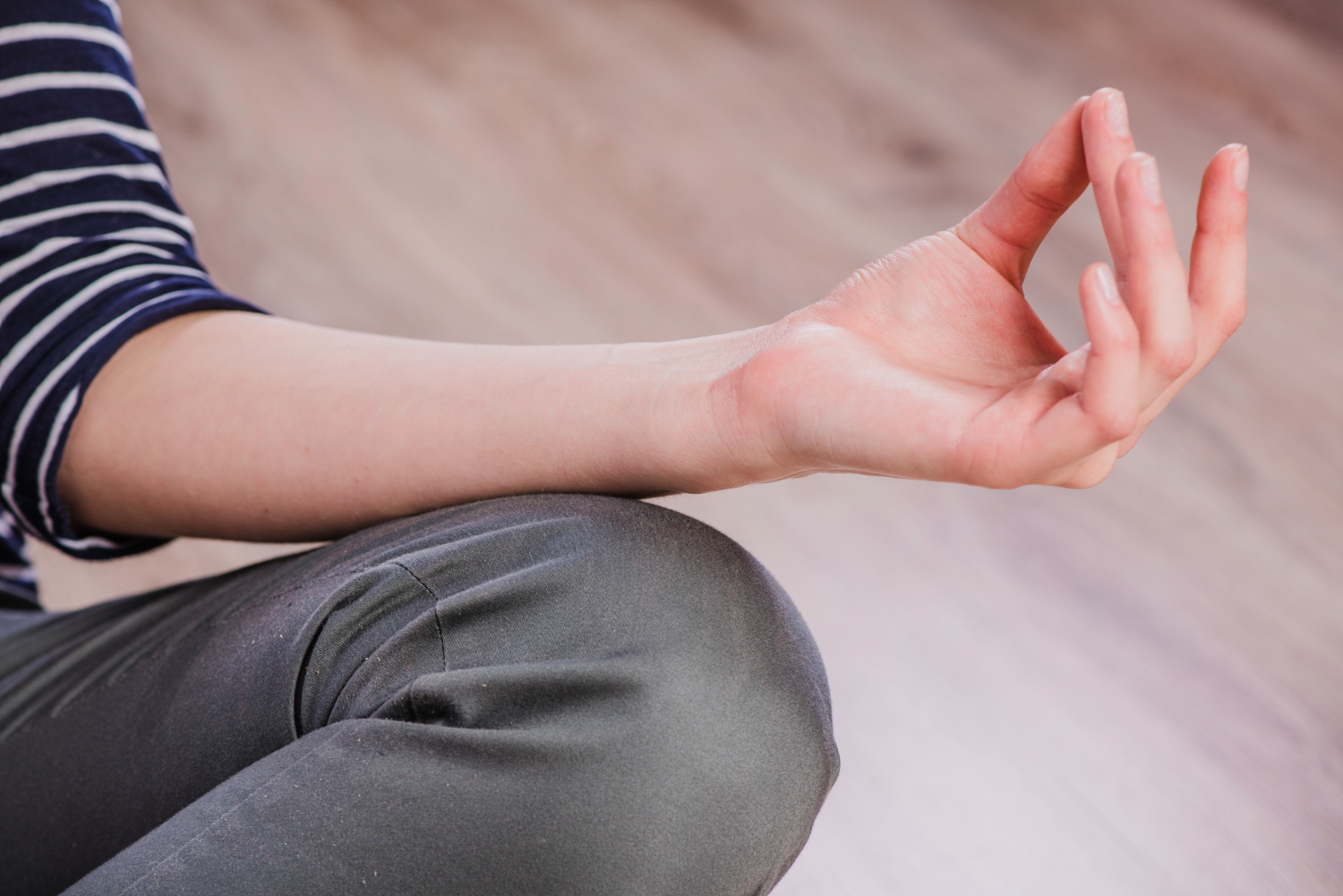
Surabhi mudra é um gesto tradicional de mão yogue frequentemente descrito como o “mudra que realiza desejos” ou um gesto associado à abundância, equilíbrio e consciência interior. É uma posição relativamente complexa da mão porque os dedos de ambas as mãos se conectam ou se conectam em um padrão específico enquanto os polegares permanecem separados. Fontes tradicionais de yoga associam a prática à meditação, concentração, equilíbrio elementar e desenvolvimento espiritual.
Ao contrário das poses de ioga física, Surabhi Mudra não requer alongar todo o corpo ou realizar movimentos exigentes. Geralmente, pode ser praticado sentado confortavelmente, tornando-o acessível como parte da meditação, exercícios respiratórios ou uma rotina silenciosa de atenção plena.
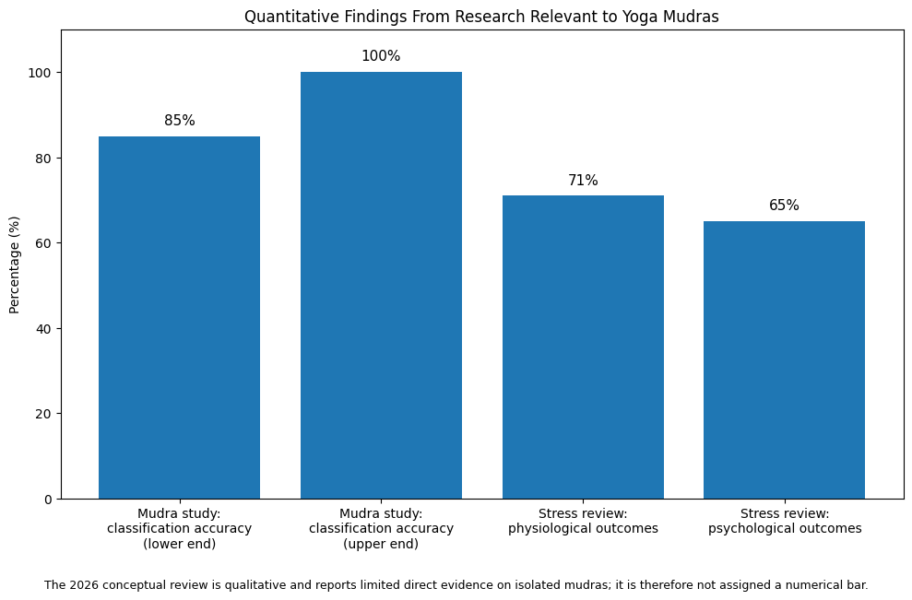
No entanto, uma discussão baseada em evidências requer uma distinção importante. Atualmente, há muito pouca pesquisa científica direta examinando o próprio Surabhi Mudra. A pesquisa sobre mudras de ioga de forma mais ampla ainda é limitada, e muitos estudos combinam mudras com meditação, exercícios de respiração ou outras práticas de ioga. Uma revisão conceitual de 2026 concluiu que a evidência direta de práticas isoladas de mudra permanece escassa, embora a pesquisa sobre gestos e práticas de ioga mais amplas forneça explicações possíveis para os efeitos na atenção, regulação emocional e atividade autonômica.
Portanto, Surabhi mudra é melhor apresentado como uma prática contemplativa tradicional, e não como um tratamento medicamente comprovado para uma doença específica.
Histórias relacionadas
 Hakini Mudra: benefícios, efeitos colaterais, como fazer e precauções
 Pose do ioga do senhor da dança: benefícios, como fazer e variações
O que é Surabhi Mudra?
Surabhi Mudra é um gesto de mão usado em certas tradições de ioga e meditação.
A palavra Surabhi está associada à vaca sagrada ou que realiza desejos na mitologia indiana. As descrições tradicionais conectam Surabhi com nutrição, abundância e realização. Esse simbolismo contribui para o nome popular do mudra, o mudra que realiza o desejo.
Nas interpretações tradicionais de ioga, os mudras não são apenas posições das mãos. São considerados gestos simbólicos que podem ajudar a direcionar a atenção e apoiar a meditação.
As explicações modernas geralmente associam Surabhi Mudra ao equilibrar os cinco elementos ou os doshas ayurvédicos. Essas afirmações pertencem aos sistemas filosóficos tradicionais e não devem ser interpretadas como mecanismos fisiológicos estabelecidos.
A Maneira prática de abordar o mudra Portanto, é usá-lo como uma âncora física para concentração e meditação.
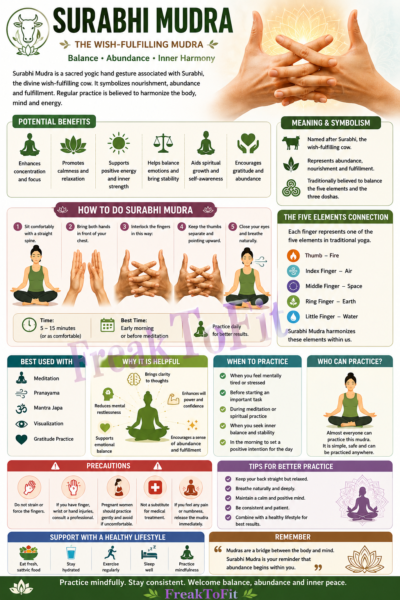
Como fazer Surabhi Mudra?
Como o arranjo do dedo pode inicialmente parecer confuso, pratique lentamente, em vez de forçar os dedos a ficarem na posição.

Passo 1: Sente-se confortavelmente.
Sente-se em uma posição confortável.
Você pode usar:
- sukhasana
- Uma posição sentada de pernas cruzadas
- uma almofada de meditação
- uma cadeira
Você não precisa se sentar em uma postura de ioga difícil.
Mantenha a coluna confortavelmente ereta sem criar tensão desnecessária.
Passo 2: Relaxe os ombros.
Deixe seus ombros caírem naturalmente.
Relaxe o rosto e o rosto.
Faça várias respirações confortáveis.
Passo 3: Traga as mãos para frente.
Coloque as duas mãos na frente do peito ou do abdômen.
Mantenha as palmas das mãos voltadas uma para a outra.
Passo 4: Conecte os dedos.
O arranjo Surabhi comumente descrito envolve conectar os dedos correspondentes de mãos opostas em um padrão cruzado.
Um método comumente ensinado é:
- Toque a ponta do dedo anelar direito até a ponta do dedo pequeno esquerdo.
- Toque a ponta do dedo anelar esquerdo até a ponta do dedo mínimo direito.
- Leve os dedos do meio em direção aos dedos indicadores opostos.
- Mantenha os polegares separados e direcionados para cima ou para o peito.
Diferentes professores de ioga podem demonstrar pequenas variações no posicionamento dos dedos, portanto, seguir a técnica ensinada por um instrutor qualificado pode ser útil. As descrições tradicionais também enfatizam a interconexão dos dedos, mantendo os polegares separados.
Passo 5: Encontre uma posição confortável.
Os dedos não devem ser forçados.
Se suas mãos ficarem tensas, reduza a pressão ou solte a posição.
Passo 6: Respire naturalmente.
Feche os olhos se estiver confortável.
Respire lento e natural.
Em vez de se concentrar em saber se você está experimentando um “efeito energia”, basta observar sua respiração e sensações corporais.
Passo 7: Pratique atentamente.
Permaneça no mudra por alguns minutos.
Você pode combiná-lo com:
- meditação
- Respire a consciência
- Repetição de mantra
- Reflexo serena
Por quanto tempo você deve praticar Surabhi Mudra?
Não existe uma duração ideal cientificamente estabelecida para Surabhi mudra.
As fontes tradicionais de ioga geralmente sugerem praticá-lo por vários minutos de cada vez, com algumas sessões de recomendação de aproximadamente 5 a 15 minutos.
Para iniciantes, 5 minutos é um ponto de partida razoável.
Se as mãos permanecerem confortáveis, você poderá aumentar gradualmente a duração.
O objetivo não deve ser manter o mudra o maior tempo possível.
Uma prática curta e relaxada pode ser mais sustentável do que uma longa sessão que cria desconforto no dedo ou no pulso.
Significado tradicional de Surabhi mudra.
Surabhi Mudra tem um forte componente simbólico.
O nome é tradicionalmente relacionado com Surabhi, a vaca divina associada à abundância e realização.
Esse simbolismo é o motivo pelo qual alguns praticantes usam o mudra durante a meditação, focado em:
- abundância
- gratidão
- intenção
- crescimento pessoal
- Reflexão espiritual
- realização
Em algumas tradições de ioga, Surabhi Mudra também é descrito como um Tridosha Nashak Mudra, com a crença tradicional de que ajuda a equilibrar Vata, Pitta e Kapha.
Estes são conceitos tradicionais ayurvédicos e não são equivalentes a estados fisiológicos medidos medicamente.
Surabhi Mudra e os Cinco Elementos.
Alguns sistemas tradicionais associam os dedos aos cinco elementos, comumente descritos como:
- polegar - fogo
- dedo indicador - ar
- dedo médio - espaço
- Dedo anelar - Terra
- dedo mindinho - água
Surabhi Mudra traz os dedos de ambas as mãos para um arranjo distinto, que os praticantes tradicionais interpretam como uma forma de harmonizar as qualidades elementares.
De uma perspectiva científica moderna, no entanto, não há evidências fisiológicas estabelecidas de que tocar dedos específicos juntos muda literalmente os níveis elementares do corpo.
O simbolismo tradicional ainda pode fornecer uma estrutura significativa para a meditação.
Benefícios potenciais do Surabhi Mudra.
é importante separar as reivindicações tradicionais dos benefícios Apoiado em pesquisas científicas.
Não existem ensaios clínicos de alta qualidade que demonstrem que Surabhi Mudra trata especificamente de uma doença específica.
No entanto, a prática pode ter um valor potencial como parte de uma rotina mais ampla de contemplação.
1. Pode apoiar a atenção plena.
Segurar uma posição específica da mão fornece o cuidar de um físico ponto de foco.
Em vez de permitir que a atenção vagueie continuamente, você pode usar a sensação e a posição das mãos como âncora.
Isso é semelhante a outras técnicas de atenção plena nas quais os praticantes se concentram na respiração, nas sensações corporais ou em uma frase repetida.
2 . Pode estimular o relaxamento.
Se Surabhi mudra é praticado sentado em silêncio e respirando lentamente, a prática geral pode estimular o relaxamento.
É difícil determinar se algum O benefício vem especificamente do mudra Ou pela combinação de:
- Sentado quieto
- Respiração lenta
- meditação
- Estimulação reduzida
- atenção focada
A pesquisa sobre ioga e meditação fornece evidências mais fortes do que pesquisas sobre o próprio Surabhi Mudra.
Uma revisão sistemática de 2024 examinou 28 estudos elegíveis envolvendo 2.574 participantes e descobriu que muitos estudos de sessões únicas de ioga, meditação ou respiração relataram reduções na reatividade ao estresse agudo.
3. Pode suportar a concentração.
Como os dedos precisam permanecer em um arranjo particular, a prática requer alguma atenção.
Isso pode tornar o Surabhi Mudra um componente útil de uma prática de concentração.
No entanto, seria impreciso afirmar que o mudra melhora de forma independente a memória ou a inteligência sem evidência direta.
4. Pode apoiar uma rotina de meditação.
Um dos benefícios potenciais mais simples é o comportamento.
Ter um gesto consistente com as mãos pode se tornar uma sugestão que lhe diz que é hora de sentar-se em silêncio e meditar.
Isso pode ajudar a estabelecer uma rotina regular.
5. Pode promover a consciência corporal.
A posição incomum do dedo cria uma sensação tátil notável.
Você pode observar:
- pressão do dedo
- temperatura
- tensão muscular
- respiração
- postura
Isso pode estimular uma maior consciência das sensações físicas.
6. Pode incentivar a reflexão intencional.
Como o Surabhi Mudra está tradicionalmente conectado com abundância e realização, alguns praticantes o usam enquanto Refletindo sobre o pessoal intenções.
Por exemplo, você pode se sentar com a pergunta:
“O que significa cumprimento para mim?”
Isso transforma o mudra em uma prática reflexiva em vez de simplesmente segurar uma posição de mão.
O que a ciência diz sobre Surabhi Mudra?
Uma revisão de Hasta Mudras de 2026 observou que a pesquisa disponível sobre yoga mudras permanece limitada e que muitos estudos combinam mudras com outras técnicas de yogue. Os autores propuseram possíveis ligações entre gestos intencionais, atenção, emoção e processos sensório-motores, mas enfatizaram a escassez de evidências diretas de práticas isoladas de mudra.(1)
Outro estudo investigou o yogic Mudras usando imagens eletrofotônicas e incluiu 29 voluntários no grupo Mudra e 32 controles. No entanto, esse tipo de estudo não estabelece que o Surabhi Mudra produz benefícios médicos específicos, e seus achados não devem ser generalizados para o tratamento da doença.(2)
Portanto, afirmações como “Surabhi mudra cura o diabetes”, “equilibra hormônios” ou “desintoxica o corpo” não devem ser apresentadas como fatos científicos estabelecidos.
Surabhi mudra e estresse.
Embora haja evidências diretas, a prática mais ampla de ioga e meditação foi investigada para o gerenciamento do estresse.
Um estudo controlado randomizado envolvendo 131 pessoas com estresse leve a moderado em comparação com o ioga com o treinamento de relaxamento. Após 10 semanas, ambas as abordagens melhoraram o estresse, a ansiedade e as medidas de qualidade de vida, com ioga mostrando maior melhora em algumas medidas de saúde mental.
Um estudo controlado randomizado separado do Hatha Yoga encontrou melhorias em algumas medidas de estresse e saúde mental, embora a intervenção não tenha alterado significativamente todos os resultados de ansiedade.
Esses estudos apoiam a ideia mais ampla de que o yoga pode ser útil para o gerenciamento do estresse.
Eles não provam que o próprio Surabhi Mudra produz os mesmos efeitos.
Surabhi Mudra e meditação.
Surabhi mudra pode ser combinado com meditação.
Uma prática simples pode envolver:
- Sente-se confortavelmente.
- forma surabhi mudra.
- Feche os olhos.
- Relaxe os ombros.
- Respire naturalmente.
- Observe a sensação de suas mãos.
- Quando sua mente vaguear, volte a atenção para a respiração.
- Continue por 5 a 10 minutos.
Você também pode repetir silenciosamente uma frase simples, como:
“Estou presente.”
ou:
“Saúdo a clareza e o equilíbrio.”
A frase é um auxílio à meditação e não um mecanismo comprovado com medicação.
Surabhi mudra com pranayama.
Você também pode incorporar o mudra em práticas de respiração suave.
Por exemplo, pratique Surabhi mudra enquanto observa a respiração natural.
Se você já tem experiência com Pranayama, pode combiná-lo com um Técnica de respiração adequada ministrado por um instrutor qualificado.
Os iniciantes devem evitar obrigar a retenção da respiração ou Realizar técnicas de respiração intensa Simplesmente porque estão associados a práticas espirituais.
A revisão sistemática de componentes de ioga em 2024 encontrou evidências de que algumas práticas de ioga, respiração e meditação de uma única sessão podem influenciar a reatividade do estresse agudo, mas a pesquisa envolveu muitas técnicas diferentes, em vez de Surabhi mudra especificamente.
Surabhi Mudra para iniciantes.
Se você é completamente novo em mudras, a posição complicada do dedo pode inicialmente se sentir desconfortável.
Comece com sessões curtas.
rotina para iniciantes.
1 minuto: Sente-se confortavelmente.
1 minuto: Relaxe os ombros e as mãos.
2 minutos: forma surabhi mudra.
2 minutos: Observe sua respiração.
2 minutos: Pratique meditação silenciosa.
1 minuto: Solte o mudra lentamente.
1 minuto: Observe como você se sente.
Isso fornece uma prática simples de 10 minutos.
Não há necessidade de se forçar a sentar-se por 30 ou 60 minutos.
Erros comuns ao praticar Surabhi Mudra.
Forçando os dedos.
Os dedos devem se conectar suavemente.
não puxe ou empurre eles na posição.
segurando com muita força.
Um mudra não é um exercício de força de aperto.
Use pressão mínima.
Criando tensão no ombro.
As pessoas às vezes levantam os ombros enquanto se concentram nas mãos.
Deixe-os relaxar.
prendendo a respiração.
Continue respirando naturalmente, a menos que esteja praticando uma técnica de respiração intencionalmente sob orientação adequada.
Esperando resultados imediatos.
Surabhi Mudra não é algo que precisa produzir uma sensação dramática.
Uma prática silenciosa ainda pode ser significativa.
Tratar as reivindicações tradicionais como fatos médicos.
Declarações sobre o equilíbrio dos doshas, hormônios, órgãos ou energia devem ser entendidas dentro de sua estrutura tradicional.
Eles não devem substituir a avaliação médica.
Surabhi Mudra e os chakras.
Fontes modernas de ioga às vezes associam Surabhi mudra ao Manipura ou Chakra do Plexo Solar.
O chakra da Manipura é tradicionalmente associado a:
- poder pessoal
- confiança
- transformação
- força de vontade
- força interior
Alguns praticantes usam Surabhi mudra durante a meditação focados nessas qualidades.
No entanto, os chakras fazem parte dos sistemas espirituais tradicionais e não são reconhecidos como órgãos anatômicos pela medicina moderna.
Se você usa a visualização de chakra, trate-o como uma prática contemplativa ou simbólica.
Leia também: Benefícios surpreendentes para a saúde de Prithvi Mudra
Surabhi Mudra pode melhorar a digestão?
Fontes tradicionais às vezes afirmam que Surabhi Mudra apoia a digestão e o metabolismo.
No entanto, não há pesquisas clínicas de alta qualidade suficientes para concluir que o Surabhi Mudra melhora diretamente a função digestiva.
Se você tiver persistente:
- dor abdomina
- inchaço
- vômito
- diarréia
- constipação
- Sangue nas fezes
- Perda de peso inexplicável
Procure uma avaliação médica em vez de confiar em um mudra.
Surabhi mudra pode equilibrar hormônios?
Algumas descrições online afirmam que o Surabhi mudra influencia as glândulas endócrinas ou o equilíbrio hormonal.
Essas afirmações não são estabelecidas por evidências clínicas de alta qualidade.
O sistema endócrino é complexo e os distúrbios hormonais exigem testes adequados e diagnóstico profissional.
Surabhi mudra pode ser usado como prática de meditação, mas não deve ser apresentado como um tratamento para doenças da tireoide, SOP, diabetes, distúrbios adrenais ou outras condições endócrinas.
Surabhi Mudra pode ajudar na ansiedade?
Não há evidências suficientes para dizer que Surabhi Mudra trata especificamente a ansiedade.
No entanto, meditação e ioga mais amplamente foram estudados para o estresse e bem-estar psicológico.
Um estudo randomizado recente do Yoga Nidra, por exemplo, encontrou pequenas melhorias em vários resultados psicológicos e mudanças nas medidas do cortisol após a prática regular, embora esta fosse uma intervenção do Yoga Nidra em vez de Surabhi mudra.(3)
Portanto, Surabhi Mudra pode ser incorporado em uma rotina de relaxamento mais ampla, mas não deve substituir o profissional Tratamento para um transtorno de ansiedade.
Surabhi mudra durante a ioga.
Surabhi Mudra não precisa ser praticado separadamente do yoga.
Você pode usá-lo durante:
- meditação sentada
- pranayama
- Yoga Nidra
- savasana
- Alongamento suave
- Prática de atenção plena
É particularmente fácil incorporar durante as partes sentadas de uma sessão de ioga, porque não requer um esforço físico substancial.
Surabhi mudra durante Savasana.
Após completar uma sessão de ioga, deite-se confortavelmente em Savasana.
No entanto, como Surabhi Mudra exige que ambas as mãos mantenham uma configuração específica, pode ser mais prático usá-lo enquanto estiver sentado do que totalmente relaxado em Savasana.
Uma meditação confortável imediatamente após Savasana pode ser uma alternativa.
Com que frequência você deve praticar Surabhi Mudra?
Não existe uma frequência cientificamente estabelecida.
Uma abordagem prática é:
Iniciantes: 5 minutos uma vez por dia.
Praticantes regulares: 10 a 15 minutos uma ou duas vezes ao dia, se confortável.
As recomendações de prática tradicionais variam, portanto, não há necessidade de tratar uma duração específica como medicamente necessária.
A consistência é mais importante do que forçar uma sessão longa.
Quem deve ter cuidado?
Surabhi mudra geralmente é uma prática suave para as mãos, mas pessoas com condições de mão ou dedo devem ser cautelosas.
Modifique ou evite a prática se você tiver:
- Dor significativa no dedo
- Cirurgia recente da mão
- Artrite grave que afeta os dedos
- Dedo de gatilho que piora com a posição
- Lesão recente no pulso ou na mão
- dormência ou formigamento
Se a posição causar dor, solte-a.
Uma prática de meditação não deve criar uma lesão.
Surabhi Mudra é seguro?
Para a maioria das pessoas saudáveis, é improvável que o posicionamento suave dos dedos por alguns minutos crie um risco físico significativo.
A principal preocupação geralmente é a pressão excessiva ou o posicionamento prolongado em alguém com problemas de mão ou de articulação.
Pare se você experimentar:
- dor
- dormência
- formigamento
- grampo
- perda de sensação
- desconforto persistente
Você não precisa tolerar Dor para obter um suposto “benefício energético”.”
Surabhi Mudra vs outros Mudras.
Surabhi mudra é mais complexo do que muitos gestos de mão comumente praticados.
Por exemplo:
Gyan Mudra Geralmente envolve tocar o polegar e o dedo indicador.
Prana Mudra Envolve uma combinação diferente de dedos.
Surabhi Mudra Requer uma interconexão mais intrincada entre as duas mãos.
Essa complexidade pode tornar o Surabhi Mudra interessante para praticantes que desejam uma âncora de meditação mais deliberada.
Surabhi Mudra e prática espiritual.
Surabhi Mudra é particularmente adequado para praticantes que abordam o yoga como mais do que exercícios físicos.
Seu simbolismo tradicional pode ser incorporado em temas contemplativos, como:
- gratidão
- abundância
- realização
- generosidade
- autorreflexão
- intenção
- Conscientização espiritual
Você não precisa interpretar esses conceitos literalmente.
Por exemplo, “abundância” pode significar simplesmente reconhecer os recursos e relacionamentos já presentes em sua vida.
Uma meditação de Surabhi Mudra de 15 minutos.
Experimente esta prática simples.
Minutos 1–3: Resolver.
Sente-se confortavelmente.
Permita que sua respiração se torne natural.
Minutos 4–6: Forme o mudra.
Lentamente, arrume os dedos.
Mantenha as mãos relaxadas.
Minutos 7–10: Foco na respiração.
Observe cada inspiração e expiração.
Não force a respiração.
Minutos 11–13: Reflexão.
Escolha um tema:
“O que significa equilíbrio para mim?”
ou:
“Pelo que sou grato hoje?”
Minutos 14–15: Fechar.
Solte os dedos.
Coloque as mãos confortavelmente nas coxas.
Abra os olhos lentamente.
Você pode praticar Surabhi Mudra antes de dormir?
Sim.
Como a prática pode ser realizada enquanto está sentada em silêncio, ela pode ser incluída em uma rotina de relaxamento à noite.
Experimente 5 a 10 minutos de respiração suave e meditação.
Evite girar o Pratique em um teste de quão rápido você pode adormecer.
Se você tiver insônia persistente, resolva o problema subjacente com orientação adequada para a saúde, em vez de depender exclusivamente de um mudra.
Perguntas frequentes.
1. O que é Surabhi Mudra?
Surabhi Mudra é um gesto tradicional de yogues com as mãos em que os dedos de ambas as mãos são dispostos em um padrão específico de interconexão. É frequentemente chamado de “mudra de realização de desejos”.”
2. Quais são os benefícios do Surabhi Mudra?
Tradicionalmente, está associado à concentração, equilíbrio, meditação, abundância e harmonia elementar. As evidências científicas que apoiam especificamente esses efeitos são limitadas.
3. Por quanto tempo devo segurar Surabhi Mudra?
Iniciantes podem começar com aproximadamente 5 minutos. Se estiver confortável, você pode praticar gradualmente por 10 a 15 minutos.
4. Surabhi mudra pode reduzir o estresse?
Não há fortes evidências diretas de Surabhi mudra especificamente. No entanto, pesquisas mais amplas sugerem que as práticas de ioga e meditação podem ajudar a reduzir o estresse em algumas populações.
5. O Surabhi Mudra pode curar doenças?
não . Não deve ser apresentado como cura ou tratamento para condições médicas.
6. Posso praticar Surabhi Mudra todos os dias?
Sim, se suas mãos e dedos permanecerem confortáveis. Uma prática diária curta pode ser mais fácil de manter do que sessões longas ocasionais.
7 . Os iniciantes podem praticar Surabhi Mudra?
Sim. A posição do dedo pode ser inicialmente difícil, então os iniciantes devem praticar lentamente sem forçar as mãos.
8. O Surabhi Mudra pode ser praticado durante a meditação?
Sim. A meditação é uma das configurações mais adequadas para o mudra.
9. O Surabhi Mudra está associado a um chakra?
Algumas tradições modernas de yoga associam isso ao Manipura ou ao chakra do plexo solar. Esta é uma estrutura espiritual e não um sistema anatômico ou médico estabelecido.
10. O Surabhi Mudra melhora a digestão?
Os benefícios digestivos são tradicionalmente reivindicados, mas não há evidências clínicas suficientes para estabelecer que o Surabhi mudra melhora diretamente a digestão.
11. Surabhi mudra pode equilibrar hormônios?
Não há evidências científicas suficientes de que o Surabhi Mudra equilibre diretamente os hormônios ou trata distúrbios endócrinos.
12. O que devo fazer se meus dedos doem?
Solte o mudra e deixe suas mãos relaxarem. Não force os dedos na posição. Se a dor persistir, procure o aconselhamento de um profissional de saúde adequado.
linha de fundo.
Surabhi Mudra é um gesto tradicional de yogues associado a Surabhi, a vaca sagrada que realiza desejos na mitologia indiana. É comumente praticado durante a meditação e é tradicionalmente associado à abundância, equilíbrio, concentração, harmonia elementar e reflexão espiritual.
De uma perspectiva baseada em evidências, no entanto, as afirmações sobre os efeitos médicos específicos de Surabhi mudra devem ser tratadas com cautela. A pesquisa científica direta sobre esse mudra em particular é muito limitada, e pesquisas mais amplas sobre ioga mudras permanecem relativamente pequenas. Uma revisão recente observou especificamente que a pesquisa isolada do mudra é escassa e que muitos estudos existentes combinam mudras com outras técnicas de ioga ou meditação.
A maneira mais razoável de usar Surabhi Mudra é como uma ferramenta de atenção plena e meditação. Sentar-se em silêncio, focando nas mãos, respirando naturalmente e praticando regularmente pode fornecer uma oportunidade estruturada para relaxar e auto-reflexão. A pesquisa sobre práticas mais amplas de ioga e meditação fornece algum suporte para efeitos de gerenciamento de estresse, mas essas descobertas não devem ser atribuídas especificamente ao Surabhi Mudra.
Mais importante ainda, não use o Surabhi Mudra como substituto do tratamento médico. Se você tiver sintomas físicos ou psicológicos persistentes, procure o cuidado profissional adequado.
+3 de fontes
A FreaktoFit tem diretrizes rígidas de sourcing e conta com estudos revisados por pares, institutos de pesquisa educacional e organizações médicas. Evitamos o uso de referências terciárias. Você pode aprender mais sobre como garantimos que nosso conteúdo seja preciso e atualizado, lendo nosso política editorial.
- Hasta Mudras em Yoga e Natyashastra: Uma Revisão Conceitual através das Lentes de Cognição Incorporada e Correlações Psicofisiológicas; https://mansapublishers.com/ijim/article/view/8070
- Classificação de imagens eletrofotônicas da prática yogue de mudra por meio de redes neurais; https://pubmed.ncbi.nlm.nih.gov/29755225/
- Efeito de uma única sessão de ioga e meditação na reatividade ao estresse: uma revisão sistemática; https://pubmed.ncbi.nlm.nih.gov/37822096/







tyvm pelo post útil!