

















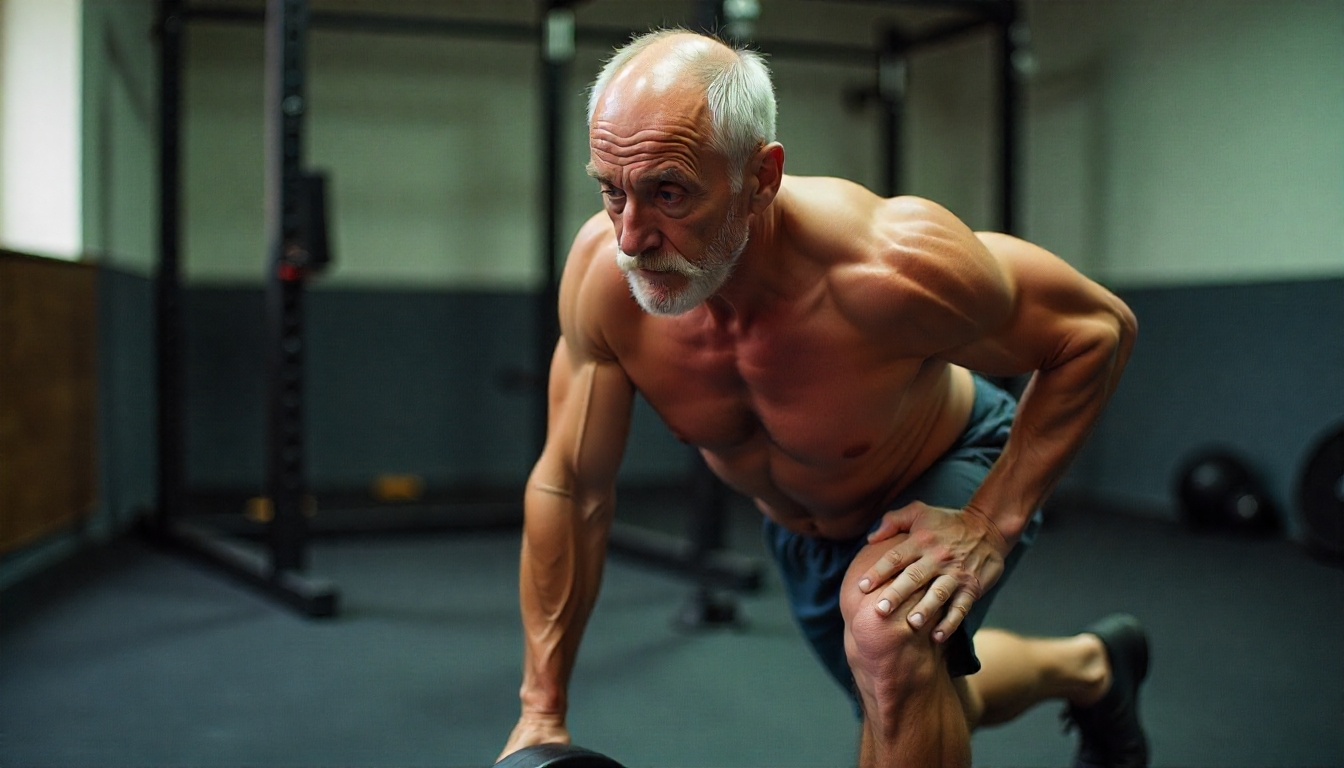
At FreakToFit we never stop insisting on the importance of good muscle toning work to “keep birthdays under control.” Now we also know, after having read the study published in Phisiology.org, that the loss of muscle inherent to age and accentuated by inactivity is much more pronounced in the legs than in the arms.(1)
The graph shows the distribution of muscle mass according to the study carried out on 468 men and women between 18 and 88 years old. The line that represents the lower body has a much steeper decline than the one that represents the upper body.

The best remedy, and practically the only one, is regular physical activity , emphasizing intense sessions with high loads and somewhat contradicting the prescriptions of doctors who generally prescribe “walking and swimming.”(2)
Related Stories
 Prone Cobra Exercise : How To Do?
 Rotary Torso Machine : Features, Benefits & How To Use
If you start from a terrible physical condition, walking and swimming are enough to start, but otherwise more intense activity is needed for the stimulus to do anything significant to maintain muscle mass.(3)
Furthermore, if intense activities are not carried out, bone density decreases even more with age, a problem that is especially significant in women due to the hormonal decline of maturity.

Why Legs Loss of Muscle Increases With Age?
There is much involvement of the lower body muscles, particularly the quadriceps, glutes and hamstrings, in standing, walking, climbing the stairs, and balance. When muscles lose strength with age, they are exposed to less mechanical load, which increases muscle loss (sarcopenia).
Contrary to the arms which are utilized on a regular basis during the routine activities, the legs need to be commendably strengthened to retain the mass and power.

The reason why it is no longer enough to walk alone.
Walking is a great activity in regards to cardiovascular exercise and joint mobility, although most adults do not get enough resistance to maintain muscle mass or bone density. Lacking any resistance or load, muscles and bones are not provided with the signal so that they could adapt and remain strong.
That is why strength-based exercises (squats, step-ups, lunges, resistance machines, or weighted exercises) become very important particularly after the middle age.

Relationships between Strength of Legs, Balance, and Longevity.
Good legs are directly connected with:
- Increased coordination and balance.
- Less risk of falls and bone fractures.
- Improved posture and gait.
- Increased autonomy in the later life.
It is also clear that persons who have stronger lower-body muscles get less mortality risk and have enhanced functional capacity during their aging.

Why You Need to Build Stronger Legs as You Get Older?
In the majority of adults, particularly after 40 years of age:
- For lower body it is best to do 2-3 strength sessions per week.
- The exercises are to be progressive and to increase resistance.
- To avoid injury, it is necessary to have proper form and supervision.
Even brief and concentrated sessions can prove to be a difference maker when undertaken regularly.
Personal Experience.
I am Mark Reynolds, 58 — Retired Architect & Recreational Cyclist, Austin, Texas, as I entered my late 50s, I noticed climbing stairs and getting up from chairs felt harder than before. I had always stayed active, but I rarely focused on leg strength. After adding squats, lunges, and leg presses to my routine twice a week, my balance improved, knee discomfort reduced, and everyday movements felt easier and more stable.
“Building leg strength gave me back confidence, balance, and independence in my daily life.”

Expert Opinion.
As per Dr. Laura Mitchell, PhD — Exercise Physiologist & Aging Specialist, leg strength is one of the most important predictors of healthy aging. As we grow older, muscle loss occurs more rapidly in the lower body, which directly affects balance, mobility, and fall risk. Resistance training that targets the legs—such as squats, step-ups, and controlled load-bearing exercises—helps preserve muscle mass, maintain bone density, and support long-term independence. Even two focused strength sessions per week can make a measurable difference in functional ability as we age.
Frequently Asked questions.
1. Why then do legs get weaker than the arms as we grow old?
Inactivity affects leg muscles more and is the one that needs more resistance to preserve strength. Unless they are specifically trained, they are lost at a greater rate than upper-body muscles.
2. Do older adults maintain leg strength by walking?
Walking is good in endurance and most of the times is not sufficient to keep away muscle and bone deterioration. The stimulus needed to maintain the mass of leg muscles is achieved through strength training.
3. What are the most appropriate exercise of the legs among old people?
Squats, sit-to-stands, step-ups, lunges, leg-presses, and exercises on a resistance band are some of the best exercises to do safely.
4. Will bone density grow in old age through strength training?
Yes. Bone remodeling is provoked by weight-bearing and resistance exercises, which are especially necessary to prevent the loss of bone density during menopause.
5. Is 50 or 60 too late to lift heavy weights?
Strength training is not only safe but most of the time very helpful at any age when it is done with the right technique, gradual progress and under professional supervision.
Bottom Line.
Aging does not necessarily result in loss of leg strength: mainly it is a consequence of inactivity and lack of training stimulus. As much as mild exercises such as walking and swimming are a good starting point, routine and suitably rigorous strength training is needed to preserve muscle mass, bone density, balance and independence as we age.
The use of strong legs today is an investment that will suit the mobility, confidence and quality of life in the coming years.
+3 Sources
FreakToFit has strict sourcing guidelines and relies on peer-reviewed studies, educational research institutes, and medical organizations. We avoid using tertiary references. You can learn more about how we ensure our content is accurate and up-to-date by reading our editorial policy.
- Skeletal muscle mass and distribution in 468 men and women aged 18–88 yr; https://journals.physiology.org/doi/pdf/10.1152/jappl.2000.89.1.81
- Fluorescent oxidation products and risk of coronary heart disease: a prospective study in women; https://pubmed.ncbi.nlm.nih.gov/24103570/
- Extensive heterotopic ossification after suspensory cortical fixation of acute distal biceps tendon ruptures; https://pubmed.ncbi.nlm.nih.gov/22738753/