











































 Workout

 Meditation


 Podcast
 E-book


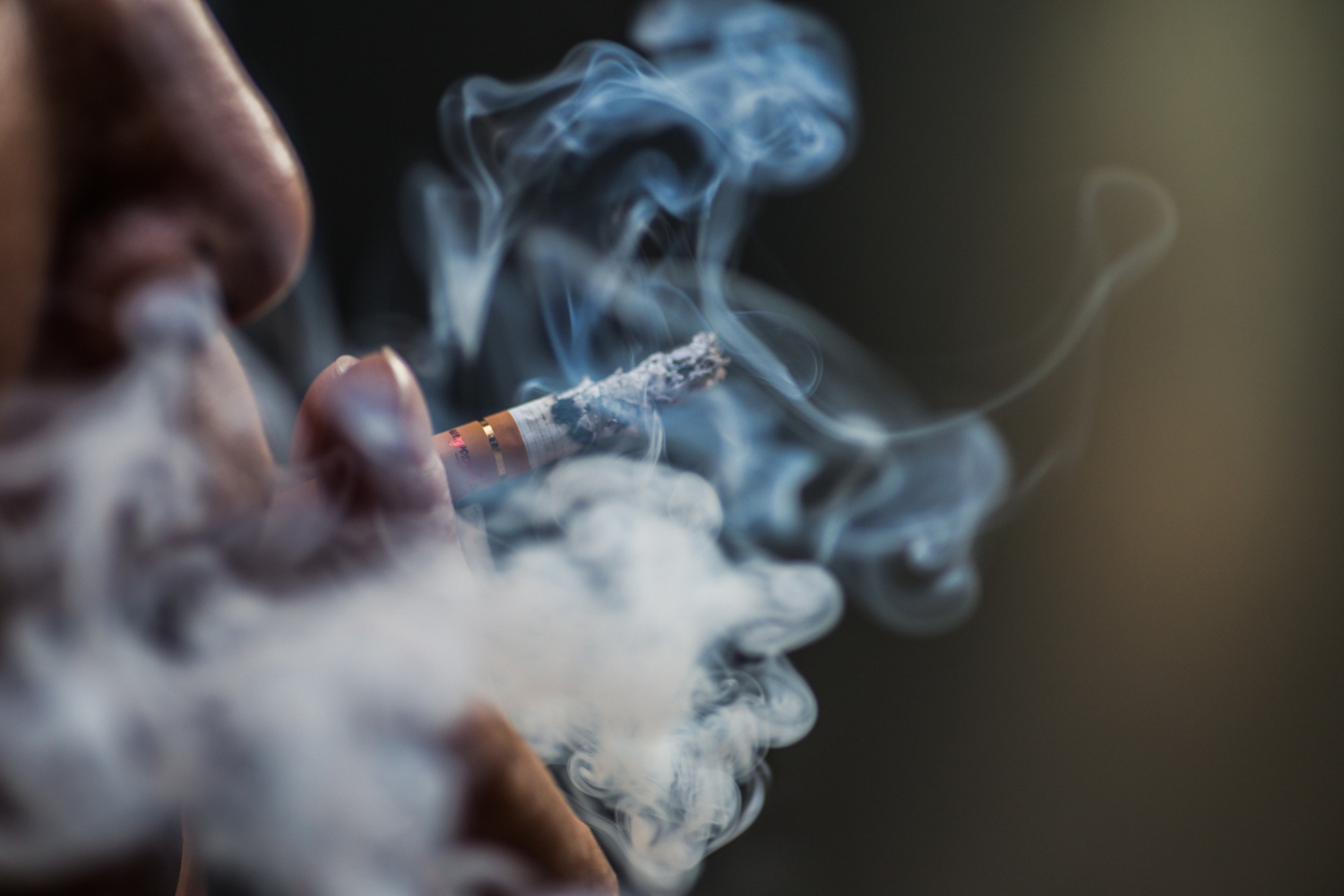
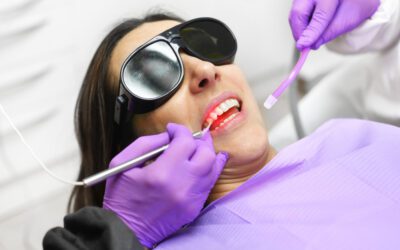
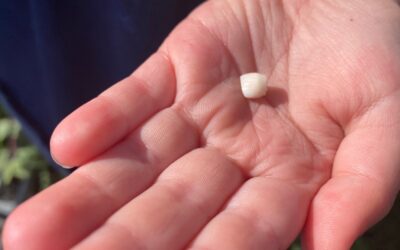
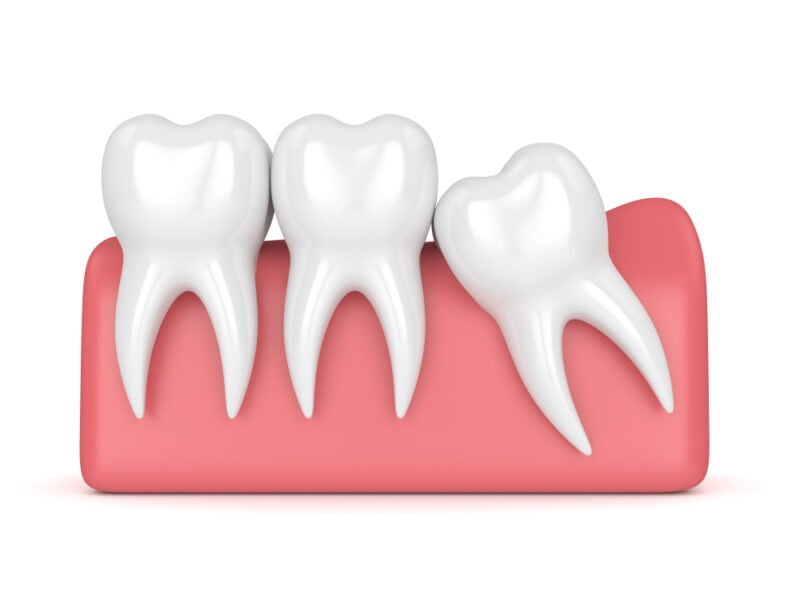
Wisdom tooth extraction is a popular procedure in dental work which relates to removal of one or more of the wisdom teeth normally because they pose a risk of causing dental infections. Once the extraction is done, the incision can be sewed shut using stitches to ensure an adequate healing process takes place.
Among the items that a person should take into account when using the recovery period a feature is smoking which interferes with the healing process. When smoking is done after wisdom tooth removal with sutures, this practice affects the process of recovery unfavorably and promotes the occurrence of complications.
Related Stories
 8 Proven Health Benefits of Cold Air Intake That You Must Know
 Is Crying a Sign of Weakness?
In the paper at hand, we will examine the time at which smoking is permissible after the operation of the extraction of the wisdom teeth with the subsequent stitches and why it is important to act in accordance with the prescription of a dentist in order to achieve a quick and effective result.
When Can You Smoke After Wisdom Tooth Extraction With Stitches?
After the wisdom tooth is extracted and sutures put on, one should not smoke. Smoking may slow down healing and contribute to such complications as infection, a dry socket, and prolonged bleeds.
Due to the suction generated during smoking, the blood clot appearing in the extraction area may be loosened, which gives rise to such an unpleasant outcome as dry socket, that is, the exposure of bare underlying bone.
Also, the reaction of the chemicals in cigarettes on the surgery location may irritate the location; it interferes with the flow of blood, and also it prevents the normal healing reaction of the body.
To experience good healing and reduce the possibility of developing complications, smoking should be avoided at least 48 or 72 hours after extraction.
Is It safe to smoke after wisdom tooth extraction with stitches?
It is recommended that, after a stitched wisdom tooth extraction, a patient should not smoke at least within 48-72 hrs.
Smoking may interfere with the healing process by slowing the amount of blood reaching a surgical wound and also injecting the mouth with dangerous chemicals, which may speed up the possibility of getting an infection, thus slowing down the healing process.
The clot of blood which has been formed in the socket, may also get loosened by the suction during the inhalation of smoke and it then causes a very painful state of the dry socket.
The dentist should be followed and one should avoid smoking until the stitches are taken off and the healing process is properly distanced.
Importance of dentist’s recommendations for a successful recovery After Wisdom Tooth Extraction.
After wisdom tooth extraction accompanied by stitches, it is imperative to follow the advice of the dentist in order to have a quick and successful recovery. The following are the reasons why:
1 Preventing infection.
The dentist will give guidelines on the proper ways of taking care of the surgery site. Adherence to these measures like maintaining the area clean and avoiding consumption of certain foods, among others, will ensure greatly the minimal risk of the infection.
Wounds are prone to infections which will slow down the healing process and result in more pain and more complications.(1)
2 Promoting proper healing.
The dentist can prescribe certain mouth rinses or antibiotics that would prevent infection and ensure proper healing. In observing these guidelines the surgical site will recover efficiently eliminating pain and a possible development of complications.(2)
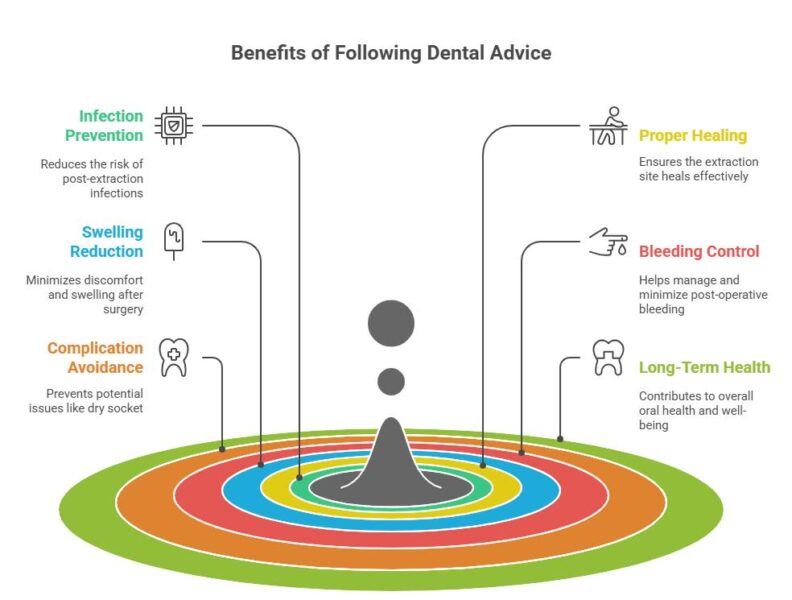
3 Reducing swelling and discomfort.
Swelling and discomfort occur usually after the extraction. The dentist might recommend the use of ice packs, prescription pain medications or even the over the counter analgesics to get rid of such symptoms.
By following these pieces of advice, one will be able to control the pain, lower swelling, and improve the recovery.
4 Minimizing bleeding.
The removal of wisdom teeth is bound to lead to bleeding particularly where the stitches are used. The dentist will give guidelines on ways in which bleeding can be controlled e.g. by biting on gauze or tea bags. Adherence to these recommendations will aid in reducing the bleeding as well as accelerating the healing process.(3)

5 Avoiding complications.
Compliance with the dentists recommendations minimizes the occurrence of such complications as dry socket, infection, or slow healing.
However, patients can reduce the chances of these complications by observing the precautionary measures and abide with the post operative prescriptions and with proper care, achieve successful recovery.
6 Promoting long-term oral health.
The reasons why wisdom extraction is conducted are usually to avoid future dental problems; overcrowding or impaction. Patients can help themselves by adhering to the dental suggestions of the dentist thereby helping in their oral health in the long run.
A rapid and effective reconstruction implies no more dental issues in the future and a healthier mouth.
Expert Opinion: Dr. R. Anand, Oral & Maxillofacial Surgeon.
Q: After a wisdom tooth extraction with stitches, how long should one not smoke?
Dr. Anand: At least 72 hours, but if it were up to me, I’d say 5-7 days. The first few days are really important for the blood clot to form and get firm. If you smoke during that time, the cigarette can move the clot and you will have a dry socket, which is very painful.
Q: Why is smoking detrimental to the recovery process?
Dr. Anand: Nicotine tightens the blood vessels, so less oxygen is delivered and the healing process is slower. Moreover, the smoking inhalation can also remove the clot and then the bone will be left unprotected.
Q: What if vaping or chewing tobacco?
Dr. Anand: They have the same risks – as far as nicotine or any method that involves suction is concerned. But if you really need to, take a nicotine patch instead, however, stay away from oral contact.
Q: Any tips from the doctor to the patients?
Dr. Anand: Obey your dentist’s aftercare instructions to the letter – soft food, no straws, no smoking – and maybe think about making a permanent decision to quit smoking during this period.
“Strictly following your dentist’s post-extraction instructions — including avoiding smoking, maintaining oral hygiene, and managing swelling — is the single most effective way to prevent infection, dry socket, and ensure fast, complication-free healing.””

Frequently Asked Questions.
1 When could I possibly have a smoke after a wisdom tooth removal if there is a stitch?
The absolute shortest time that should pass between the event and the smoking of a cigarette is 48 to 72 hours (2-3 days). Though the 5-7 days of smoking hiatus would still be a good idea and even more depending on your case.
2 Suppose I only smoke once, and that is at 24 hours after the removal of my wisdom tooth. What would be the consequence?
Smoking within 24 hours after surgery greatly increases the risk of the clot being dislodged hence dry socket, delayed healing, and infection. Some sources mention 24 h as an absolute minimum time, and still, it is not recommended to smoke.
3 If there are stitches, would that change the smoking advice?
Sure- fabric normally signifies that the removal was more complicated (an impacted tooth, surgical removal). It means that the area that has been operated on is most likely the one that needs more time to stabilize, so it is better to delay smoking for a longer time. (Though the exact ‘extra time’ is not always quantified in the guidelines.)
4 What if I smoke through a straw, use a hookah, or vape? What if I chew tobacco?
The same or even greater caution should be taken- if the action involves suction/inhalation, heat, or irritants (vaping, hookah, chewing tobacco, even nicotine gum) which can dislodge the clot or slow the process of healing Healthline+1
5 What if it is a dry socket, how will I know it is one?
Dry socket main symptoms are: very painful bursting that arises a couple of days after the extraction, bad smelling or tasting in the oral cavity, the bone is visible in the socket, if the healing that is usually expected is prolonged. And smokers are in a significantly higher risk than others.
6 Could I possibly smoke a nicotine patch and be safe?
Of course, nicotine patches (or other nicotine replacement therapy) would be better than smoking right after a tooth extraction, as they do not require suction, heat, or smoke introduction into the mouth.
Though, it is still nicotine which narrows the blood vessels and may prolong healing to some extent, so do talk to your dentist first.
7 If not sooner, then is the extraction site considered “healed enough” to smoke safely?”
Healing and its processes vary from person to person and from day to day. The majority of sources claim that the risk of dry socket is the highest within the first 3-5 days.
After that period, the risk is significantly lower, though a complete week or more will be the safest option.
Bottom Line.
The post-operative instructions will be given by your dentist or oral surgeon when stitches are used in wisdom tooth extraction and are very essential.
It is highly recommended to avoid smoking within 72 hours because it would facilitate adequate healing and the likelihood of developing complications like infection or dry socket. Cigarette smoke chemicals may slow down the flow of blood and healing process.
Also, simply the act of smoking can develop suction or pressure in the mouth that will knock the blood clot loose and interfere with the healing location.
It is advisable to avoid smoking until the time you have completely healed and your dental expert has cleared you without any problem. Always remember, it is best to refer to your dentist or oral surgeon to give you guidelines according to your case.
+3 Sources
FreakToFit has strict sourcing guidelines and relies on peer-reviewed studies, educational research institutes, and medical organizations. We avoid using tertiary references. You can learn more about how we ensure our content is accurate and up-to-date by reading our editorial policy.
- Compliance of postoperative instructions following the surgical extraction of impacted lower third molars: A randomized clinical trial; https://pmc.ncbi.nlm.nih.gov/articles/PMC4393987/
- Smoking as a Risk Factor for Dry Socket: A Systematic Review; https://pubmed.ncbi.nlm.nih.gov/35877395/
- Quality of life after extraction of mandibular wisdom teeth: A systematic review; https://pmc.ncbi.nlm.nih.gov/articles/PMC9486647/