











































 Workout

 Meditation


 Podcast
 E-book

The Fast Facts
- The nervous system plays a central role in regulating stress responses, emotional stability, and overall physical health.
- Based on these factors, the tool calculates a nervous system balance score.
- The Free Dysregulated Nervous System Trauma Analyzer helps estimate possible nervous system dysregulation patterns using self-reported indicators such as stress levels, sleep quality, anxiety frequency, and physical tension.

The nervous system plays a central role in regulating stress responses, emotional stability, and overall physical health.
- What Is Nervous System Dysregulation?
- Why Nervous System Regulation Matters?
- How the Free Nervous System Analyzer Works?
- Free Dysregulated Nervous System Trauma Analyzer
- Your Nervous System Balance Score
- How to Use the Free Dysregulated Nervous System Trauma Analyzer?
- Benefits of Using the Free Nervous System Analyzer.
The Free Dysregulated Nervous System Trauma Analyzer helps estimate possible nervous system dysregulation patterns using self-reported indicators such as stress levels, sleep quality, anxiety frequency, and physical tension.
This tool provides a simple overview of nervous system balance and stress load.
Related Stories
 Free Yoga Form Checker Webcam AI Version– Improve Your Yoga Alignment
 Chipotle Nutrition Calculator – Calculate Calories Before You Order
What Is Nervous System Dysregulation?
Nervous system dysregulation occurs when the body’s stress-response system becomes overactive or imbalanced.
The nervous system consists of two primary components:
Sympathetic nervous system – responsible for the “fight or flight” response.
Parasympathetic nervous system – responsible for relaxation and recovery.
When these systems are out of balance, individuals may experience symptoms such as anxiety, fatigue, and persistent stress.
Why Nervous System Regulation Matters?
Maintaining a balanced nervous system can support:(1)
• emotional resilience.
• stress management.(2)
• sleep quality.
• overall well-being.
Understanding stress patterns may help individuals develop strategies for improving nervous system balance.
How the Free Nervous System Analyzer Works?
The analyzer evaluates several indicators related to nervous system activity.
These include:
Sleep Quality.
Poor sleep may indicate elevated stress activation.
Stress Levels.
Chronic stress can affect nervous system balance.
Anxiety Frequency.
Frequent anxiety may indicate heightened nervous system arousal.
Energy Levels.
Low energy may reflect stress-related fatigue.
Muscle Tension.
Physical tension is commonly associated with stress activation.
Based on these factors, the tool calculates a nervous system balance score.
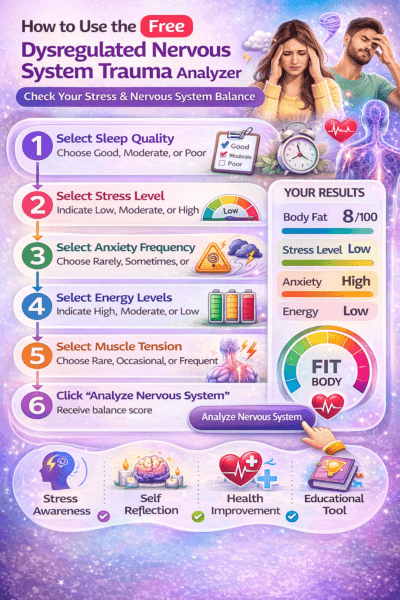
Free Dysregulated Nervous System Trauma Analyzer
Estimate possible nervous system stress patterns
Your Nervous System Balance Score
Enter your information above.
How to Use the Free Dysregulated Nervous System Trauma Analyzer?
Step 1: Select Sleep Quality.
Choose whether your sleep quality is good, moderate, or poor.
Step 2: Select Stress Level.
Indicate whether your stress level is low, moderate, or high.
Step 3: Select Anxiety Frequency.
Choose how often you experience anxiety or overthinking.
Step 4: Select Energy Levels.
Indicate your general daily energy level.
Step 5: Select Muscle Tension.
Choose how frequently you experience muscle tension or restlessness.
Step 6: Click Analyze Nervous System.
The analyzer will generate your nervous system balance score.
Benefits of Using the Free Nervous System Analyzer.
Stress Awareness.
Helps individuals recognize patterns of stress and nervous system activation.
Self-Reflection.
Encourages reflection on lifestyle habits affecting mental well-being.
Quick Assessment.
Provides instant feedback without complex testing.
Educational Tool.
Helps users understand the role of nervous system balance in overall health.
Tips for Supporting Nervous System Balance.
You may help regulate your nervous system by:
• practicing breathing exercises.
• engaging in regular physical activity.
• improving sleep quality.
• practicing mindfulness or meditation.
• maintaining balanced nutrition.
+2 Sources
FreakToFit has strict sourcing guidelines and relies on peer-reviewed studies, educational research institutes, and medical organizations. We avoid using tertiary references. You can learn more about how we ensure our content is accurate and up-to-date by reading our editorial policy.
- Autonomic Nervous System Correlates of Posttraumatic Stress Symptoms in Youth: Meta-Analysis and Qualitative Review; https://pmc.ncbi.nlm.nih.gov/articles/PMC8858870/
- Autonomic dysfunction in posttraumatic stress disorder indexed by heart rate variability: a meta-analysis; https://pmc.ncbi.nlm.nih.gov/articles/PMC7525781/