


















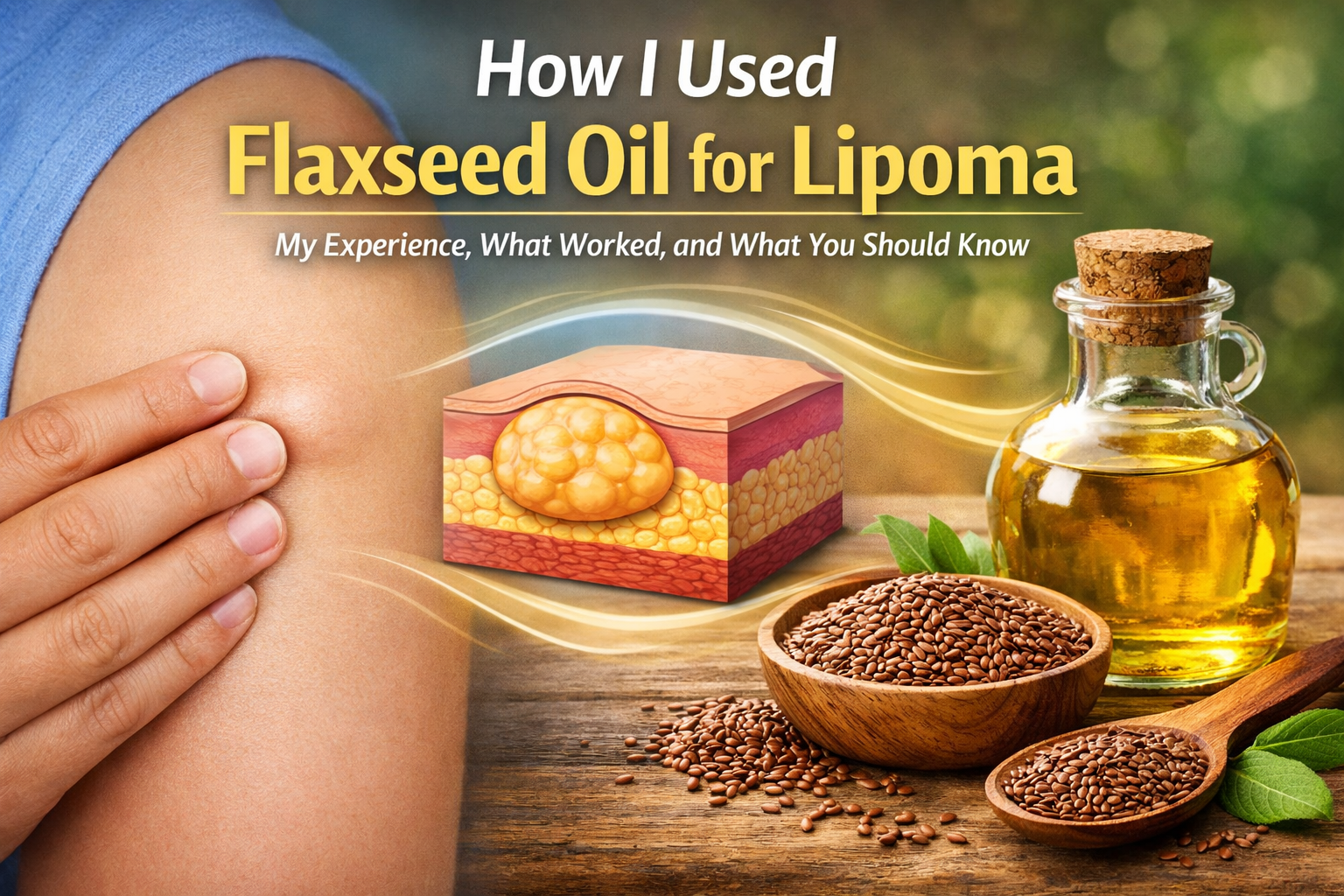
The first time I noticed that I had a small and soft lump under my skin, I was simultaneously concerned and curious. Upon meeting a health professional, he informed me that it is a lipoma, or a benign fatty growth. Although it was not a dangerous case, I was not absolutely willing to disregard it or to choose surgical removal immediately.
It was then that I began to look into non-invasive, supportive options. One of the solutions, which were repeatedly mentioned during the traditional discussion of wellness and in the contemporary research on nutrition, was flaxseed oil. It is said to be the source of antioxidant properties and high levels of omega-3 fatty acids, as well as have anti-inflammatory qualities, which made it appear like a worthy addition to my routine.(1)
In this article, I will tell you how I personally used the flax seed oil in treating lipoma, what happened to me in the long run and what you can really expect in case you decide to use it. It is founded on my personal experience and thorough research and emphasis on safety and evidence-based knowledge.
Understanding Lipoma Before Trying Any Remedy.
Before attempting to cure by means of medicine or surgery, it is better to understand what it is and what it is not.<|human|>What is Lipoma Before trying any remedy Before attempting to cure, either by medicine or surgery, it is well to know what it is and is not.


I did not go out there without first understanding what I was getting into.
A lipoma is simply a mass of fat cells that creates an extremity soft movable mass under the skin. It is usually:
- Non-cancerous.
- Slow-growing.
- Painless in most cases.
The most important lesson that I learned was as follows: the lipomas are structural fat deposits. It is that nothing can be melted at once by oil or any topical agent. This knowledge enabled me to take flaxseed oil realistically.
The other significant lesson that I acquired at this stage is that lipomas may differ with each individual. There are those that stay unchanged over years and there are those that can increase gradually over the years. Such inconsistency helped me to understand that it is better to follow changes without haste rather than rush to get immediate outcomes. I also learnt to pay more attention to my body and started to notice even minor changes more closely.

Why I Chose Flaxseed Oil?
I decided on flax, flaxseed oil because I had research on the nutritional and therapeutic profile of flax. What stood out to me were:
- Omega -3 fatty acids (particularly ALA) are increased.
- Anti-inflammatory effects.(2)
- Help lipid metabolism.
- Possible application in the enhancement of skin and tissue health.
Although it has not been proven that flaxseed oil is able to eliminate lipomas, the overall benefits on the body made me think of it as the supportive method, but not as the curative one.

Moreover, the flaxseed oil is also known to be beneficial in heart health, hormonal balance and digestion. The fact that it helps in the general wellbeing made me more confident in using it as a part of my daily routine. I did not want one that only addressed a single issue- I wanted something that could be able to address my body in general.
How I Used Flaxseed Oil (My Routine)?
I used a combination strategy, internal consumption and external application. Consistency was my priority.
1. Internal Use: Everyday Consumption.
This was the most significant element of my routine.
What I did:
- Consumed 1-tablespoon of cold-pressed flax seed oil daily.
- ate it in the morning on no bread.
- At times combined it with lukewarm water or used in smoothies.
Why I did this?
The Omega-3 fatty acids aid in controlling inflammation and may aid in metabolism of fats in the body. I aimed to enhance internal balance and not to concentrate on the surface.
This step turned out to be routine and not a job. I observed that when you get used to it and something becomes a part of your routine then consistency is easy. This played a major role in ensuring continuity of results and progressive changes.
2. Application to External Regions: Massage Application.
I also applied flaxseed oil on the lipoma.
My method:
- Cleaned the area thoroughly
- Took some drops of flax seed oil.
in case of pain gently massaged the area 510 minutes. - Repeated this twice daily
What I focused on:
The oil was not as significant as the massage itself. It contributed to the enhancement of blood flow in the region and softened the tissue.
I also ensured that I did not pressure a lot. Massage was better than hard rubbing. After some time, this habit became soothing and I had included it in my self-care routine.
3. Duration and Consistency.
I did this routine approximately between 8-10 weeks.
I did not miss days and I did not unnecessarily take higher dosage. I remained steady and not pushy.
Among what I have learnt here is the fact that natural methods take time. Results are not instantaneous like in the case of medications or procedures. Being disciplined without immediate transformation assisted me in being grounded.
What I Noticed Over Time?
I would like to be absolutely open on this as this is where most articles are deceptive.
Slight Change in Texture.
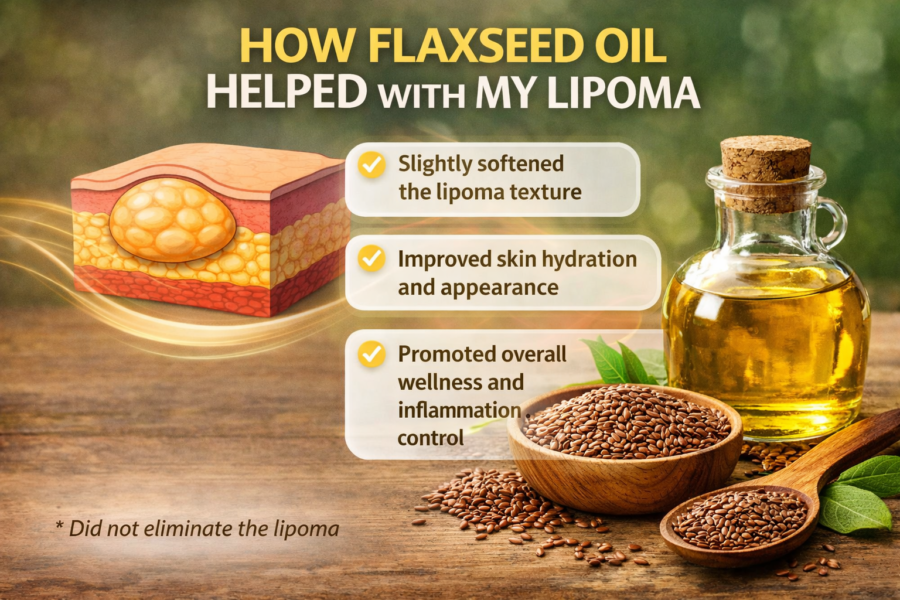
After some time the lipoma became a bit softer. It was not so solid as I had initially noticed it.
Improved Skin Quality.
The area surrounding the lipoma softened and got more moist. The overall skin texture was seen to improve.
Better Overall Wellness.
Because I was taking flaxseed oil every day, I had general effects such as increased digestion and decreased inflammation in my body.
My energy levels as well as general lightness also improved. Though these might not be directly associated with the lipoma, they still supported the fact that my body was responding positively to the changes.
What Did NOT Happen?
Trust and clarity is also important.
- The lipoma did not disappear
There was no drastic reduction in size. - Results were slow and subtle
Flaxseed oil failed to serve as a medicine. It acted more as a support measure.
This knowledge made me not to be disappointed. I did not count the size reduction, but rather based the measurement on the overall progress and continuity.
Why Flaxseed Oil May Help (Scientific Perspective)?
What I have heard is that flaxseed oil acts indirectly and does not attack the lipoma itself.
1. Anti-Inflammatory Action.
The omega-3 fatty acids can lessen inflammation that can relieve tension around the lipoma.
2. Lipid Metabolism Support.
Flax seed oil can help in the process the body uses fat, but not the direct breaking down of fat deposits like lipomas.
3. Skin and Tissue Health.
Application to the top enhances the hydration and elasticity in the area rendering it softer.
Moreover, flaxseed oil also has antioxidants that can potentially protect tissues against oxidative stress. This helps to make the skin healthier and the tissues more resilient as time goes by.
Safety Precautions I Followed.
I did not take this as a non-hazardous cure.
- I also got my diagnosis confirmed by a doctor.
I was just using high-quality cold-pressed flax oil. - I did not boil the oil (boiling is not allowed)
I pre-tested this on skin with a patch. - I checked whether there was an abnormal change.
I also made sure that I kept the oil in a cool dark environment in order to preserve its quality. Flax seed oil is heat and light sensitive and when stored incorrectly, it can lose its efficiency.
When You Should Not Rely on This Method Alone?
In some cases, home remedies are inapplicable.
Do not use flax seed oil exclusively when:
- The lump grows rapidly.
- It becomes painful.
- It feels hard or irregular.
- There are several lumps that come out of the blue.
In these instances medical examination is necessary.
I cannot emphasize enough on this, self-diagnosis may be dangerous. Certainly, never attempt any home-based method without the advice of a professional.
How I Used Flaxseed Oil for Lipoma – My Personal Experience.
As Jessica Booth, a health and wellness writer with over a decade of experience, I’ve always been drawn to simple, research-backed lifestyle approaches—so when I explored flaxseed oil for lipoma, I focused on consistency, realistic expectations, and supporting overall body health rather than looking for a quick fix.
“I found that using flaxseed oil consistently supported my overall skin and wellness, even though it didn’t eliminate the lipoma.”

My Honest Reflection.
The flaxseed oil use altered my perspective on the situation. I did not seek to have a quick fix, but rather I wanted to have my body supported in a balanced manner.
It helped me:
- Stick to an exercise program.
- Enhance general external and internal health.
- Keep my expectations in check.
It also made me patient and aware. I was brought into closer touch with my body and more aware of what I eat each day.
Is Flaxseed Oil Worth Trying?
Yes, in my experience, but only as a helping technique.
It is useful for:
- Improving skin condition.
- Helping to maintain general inflammation.
Additional nutritional support to a healthy lifestyle.
It is not:
- Established therapy of lipoma.
- An alternative to medical treatment.
- A guaranteed solution.
Additional Tips That Helped Me.
I also did some lifestyle changes, with flaxseed oil:
- Eating more whole foods.
- Less junk food processed and high in fat.
- Stayed hydrated.
- Engaged in physical exercise.
Stress management and good sleep were also addressed by me. These are important in general health and might have an indirect effect on the ways the body responds to such conditions.
Final Thoughts.
When you have an issue with a lipoma, it is only normal to seek non-invasive alternatives. Flaxseed oil may be included in that adventure, but one should remain informed and realistic.
In my case, it was not about ridding myself of the lipoma overnight. It meant having a slow and steady method to help my body to balance itself.
When you finally decide to use flaxseed oil, be patient, alert and advised by a proper medical practitioner.
It is that equilibrium that counts.
+2 Sources
FreakToFit has strict sourcing guidelines and relies on peer-reviewed studies, educational research institutes, and medical organizations. We avoid using tertiary references. You can learn more about how we ensure our content is accurate and up-to-date by reading our editorial policy.
- A comprehensive review of the health benefits of flaxseed oil in relation to its chemical composition and comparison with other omega-3-rich oils; https://pubmed.ncbi.nlm.nih.gov/37464425/
- Short-term flaxseed oil, rich in omega 3, protects mice against metabolic damage caused by high-fat diet, but not inflammation; https://pubmed.ncbi.nlm.nih.gov/36706930/