

















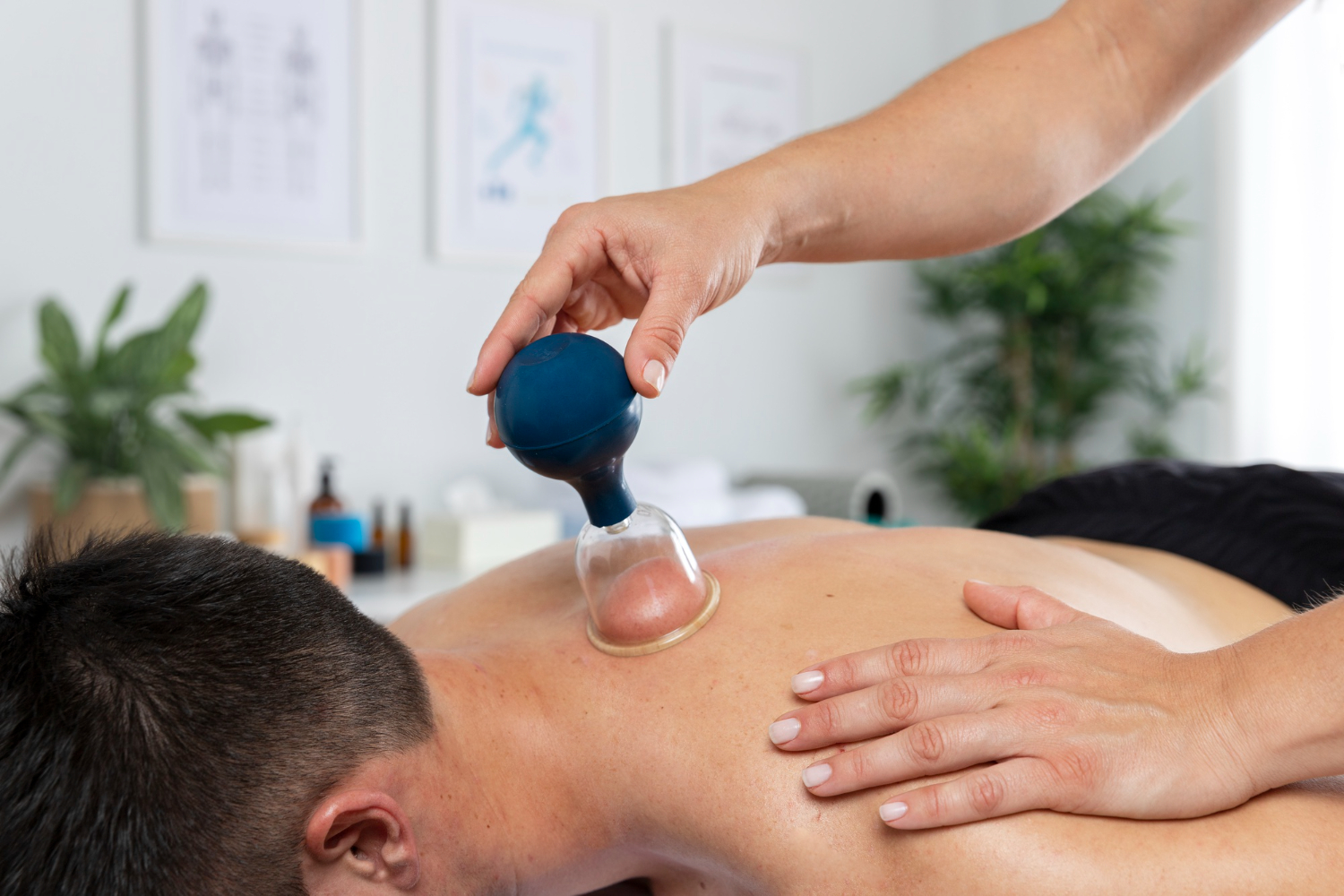
Cupping therapy is a traditional complementary health practice in which cups are placed on the skin and suction is created inside them. The negative pressure pulls the skin and superficial tissues upward into the cup.
Cupping has been used in several traditional medical systems, including practices originating in China and the Middle East. Modern cupping may use glass, silicone, plastic or other types of cups.(1)
There are two broad forms:
Dry cupping: The skin is not pierced. Suction is created mechanically or through another method.
Related Stories
 6 Best Yoga Poses to Boost Immunity Power
 How Yoga Helped Me Recover From the Discomfort and Strain of Wearing Masks Daily
Wet cupping: The skin is pierced so that blood enters the cup. Because this involves blood exposure and a greater risk of infection and bleeding, wet cupping should not be attempted at home.
For home use, the safer approach to consider is dry cupping with a commercially manufactured, reusable or single-person cup system, provided the person has no contraindications and follows the manufacturer’s instructions.
It is also important to understand what cupping can and cannot do. Research suggests that cupping may help some types of pain, but overall evidence remains limited and varies considerably between conditions and studies. The U.S. National Center for Complementary and Integrative Health (NCCIH) states that most cupping research is of low quality and that evidence for pain relief is not strong enough to draw firm conclusions.
How Does Cupping Therapy Work?
When suction is created inside a cup, pressure inside the cup becomes lower than the pressure outside it. This causes the skin and superficial tissues to rise into the cup.
The visible circular marks afterward are usually caused by changes in small blood vessels close to the skin rather than by a conventional bruise caused by an impact.
Some proposed explanations for cupping include:
- Local mechanical stimulation
- Temporary changes in blood flow
- Stimulation of sensory nerves
- Changes in muscle tension
- Modulation of pain perception
- Relaxation and placebo/contextual effects
However, not all proposed mechanisms have been scientifically established.
It is therefore better to say that cupping creates mechanical stimulation and may influence pain perception and local tissue responses, rather than claiming that it “removes toxins,” “cleanses the blood,” or “pulls disease out of the body.”
Those claims are not supported by strong clinical evidence.
Is Cupping Therapy at Home Safe?
Dry cupping can be relatively low risk when performed appropriately, but “natural” or “non-invasive” does not mean completely risk-free.
Possible side effects include:
- Temporary circular skin marks
- Bruising
- Skin tenderness
- Mild soreness
- Itching
- Skin irritation
- Burns if heat/fire is used
- Blisters
- Infection
- Persistent skin discoloration
- Scarring
NCCIH specifically warns that cupping can cause persistent discoloration, scars, burns and infections. Rare serious complications have also been reported.
For this reason, fire cupping and wet cupping are poor choices for unsupervised home treatment.
A home user should preferably avoid any technique involving flames, needles, bloodletting or skin cutting.
What Is the Difference Between Dry and Wet Cupping?
Dry Cupping.
Dry cupping involves suction without cutting or piercing the skin.
This is the form most suitable for people who want to explore cupping at home.
It can be performed using:
- Silicone cups
- Manual suction cups
- Pump-operated cups
Because the skin remains intact, the risk of bloodborne infection is considerably lower than with wet cupping, although skin irritation and infection can still occur.
Wet Cupping.
Wet cupping involves making small skin punctures after suction and allowing blood to enter the cup.
This creates additional risks involving:
- Bleeding
- Infection
- Scarring
- Blood contamination
- Transmission of bloodborne pathogens
NCCIH notes that contaminated cupping equipment can transmit bloodborne diseases such as hepatitis B and C when equipment is not properly sterilized.
Wet cupping should not be performed at home.
Potential Benefits of Cupping Therapy.
Cupping is often promoted for many different health conditions. However, the quality of evidence varies considerably.
1. May Help With Some Types of Pain.
Pain is the area where cupping has received some of the most research attention.
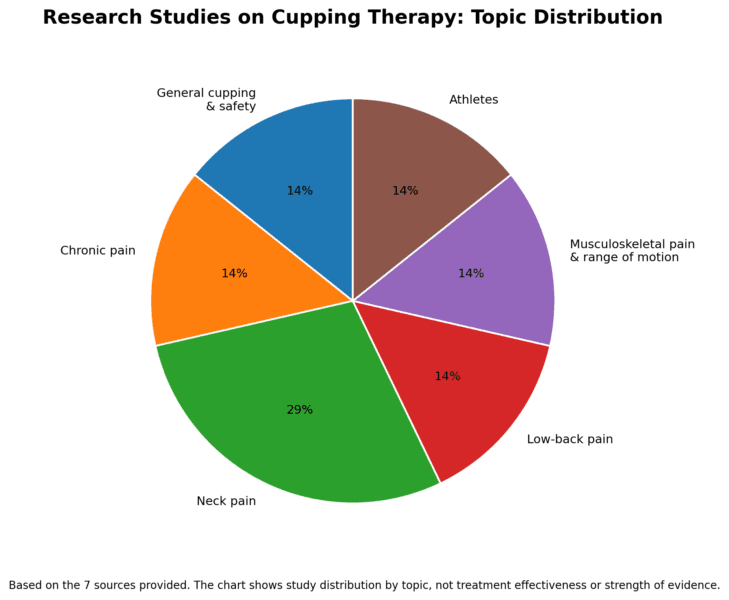
A systematic review and meta-analysis of 18 randomized trials involving 1,172 people with chronic pain found that cupping produced short-term improvements compared with no treatment. However, the benefit was not statistically significant when compared with sham cupping for pain intensity. The researchers also highlighted considerable heterogeneity and risk of bias.(2)
This distinction is important.
If cupping performs better than doing nothing, that does not necessarily mean the suction itself is responsible for the entire effect.
Expectation, attention, relaxation, touch and other contextual factors may contribute.
2. Neck Pain.
Research has examined cupping for chronic neck pain.
A systematic review of 18 randomized controlled trials reported reductions in neck pain and improvements in function compared with some control groups. However, the authors emphasized that the overall quality of evidence was low and that more rigorous research was needed.(3)
A newer 2026 systematic review and meta-analysis included nine randomized controlled trials involving 401 participants with chronic neck pain. It reported improvements in pain and functional disability, while also noting methodological limitations in several studies.(4)
This newer evidence is encouraging, but it still does not establish cupping as a replacement for standard medical or physiotherapy care.
3. Lower Back Pain.
Cupping is frequently used for back discomfort.
Earlier meta-analysis research found improvements in pain and disability scores compared with control treatment, but the authors noted substantial heterogeneity and risk of bias.(5)
NCCIH similarly reports that some research has found possible benefits for low-back pain, while emphasizing uncertainty because studies have used different forms of cupping and several had methodological limitations.
Therefore, cupping may be considered a complementary option for some people with nonspecific musculoskeletal pain, rather than a proven cure for the underlying cause.
4. Muscle Tightness and Mobility.
Some people use dry cupping around muscles that feel tight or stiff.
A systematic review of 21 randomized trials involving 1,049 participants found low-quality evidence suggesting that dry cupping may reduce pain associated with chronic neck and nonspecific low-back pain and may influence range of motion. However, the authors could not make definitive conclusions because evidence quality ranged from low to moderate.(6)
If you have persistent muscle tightness, however, the underlying cause matters.
Strength training, mobility work, physiotherapy, sleep, recovery and appropriate activity modification may be more important for long-term improvement.
Cupping Therapy at Home for Beginners.
If you are considering home cupping, start with dry cupping rather than wet cupping.
Choose a commercially manufactured cup designed for home use.
Silicone cups are popular because they do not require flames or complicated equipment.
Before starting, read the instructions supplied with your particular cups.
A general dry-cupping session may look like this:
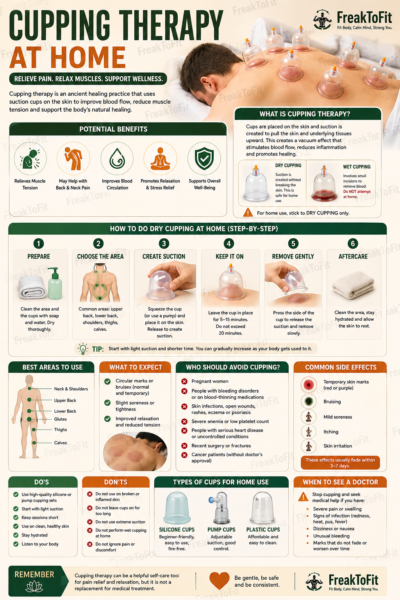
Step 1: Choose a Suitable Area.
Common areas include large muscle regions such as the:
- Upper back
- Lower back
- Thighs
- Calves
- Shoulders
Avoid delicate areas and regions with visible veins, open wounds or irritated skin.
Step 2: Clean the Skin.
Wash the area with mild soap and water and dry it thoroughly.
Clean the cups according to the manufacturer’s instructions before use.
Step 3: Apply a Small Amount of Suitable Lubricant if Needed.
For moving or “gliding” cups, a suitable skin lubricant may reduce friction.
For stationary silicone cups, lubrication may not be necessary.
Follow the instructions provided with the equipment.
Step 4: Create Gentle Suction.
Place the cup against the skin and create mild suction.
You should feel pulling or pressure, but not severe pain.
Beginners should avoid trying to create the strongest possible suction.
More suction does not necessarily mean better results.
Step 5: Keep the Session Conservative.
Leave stationary cups in place only for the period recommended by the equipment manufacturer or a qualified practitioner.
There is no evidence that keeping cups on for excessively long periods produces better results.
If the skin becomes intensely painful, numb or excessively swollen, remove the cup.
Step 6: Remove the Cup Carefully.
Break the seal gently rather than pulling aggressively on the skin.
The area may appear red, purple or darker afterward.
This can be a normal temporary response to suction.
Can You Do Cupping on Yourself?
Yes, dry cupping can be performed on some accessible areas, but self-treatment has limitations.
The back, particularly the central and upper regions, can be difficult to see and reach accurately.
Trying to place cups in areas you cannot clearly observe may increase the risk of:
- Excessive suction
- Poor positioning
- Skin injury
- Leaving cups in place too long
If you want cupping on your back or another difficult-to-reach region, professional assistance is preferable.
Where Should You Not Use Cupping?
Avoid applying cups directly over:
- Open wounds
- Cuts
- Infected skin
- Active rashes
- Severe eczema
- Psoriasis flares
- Fresh scars
- Varicose veins
- Major visible blood vessels
- Areas with impaired sensation
- Areas with significant swelling
- Recently injured tissue
NCCIH notes that cupping can worsen eczema or psoriasis in some circumstances.
Avoid applying cups over the front of the neck or directly over sensitive anatomical structures unless specifically advised by a qualified professional.
Can You Use Cupping on Your Face?
Facial cupping is marketed extensively for cosmetic purposes.
However, facial skin is thinner and more delicate than many areas of the body.
Strong suction can cause:
- Bruising
- Broken capillaries
- Skin irritation
- Swelling
- Pigmentation changes
If someone chooses facial cupping, it should be approached much more cautiously than cupping a large muscle area.
There is also insufficient high-quality evidence to claim that home facial cupping permanently removes wrinkles, reshapes the face or produces a lasting lifting effect.
Cupping Therapy for Weight Loss.
Cupping is sometimes advertised as a weight-loss or fat-burning treatment.
There is not sufficient high-quality evidence to support cupping as a weight-loss method.
Cupping does not replace:
- Calorie management
- Adequate protein intake
- Resistance training
- Cardiovascular activity
- Sleep
- Sustainable dietary habits
Temporary changes in skin appearance after cupping should not be interpreted as fat loss.
If weight management is your goal, evidence-based nutrition and exercise strategies should remain the foundation.
Does Cupping Remove Toxins?
This is another common marketing claim.
There is no strong evidence that cupping “pulls toxins” out of the body.
Your body already has highly developed systems for processing and eliminating metabolic waste, primarily involving organs such as the liver and kidneys.
The discoloration caused by cupping is not evidence that toxins have been removed.
Therefore, health content should avoid statements such as “dark marks mean more toxins” or “cupping detoxifies your blood.”
Can Cupping Improve Blood Circulation?
Cupping creates localized suction and changes the appearance and blood flow of superficial tissues.
It is reasonable to describe this as a local mechanical effect.
However, claims that cupping substantially improves whole-body circulation or “cleans blocked blood vessels” are not established.
People with circulation problems should not attempt to self-treat the underlying condition with cupping.
Who Should Avoid Cupping Therapy?
Home cupping may not be appropriate for everyone.
Speak with a healthcare professional before using cupping if you have a significant medical condition or take medications that affect bleeding.
Extra caution is appropriate for people with:
- Bleeding disorders
- Conditions causing easy bruising
- Significant anemia
- Blood-clotting problems
- Active skin disease
- Poor wound healing
- Serious cardiovascular disease
- Severe circulation problems
- Recent surgery
- Significant neurological problems affecting sensation
Pregnancy also warrants professional advice rather than self-treatment.
Cleveland Clinic advises avoiding cupping during pregnancy because researchers know relatively little about its effects in pregnancy.
Cupping and Blood-Thinning Medicines.
People taking anticoagulant or antiplatelet medications should be particularly cautious.
Even dry cupping can cause bruising, while wet cupping deliberately breaks the skin and causes bleeding.
If you take medication such as an anticoagulant, do not assume that a complementary treatment is automatically safe.
Discuss it with your healthcare professional first.
Cupping Therapy for Athletes.
Some athletes use cupping after training because they believe it helps with recovery or muscle soreness.
Research in athletes has produced mixed findings.
A systematic review of randomized trials involving amateur and professional athletes found that some studies reported improvements in perceived pain, disability or range of motion, but most trials had unclear or high risk of bias, and safety reporting was inadequate. The researchers concluded that there was insufficient evidence to make an explicit recommendation for or against cupping in athletes.(7)
Therefore, cupping should not replace:
- Adequate sleep
- Hydration
- Nutrition
- Progressive training
- Recovery days
- Appropriate physiotherapy
- Treatment of an actual injury
Common Mistakes When Doing Cupping at Home.
Using Too Much Suction.
Stronger suction is not automatically better.
Leaving Cups on Too Long.
Longer sessions can increase skin irritation and bruising.
Using Fire at Home.
Fire cupping creates an unnecessary burn risk for inexperienced users.
Attempting Wet Cupping.
Wet cupping involves blood and requires appropriate infection-control procedures. It should not be performed as a DIY treatment.
Cupping Over Injured Skin.
Cupping can aggravate damaged or inflamed skin.
Sharing Cups Without Proper Disinfection.
Blood or body-fluid contamination can create infection risks.
Treating a Serious Symptom With Cupping Alone.
Cupping should never delay diagnosis of unexplained or persistent symptoms.
NCCIH recommends not using complementary practices as a substitute for proven conventional treatment or as a reason to postpone medical evaluation.
What Should You Expect After Cupping?
The most obvious result is often circular discoloration.
The marks can range from light pink to dark purple depending on factors such as:
- Suction strength
- Duration
- Individual skin characteristics
- Location
- Previous exposure to cupping
The marks generally fade over time.
You may also experience mild soreness or tenderness.
However, severe pain is not an expected goal.
Seek medical attention if you develop:
- Increasing redness
- Severe swelling
- Pus or yellow discharge
- Fever
- Severe or worsening pain
- Significant blistering
- A serious burn
- Unusual bleeding
Cleveland Clinic specifically advises contacting a healthcare professional for burns, extreme pain or signs of skin infection such as redness, tenderness or yellow discharge.
How Often Can You Do Cupping at Home?
There is no universally established evidence-based schedule for home cupping.
Research studies have used widely different protocols, making it difficult to identify an optimal frequency.
Instead of repeatedly cupping the same area, allow the skin to recover completely.
If you are using cupping repeatedly for chronic pain, it is more useful to assess whether the overall condition is actually improving rather than simply increasing the frequency of sessions.
Persistent pain deserves proper assessment.
Cupping vs Massage.
Massage and cupping are not the same intervention.
Massage uses manual pressure and movement to manipulate soft tissue.
Cupping creates suction through a cup.
Some practitioners combine the two by moving lubricated cups over the skin.
There is insufficient evidence to say that one is universally superior.
The appropriate choice depends on the person’s symptoms, preferences, medical history and treatment goals.
Cupping vs Physiotherapy.
For musculoskeletal problems, physiotherapy may address factors that cupping does not directly address, such as:
- Strength
- Joint mobility
- Movement patterns
- Balance
- Exercise tolerance
- Functional limitations
- Progressive rehabilitation
Cupping may be considered a complementary modality in some situations, but it should not automatically replace rehabilitation.
For persistent pain, an individualized exercise and rehabilitation plan may be much more important for long-term function.
Is Cupping Therapy Scientifically Proven?
The most accurate answer is partially, but not conclusively.
There is research suggesting potential short-term benefits for certain pain conditions, especially musculoskeletal pain.
For example, a systematic review of dry cupping found low-quality evidence for pain reduction in chronic neck and nonspecific low-back pain, with moderate-quality evidence for some functional outcomes in chronic neck pain.
Another meta-analysis of chronic pain found benefits compared with no treatment but not significant benefits compared with sham cupping for pain intensity.
NCCIH summarizes the overall situation by stating that some research suggests cupping may reduce pain, but most research is low quality and there is insufficient high-quality evidence for many other conditions.
This is why responsible health information should use phrases such as “may help,” “some studies suggest,” and “evidence remains limited” rather than claiming that cupping definitely treats disease.
Frequently Asked Questions.
1. Is cupping therapy at home safe?
Dry cupping can be relatively low risk when performed correctly on appropriate areas, but bruising, burns, skin irritation and infection can occur. Wet cupping and fire cupping should not be attempted as DIY procedures.
2. How long should you leave a cup on?
Follow the instructions for your specific device and use conservative suction. There is no strong evidence that leaving cups on for excessively long periods provides greater benefits.
3. Does cupping hurt?
Cupping usually creates a pulling or tight sensation. Mild tenderness afterward can occur, but severe or escalating pain is a reason to stop.
4. Why does cupping leave dark circles?
The suction can cause temporary changes in small blood vessels near the skin, producing circular discoloration.
5. Can cupping remove toxins?
There is no strong scientific evidence that cupping removes toxins from the body.
6. Can I do wet cupping at home?
It is not recommended. Wet cupping involves skin puncture and blood exposure, creating additional bleeding and infection risks.
7. Can cupping help back pain?
Some studies suggest short-term improvements in pain and disability, but evidence quality is limited and inconsistent.
8. Can cupping cure chronic pain?
No. Cupping should not be described as a cure. It may provide short-term symptom relief for some people, but persistent pain requires appropriate assessment and treatment.
9. Can I exercise after cupping?
Light activity may be comfortable for many people, but if the treated area is sore or heavily marked, allowing it to recover before intense exercise is sensible.
10. Should I use cupping instead of medical treatment?
No. Cupping is best considered a complementary approach when appropriate. It should not delay diagnosis or replace evidence-based treatment.
Final Takeaway.
Cupping therapy at home can be considered a complementary wellness practice, but it should be approached cautiously and realistically. Dry cupping is considerably more suitable for home use than wet cupping because it does not intentionally break the skin.
Research suggests that cupping may provide short-term relief for some musculoskeletal pain, particularly neck and low-back pain, but the overall evidence has important limitations.
For home users, safety should come before intensity. Use appropriate equipment, gentle suction, avoid damaged or diseased skin, never attempt wet cupping as a DIY procedure, and do not use cupping to postpone medical evaluation.
Most importantly, cupping should be viewed as one possible complementary tool—not a detox treatment, weight-loss method, cure, or replacement for medical care, physiotherapy, exercise or appropriate pain management.
+3 Sources
FreakToFit has strict sourcing guidelines and relies on peer-reviewed studies, educational research institutes, and medical organizations. We avoid using tertiary references. You can learn more about how we ensure our content is accurate and up-to-date by reading our editorial policy.
- Cupping; https://www.nccih.nih.gov/health/cupping
- Cupping for Patients With Chronic Pain: A Systematic Review and Meta-Analysis; https://pubmed.ncbi.nlm.nih.gov/31982686/
- Is cupping therapy effective in patients with neck pain? A systematic review and meta-analysis; https://pubmed.ncbi.nlm.nih.gov/30397006/
- Effect of cupping therapy on chronic neck pain: A systematic review and meta-analysis of randomized controlled trials; https://pubmed.ncbi.nlm.nih.gov/42105092/
- The effect of cupping therapy for low back pain: A meta-analysis based on existing randomized controlled trials; https://pubmed.ncbi.nlm.nih.gov/28946531/
- Dry cupping for musculoskeletal pain and range of motion: A systematic review and meta-analysis; https://pubmed.ncbi.nlm.nih.gov/33218554/
- Effects of Cupping Therapy in Amateur and Professional Athletes: Systematic Review of Randomized Controlled Trials; https://pubmed.ncbi.nlm.nih.gov/29185802/