















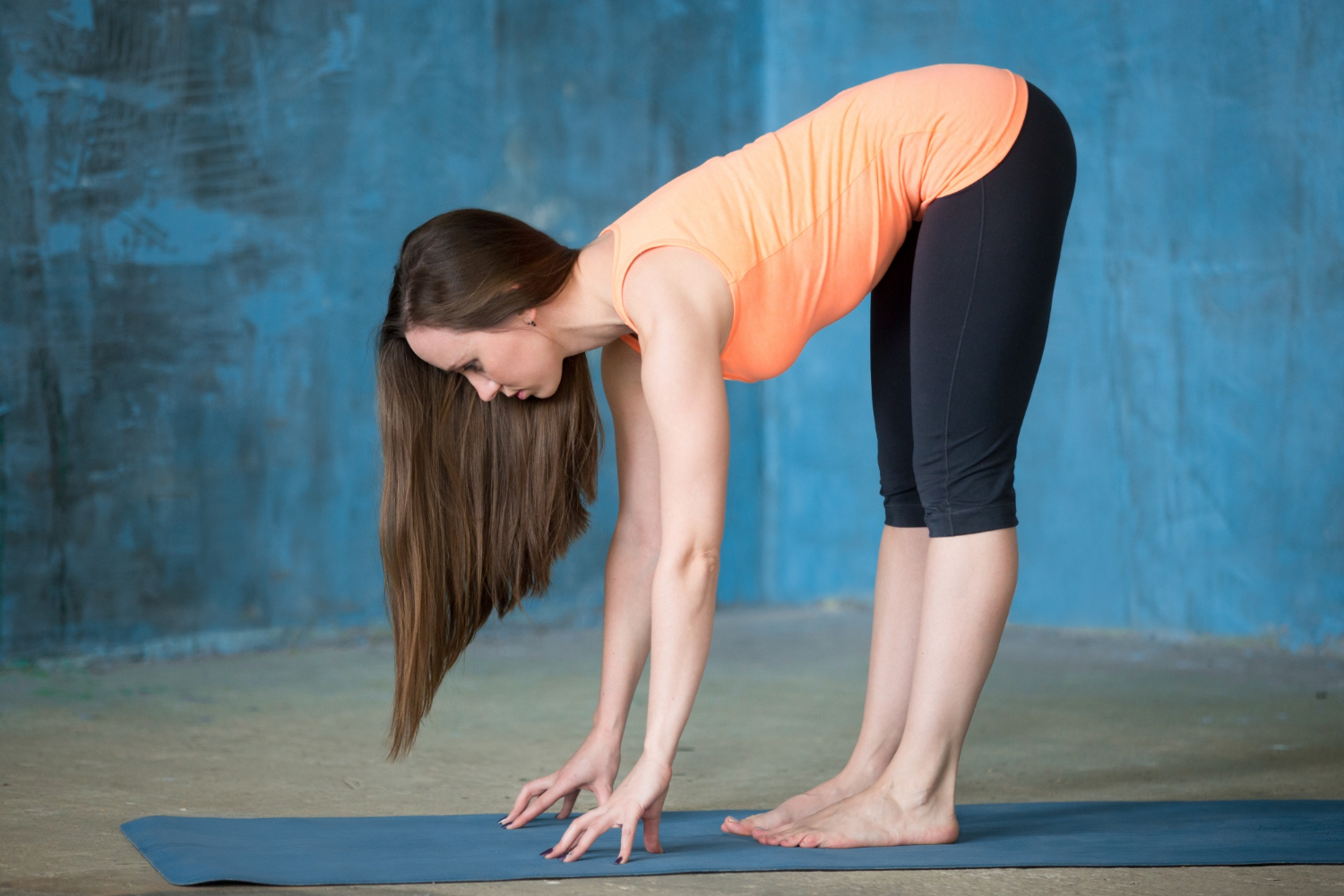
Standing Pigeon Pose is a one-legged balance in which one leg acts as the support while the other leg is externally rotated and crossed over it.
A typical version looks like this:
- Stand upright.
- Shift your weight onto one leg.
- Lift the opposite foot.
- Cross the lifted ankle over the opposite thigh.
- Flex the lifted foot.
- Bend the standing knee slightly.
- Keep the chest lifted or hinge forward, depending on your ability.
- Use a wall or other stable support if necessary.
The posture is sometimes taught as a standing variation of Figure Four Pose or Standing Figure Four. It shares some of the hip-positioning characteristics of floor-based Pigeon, but the demands on balance are different.
Traditional Pigeon Pose, or Eka Pada Rajakapotasana, is generally considered an intermediate posture and involves substantial hip mobility.
Related Stories
 Yoga for Diverticulitis: Safe Poses, Benefits & Precautions
 5 Magical Quantum Exercise With The Power of Yoga
Standing Pigeon Pose vs Pigeon Pose.
Although the names are similar, these poses are not identical.
Standing Pigeon.
- Performed standing
- Requires single-leg balance
- Uses the crossed leg as a figure-four position
- Can be modified easily with a wall
- Primarily challenges balance, hip mobility and lower-body control
Floor Pigeon.
- Performed on the floor
- Places one leg forward and one behind
- Requires considerable hip external rotation
- Can place substantial demands on the front knee
- Often used as a deeper hip-opening posture
Standing Pigeon can therefore be a useful alternative for people who don’t want to place the front knee into the position required by floor-based Pigeon.
However, standing does not automatically make the pose safe for everyone.
How to Do Standing Pigeon Pose?
Perform the pose slowly rather than trying to achieve a deep stretch immediately.
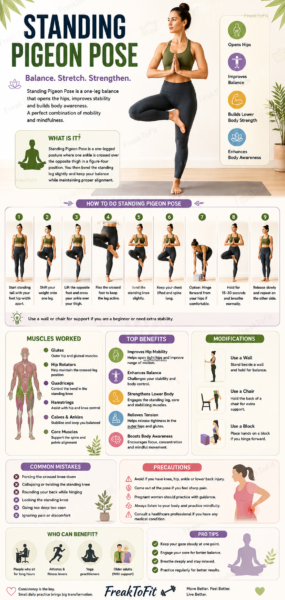
Step 1: Start Standing.
Stand with your feet approximately hip-width apart.
Distribute your weight evenly between both feet.
Keep your spine tall and your shoulders relaxed.
Step 2: Shift Your Weight.
Gradually transfer your weight onto your left foot.
Keep your left knee slightly soft rather than aggressively locking it.
Step 3: Lift Your Right Leg.
Lift the right foot from the floor.
Bring your right ankle across your left thigh, just above the knee.
Your right knee should move outward naturally.
Step 4: Flex the Crossed Foot.
Flex your right foot.
This helps you maintain active control of the crossed leg rather than allowing it to become completely passive.
Step 5: Bend the Standing Leg.
Slowly bend your left knee.
Only go as far as you can maintain good control.
You should not feel sharp pain in your knee or hip.
Step 6: Keep the Chest Upright.
Beginners can remain upright.
This is often the easiest version because it places less demand on balance.
Step 7: Add a Forward Hinge.
If your balance is good, gently hinge your torso forward from the hips.
Keep your spine long.
You can place your hands on your thighs, a block, or the floor depending on your flexibility.
Step 8: Hold and Breathe.
Take several slow breaths.
Avoid holding your breath.
Step 9: Return Slowly.
Straighten the standing leg gradually.
Uncross the lifted leg and return both feet to the floor.
Repeat on the opposite side.
How Long Should You Hold Standing Pigeon Pose?
There is no scientifically established ideal duration for this specific pose.
For beginners, 15–30 seconds per side is a reasonable starting point.
As balance improves, you may gradually increase the duration.
Quality is more important than holding the pose for a long time.
If your standing knee begins shaking excessively or your alignment deteriorates, come out of the posture.
What Muscles Does Standing Pigeon Work?
Standing Pigeon involves several muscle groups.
Gluteal Muscles.
The crossed leg places the hip into flexion and external rotation, creating a stretch and loading sensation around the gluteal region.
Hip Rotators.
The external rotators of the crossed hip are involved in maintaining the position.
Hip Flexors.
The standing position requires the hip flexors and surrounding muscles to help stabilize the pelvis.
Quadriceps.
The quadriceps of the standing leg help control knee flexion and maintain stability.
Hamstrings.
The hamstrings contribute to hip and knee control, particularly as you hinge forward.
Calves and Ankles.
Because you are standing on one leg, the ankle and calf muscles continuously make small adjustments to keep you balanced.
Core Muscles.
The abdominal and trunk muscles help stabilize the torso and pelvis.
This is one reason Standing Pigeon can feel substantially more challenging than a similar seated stretch.
Benefits of Standing Pigeon Pose.
1. May Improve Hip Mobility.
Standing Pigeon takes the lifted hip into a position involving flexion and external rotation.
The posture can therefore provide a useful mobility challenge for the hip.
Traditional and instructional sources describe Pigeon as a hip-opening posture that stretches structures around the outer hip and hip flexors.
However, the actual range available will vary substantially between individuals.
2. Challenges Balance.
Unlike floor-based Pigeon, Standing Pigeon requires you to stabilize your body on one leg.(1),(2)
This makes balance a major component of the exercise.
Your:
- Foot
- Ankle
- Calf
- Knee
- Hip
- Core
all contribute to maintaining stability.
3. Encourages Lower-Body Control.
Standing on one leg while the opposite hip is positioned asymmetrically requires coordination.
This can help make you more aware of how your pelvis, knee and foot are positioned.
4. Stretches the Outer Hip.
The crossed-leg position can create a noticeable stretch around the outer hip and gluteal region.
This is one of the reasons variations of Figure Four and Pigeon are commonly included in mobility routines.
5. Works the Supporting Leg.
The standing leg isn’t simply holding you upright.
It actively works to control the knee and hip while the ankle responds to small changes in balance.
6. Can Be Useful After Long Periods of Sitting.
People who spend substantial portions of the day sitting may enjoy hip-focused mobility exercises.
Standing Pigeon can be incorporated into a movement break, provided the pose is comfortable and appropriate for the individual.
It should not be described as “undoing” the effects of sitting, but it can provide a change from prolonged seated positioning.
7. Develops Body Awareness.
Because several joints have to coordinate simultaneously, the pose can encourage awareness of:
- Foot pressure
- Knee position
- Hip rotation
- Pelvic alignment
- Breathing
- Trunk position
8. Can Be Part of a Yoga Balance Sequence.
Standing Pigeon can be placed after simpler standing balances such as:
- Tree Pose
- Warrior III
- Standing Knee-to-Chest
- Eagle Pose
It can also be followed by gentle standing or seated stretches.
Does Standing Pigeon Improve Flexibility?
It may contribute to flexibility when practiced consistently as part of a broader mobility routine, but one posture should not be expected to dramatically transform flexibility on its own.
Hip range of motion varies considerably between people.
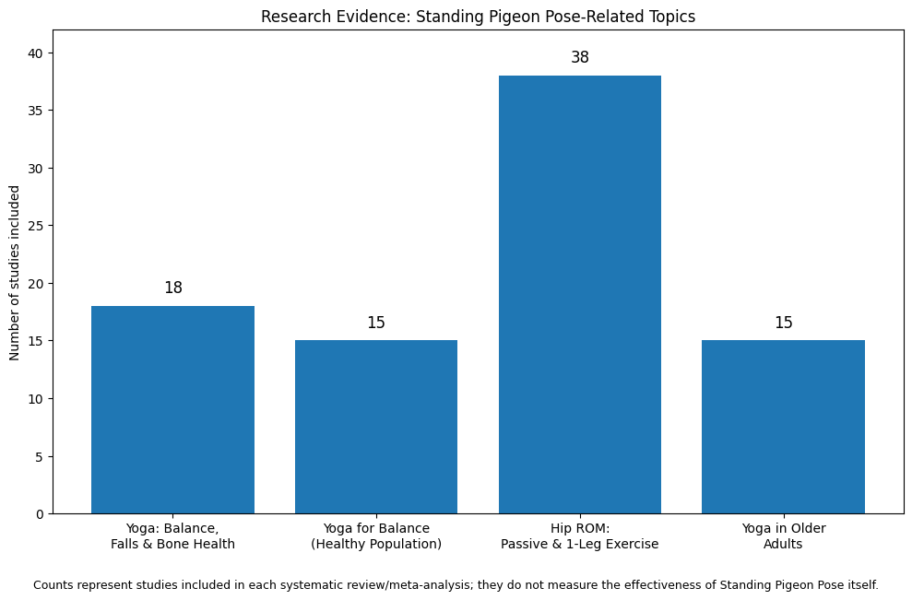
A systematic review and meta-analysis of hip range of motion found meaningful differences between individuals and across different movement conditions, reinforcing that hip mobility is influenced by multiple factors.(3)
Your flexibility may depend on:
- Joint anatomy
- Muscle and tendon properties
- Previous injuries
- Training history
- Age
- Activity level
- Neuromuscular control
Therefore, don’t compare your Standing Pigeon to another person’s version.
Standing Pigeon for Beginners.
Standing Pigeon can be challenging if you’re new to balance work.
You don’t need to perform the deepest version.
Beginner Variation.
Stand beside a wall.
Place one hand on the wall.
Shift your weight onto the opposite leg.
Cross the other ankle over your thigh.
Stay upright.
Hold for several breaths.
This removes some of the balance challenge and lets you concentrate on the hip position.
Standing Pigeon With a Chair.
A sturdy chair can provide another useful modification.
Stand behind or beside the chair.
Use the backrest for support.
Perform the crossed-leg position while keeping your torso upright.
This can be particularly helpful if you’re unsure about your balance.
Make sure the chair is stable and doesn’t slide.
Standing Pigeon With a Yoga Block.
If you want to hinge forward but cannot comfortably reach the floor, place a yoga block underneath your hands.
This can help you maintain a longer spine instead of rounding your back to reach the floor.
The goal isn’t to get your hands to the floor.
The goal is to maintain control while working within a comfortable range.
Standing Pigeon Without Bending the Standing Knee.
A very accessible version is to keep the standing leg relatively straight.
Cross the ankle over the opposite thigh and remain upright.
This reduces the depth of the posture.
It’s a good option when you want to practice the hip position without adding a deep squat.
Common Mistakes in Standing Pigeon.
Mistake 1: Forcing the Crossed Knee Down.
Your crossed knee does not need to reach a particular height.
Let it move naturally.
Forcing it downward can increase stress around the hip or knee.
Mistake 2: Collapsing the Standing Knee.
Avoid allowing the standing knee to fall inward.
Try to keep it aligned comfortably with the direction of your foot.
Mistake 3: Rounding the Back.
If you hinge forward, initiate the movement from the hips.
Don’t simply collapse your chest toward the floor.
Mistake 4: Locking the Standing Knee.
A forcibly locked knee can make balance more difficult.
Keep the knee controlled and responsive.
Mistake 5: Twisting the Pelvis.
Try to maintain a relatively stable pelvis rather than rotating the entire body to compensate for limited hip mobility.
Mistake 6: Going Too Deep.
Depth is not the goal.
A smaller range performed with control is usually more useful than a deep position performed poorly.
Mistake 7: Ignoring Pain.
A stretching sensation around the hip can be normal.
Sharp, pinching, or joint pain is a reason to stop and reassess the position.
Is Standing Pigeon Safe for the Knees?
It can be appropriate for some healthy people, but the position places the crossed leg into hip and knee flexion.
People with existing knee problems should be particularly cautious.
General Pigeon Pose guidance recommends avoiding the posture or modifying it when knee or hip problems are present.
If you have a history of:
- Meniscus injury
- Knee ligament injury
- Significant arthritis
- Recent knee surgery
- Hip injury
- Significant ankle injury
consult an appropriate healthcare professional before adding this posture to your routine.
Standing Pigeon and Knee Pain.
You should not interpret knee pain during Standing Pigeon as evidence that the pose is “working.”
If your crossed knee hurts, try:
- Moving the ankle closer toward the standing hip
- Reducing the depth
- Staying upright
- Using a wall
- Switching to a gentler hip mobility exercise
If pain persists, discontinue the exercise.
Standing Pigeon and Hip Pain.
A mild stretch around the outer hip may occur.
However, a sharp or deep pinching sensation in the front of the hip is not something to push through.
Reduce the range or choose an alternative exercise.
Persistent hip pain should be assessed rather than repeatedly stretched.
Can Standing Pigeon Help Sciatica?
You may see Pigeon Pose marketed as an exercise for sciatica.
However, sciatica can have different causes, and symptoms that travel from the lower back into the buttock and leg should not automatically be attributed to “tight hips.”
Traditional yoga sources sometimes describe Pigeon as helpful for sciatica, but this does not establish that the pose treats the underlying causes of sciatic nerve pain.
If you have diagnosed or suspected sciatica, especially if you have weakness, numbness or worsening symptoms, obtain appropriate medical or physiotherapy guidance before using deep hip stretches.
Standing Pigeon for Lower Back Tightness.
Standing Pigeon primarily targets hip positioning rather than the lower back.
Some people may feel that improving hip mobility changes how their lower body and pelvis move, but that does not mean the pose directly treats lower-back pain.
If you have persistent back pain, don’t assume that tight hips are necessarily the cause.
Standing Pigeon and Balance.
Balance is one of the most distinctive features of this posture.
Your body constantly makes small adjustments.
For example, the ankle may make subtle movements while the hip and trunk compensate for changes in your center of mass.
This makes Standing Pigeon more than a flexibility exercise.
It is also a single-leg balance and motor-control exercise.
Standing Pigeon for Athletes.
Athletes may use the pose as part of a broader mobility or yoga routine.
It can be particularly relevant for activities that require:
- Hip mobility
- Single-leg stability
- Body awareness
- Controlled movement
However, athletes should not use a static stretch as a substitute for sport-specific strength and conditioning.
A footballer, runner, dancer, or martial artist may have completely different mobility and stability requirements.
Standing Pigeon Before or After Exercise?
It depends on how you perform it.
A gentle, dynamic preparation is generally more appropriate before demanding activity than a long, intense static hold.
Standing Pigeon can be more suitable as part of a cool-down or flexibility session, particularly when held comfortably without forcing the range.
Before sports, consider dynamic movements such as:
- Leg swings
- Walking lunges
- Hip circles
- Controlled squats
- Dynamic Figure Four movements
Choose your warm-up based on the activity that follows.
Standing Pigeon as Part of a Yoga Routine.
A simple sequence could look like:
- Cat-Cow
- Downward-Facing Dog
- Low Lunge
- Standing Knee-to-Chest
- Tree Pose
- Standing Pigeon
- Warrior III
- Gentle forward fold
- Savasana
This sequence gradually introduces mobility and balance before the more demanding one-leg posture.
Preparatory Exercises for Standing Pigeon.
If the pose feels difficult, try these first.
Figure Four on Your Back.
Lie down and cross one ankle over the opposite thigh.
This allows you to explore the hip position without balancing.
Standing Knee-to-Chest.
Stand near a wall.
Lift one knee toward the chest while maintaining balance.
Tree Pose.
Practice standing on one leg while keeping the other foot against the ankle or lower leg.
Low Lunge.
This can introduce hip-extension demands for the rear leg.
Hip Circles.
Perform slow, controlled circles to explore comfortable hip movement.
Standing Pigeon vs Figure Four Stretch.
These are closely related.
The standing Figure Four is essentially the same basic crossed-leg arrangement commonly used in Standing Pigeon.
The difference often comes down to teaching style and emphasis.
Some instructors use “Standing Figure Four” for the upright version and “Standing Pigeon” for the version involving a deeper squat or forward fold.
There is no need to become overly concerned about terminology.
Focus on the movement and alignment.
Standing Pigeon vs Half Pigeon.
Half Pigeon is performed on the floor.
The front leg is bent while the opposite leg extends behind.
Standing Pigeon keeps you upright and uses one leg as the supporting limb.
If your goal is to work on balance, Standing Pigeon has an obvious advantage.
If your goal is a more supported hip stretch, a floor-based variation may be easier for some people.
Neither is universally “better.”
Can You Do Standing Pigeon Every Day?
If you are healthy and the movement is comfortable, a gentle version can be incorporated regularly.
But daily practice isn’t mandatory.
Flexibility and mobility programs should include variety.
You might alternate:
- Hip mobility
- Strength training
- Balance exercises
- Yoga
- Walking
- Recovery work
If a particular pose consistently creates pain or irritation, practicing it every day is unlikely to solve the problem.
How to Breathe in Standing Pigeon?
Breathing should remain natural.
Try this simple pattern:
Inhale: lengthen through the spine.
Exhale: soften into the comfortable range.
Avoid using the breath to force the body deeper.
If you cannot breathe comfortably, reduce the intensity.
Standing Pigeon and Mindfulness.
Balance poses can naturally encourage concentration.
When standing on one leg, it becomes difficult to focus on several unrelated thoughts at once.(4)
You can use the pose as an opportunity to notice:
- Breathing
- Foot pressure
- Muscle tension
- Pelvic position
- Concentration
This makes Standing Pigeon useful not only as physical practice but also as a simple mindfulness exercise.
How to Progress Standing Pigeon?
Progress gradually.
Level 1.
Standing Figure Four with wall support.
Level 2.
Standing Figure Four without support.
Level 3.
Bend the standing knee slightly.
Level 4.
Hinge forward with hands on blocks.
Level 5.
Deepen the forward hinge while maintaining balance.
Level 6.
Explore more advanced variations only when the basic position is stable.
There is no reason to rush toward the deepest version.
When to Avoid Standing Pigeon?
Avoid or modify the pose if you have:
- Acute knee pain
- Recent knee injury
- Significant hip pain
- Recent hip surgery
- Significant ankle injury
- Severe balance problems
- An acute lower-back injury
Traditional Pigeon Pose guidance also identifies knee and hip problems as reasons for caution.
Pregnancy may also require modifications depending on the stage and individual circumstances.
If you’re pregnant or recovering from surgery or injury, obtain individualized guidance.
Is Standing Pigeon Suitable for Older Adults?
It can potentially be modified, but balance becomes especially important.
An older adult who is unsteady should not attempt an unsupported single-leg balance simply because it is presented as a beginner yoga pose.
Use:
- A wall
- A sturdy countertop
- A stable chair
- A qualified instructor
Safety should take priority over pose depth.
How to Make Standing Pigeon More Accessible?
You can make the pose significantly easier by:
- Keeping the torso upright
- Using a wall
- Using a chair
- Keeping the standing knee less bent
- Bringing the crossed ankle closer toward the standing hip
- Reducing the hold time
- Practicing the reclined Figure Four first
These modifications don’t make the pose “less effective.”
They allow you to practice the movement at an appropriate level.
How to Make Standing Pigeon More Challenging?
For experienced practitioners, difficulty can be increased by:
- Increasing the standing knee bend
- Hinging the torso forward
- Reducing hand support
- Holding for longer
- Practicing on both sides without resting
However, don’t add instability tools such as unstable surfaces simply to make the pose harder unless you have a clear training reason and adequate supervision.
Frequently Asked Questions.
1. What is Standing Pigeon Pose?
Standing Pigeon Pose is a one-leg balance in which one ankle crosses over the opposite thigh, creating a figure-four position while the supporting leg maintains balance.
2. What does Standing Pigeon stretch?
It primarily creates a stretch around the outer hip and gluteal region of the crossed leg while challenging the hip and lower-body muscles of the standing leg.
3. Is Standing Pigeon good for tight hips?
It can be included in a hip-mobility routine, particularly because the crossed-leg position involves hip external rotation. However, flexibility varies between individuals, and the pose should not be forced.
4. Is Standing Pigeon good for balance?
Yes. Because you support your body on one leg, balance and lower-body control are important components of the posture.
5. Can beginners do Standing Pigeon?
Yes, but beginners should start with an upright version and use a wall or chair for support if necessary.
6. Is Standing Pigeon better than floor Pigeon?
Neither is universally better. Standing Pigeon emphasizes balance and single-leg control, while floor Pigeon provides a more supported hip position.
7. Can Standing Pigeon help sciatica?
It may feel comfortable for some people, but there is insufficient evidence to say that it treats sciatica. People with nerve-related symptoms should obtain an appropriate assessment.
8. Why does my knee hurt in Standing Pigeon?
The hip and knee positions may be uncomfortable if your mobility is limited or if you have an underlying knee problem. Reduce the range, modify the pose, or stop if the pain persists.
9. Should my crossed foot be flexed?
Keeping the crossed foot active and flexed is commonly taught as part of the pose. It can help you maintain control of the ankle and leg.
10. How long should I hold Standing Pigeon?
Start with approximately 15–30 seconds per side and increase gradually if comfortable. There is no established medically necessary holding time.
11. Can I do Standing Pigeon every day?
If the pose is comfortable and you have no relevant injury, you can include a gentle version regularly. However, daily practice isn’t required.
12. Can Standing Pigeon improve hip flexibility?
It may contribute to hip mobility when combined with consistent, appropriately dosed mobility training, but one yoga pose cannot guarantee a specific increase in flexibility.
13. Can I use a wall during Standing Pigeon?
Absolutely. A wall is one of the simplest ways to reduce the balance demand while learning the posture.
14. Who should avoid Standing Pigeon?
People with significant knee, hip, ankle, or balance problems should avoid unsupported versions until they receive appropriate professional guidance.
Bottom Line.
Standing Pigeon Pose is a useful yoga balance posture that combines hip mobility, outer-hip stretching, single-leg stability and body awareness. Its figure-four position can challenge the crossed hip while the supporting leg and core work to maintain balance.
For beginners, the safest approach is to start upright, use a wall or chair when necessary, keep the movement controlled, and avoid forcing the knee or hip into a deeper position. Modifications such as reducing the knee bend or placing the hands on a support can make the posture much more accessible.
Although Pigeon Pose is traditionally promoted for hip flexibility and sometimes for conditions such as sciatica, claims about treating medical problems should be approached cautiously. Evidence directly examining Standing Pigeon is limited, and a yoga posture should not replace assessment or treatment for persistent pain or injury.
Most importantly, depth is not the goal. A controlled, comfortable Standing Pigeon performed with good balance is more useful than forcing yourself into a deeper position.
+4 Sources
FreakToFit has strict sourcing guidelines and relies on peer-reviewed studies, educational research institutes, and medical organizations. We avoid using tertiary references. You can learn more about how we ensure our content is accurate and up-to-date by reading our editorial policy.
- Effect of yoga on balance, falls, and bone metabolism: a systematic review of randomized controlled trials in healthy individuals; https://pubmed.ncbi.nlm.nih.gov/39607489/
- A systematic review of yoga for balance in a healthy population; https://pubmed.ncbi.nlm.nih.gov/24517304/
- Hip Range of Motion During Passive and 1-Leg Exercises Is Greater in Women: A Meta-analysis and Systematic Review; https://pubmed.ncbi.nlm.nih.gov/37116553/
- Effects of yoga on physical and psychological health among community-dwelling older adults: A systematic review and meta-analysis; https://pubmed.ncbi.nlm.nih.gov/37577926/