



















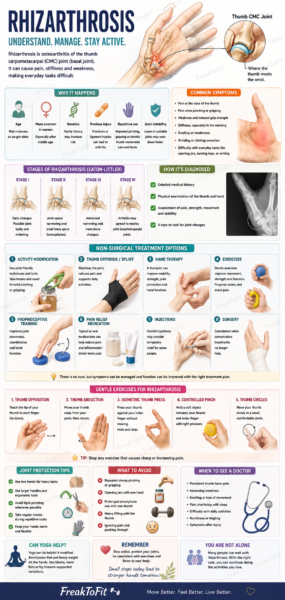
Rhizarthrosis is osteoarthritis of the thumb carpometacarpal (CMC) joint, also called the thumb basal joint. This joint sits at the base of the thumb, where the first metacarpal meets the trapezium bone in the wrist.
Because the thumb is involved in gripping, pinching, opening containers, writing, typing and many other everyday movements, arthritis in this joint can significantly affect hand function.
Rhizarthrosis is particularly common with increasing age and is more frequently seen in women. It can develop gradually, although symptoms may become noticeable after activities that place repeated stress on the thumb.
Importantly, radiographic arthritis and symptoms do not always match. A person may have visible degenerative changes on an X-ray but little pain, while another person with relatively modest imaging changes may experience substantial difficulty using the thumb.
Related Stories
 Why Do Some People Sweat More Than Others? Understanding Your Body’s Natural Response
 Acupressure Points for Belly Fat Loss
Treatment is therefore generally based on symptoms, functional limitations, examination findings and individual goals, rather than an X-ray alone.
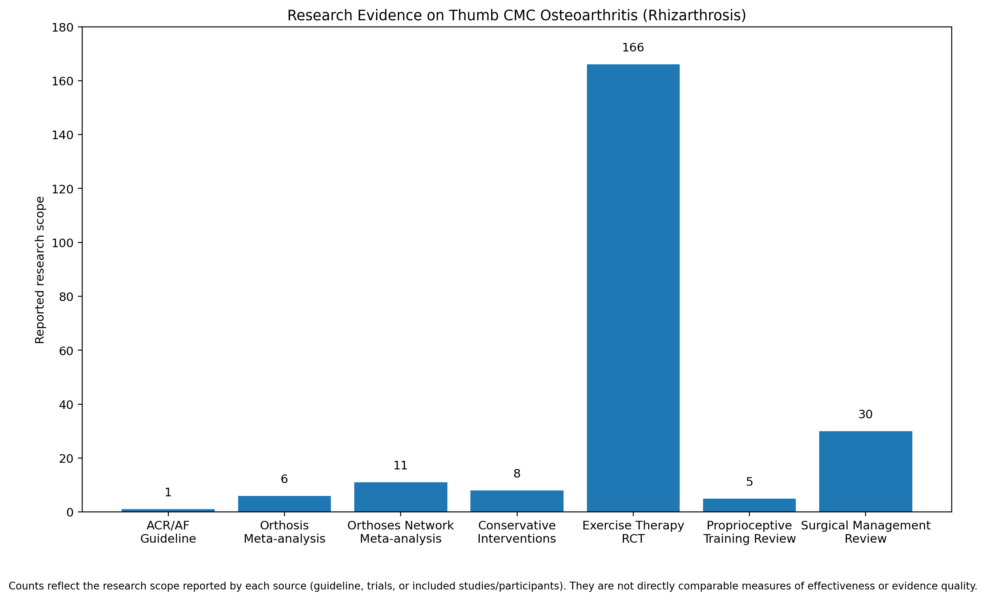
Current clinical guidance strongly recommends hand orthoses for first CMC osteoarthritis, while exercise and self-management are also important parts of osteoarthritis care.(1)
Understanding the Thumb CMC Joint.
The thumb is different from the other fingers because its CMC joint allows a large amount of movement.
It permits the thumb to:

- Bend
- Straighten
- Move away from the hand
- Move toward the hand
- Rotate across the palm
- Oppose the fingers
This combination of movement is what makes the human thumb so useful.
However, the same mobility means that the joint experiences considerable mechanical demands.

The cartilage covering the joint surfaces normally allows smooth movement and helps distribute forces.
With osteoarthritis, cartilage and other joint structures undergo degenerative changes. The joint may become painful, stiff and less mechanically efficient.
Over time, some people develop changes in the shape and stability of the joint, which can further affect gripping and pinching.
What Causes Rhizarthrosis?
There isn’t always one specific cause.
Several factors may contribute.
Age.
The likelihood of osteoarthritis generally increases with age.
Years of normal joint loading can contribute to degenerative changes.
However, aging does not mean that painful rhizarthrosis is inevitable.
Sex.
Thumb-base osteoarthritis is particularly common among women, especially later in life.
Hormonal, anatomical, occupational and biomechanical factors may all contribute, although the precise reasons are complex.
Genetics.
A family history of osteoarthritis may increase susceptibility.
Some people may have inherited anatomical or biological factors that influence cartilage and joint health.
Previous Injury.
A previous fracture, ligament injury or other trauma involving the thumb CMC joint can increase the likelihood of later arthritis.
This is sometimes called post-traumatic osteoarthritis.
Repetitive Hand Use.
Activities involving repetitive gripping, pinching or forceful thumb movements may aggravate symptoms.
Examples include:
- Gardening
- Sewing
- Manual work
- Repetitive computer or phone use
- Playing certain musical instruments
- Prolonged gripping
- Household tasks
However, repetitive use alone should not automatically be blamed for developing osteoarthritis.
Joint Instability.
Some people have greater laxity or instability around the thumb CMC joint.
Altered mechanics can increase the demands placed on surrounding tissues.
Symptoms of Rhizarthrosis.
The symptoms can vary significantly from one person to another.
Common symptoms include:
Pain at the Base of the Thumb.
This is often the most characteristic symptom.
Pain may be felt:
- At the thumb base
- Around the CMC joint
- Along the side of the wrist
- Occasionally into the thumb or hand
Pain During Pinching.
Activities such as:
- Turning a key
- Opening a jar
- Buttoning clothing
- Using scissors
- Holding a pen
may become uncomfortable.
Pain During Gripping.
Strong gripping can increase pressure through the thumb CMC joint.
Weakness.
You may notice reduced:
- Grip strength
- Pinch strength
- Ability to hold objects
Stiffness.
The thumb may feel stiff, especially after inactivity.
Swelling or Tenderness.
Some people develop tenderness around the base of the thumb.
Grinding or Clicking.
A sensation of grinding or crepitus may occur during movement.
Crepitus alone does not necessarily mean severe disease.
Reduced Thumb Movement.
As symptoms progress, some people find it increasingly difficult to move the thumb across the palm.
Why Does Rhizarthrosis Make Gripping Painful?
When you grip an object, several muscles generate force through the thumb.
The CMC joint must transmit these forces.
During strong pinch or grip activities, the mechanical load through the thumb base can increase considerably.
If the joint is painful or irritated, these forces may provoke symptoms.
This explains why relatively simple activities such as opening a jar can become surprisingly uncomfortable.
Rhizarthrosis vs Carpal Tunnel Syndrome.
These conditions are different.
Rhizarthrosis primarily affects the thumb CMC joint and typically causes pain around the base of the thumb.
Carpal tunnel syndrome involves compression of the median nerve at the wrist and commonly causes:
- Tingling
- Numbness
- Burning
- Altered sensation
- Weakness
particularly in the thumb, index and middle fingers.
Someone can have both conditions, so persistent or unusual symptoms should be assessed rather than self-diagnosed.
Rhizarthrosis vs De Quervain’s Tenosynovitis.
These are also different.
De Quervain’s tenosynovitis affects tendons on the thumb side of the wrist.
It can cause pain around the wrist near the base of the thumb, particularly during thumb and wrist movements.
Rhizarthrosis is arthritis of the thumb CMC joint.
A healthcare professional can distinguish between these conditions through physical examination and, when necessary, imaging.
How Is Rhizarthrosis Diagnosed?
Diagnosis generally begins with a medical history and physical examination.
A clinician may ask:
- Where is the pain?
- When did it begin?
- Which activities aggravate it?
- Is there stiffness?
- Is grip strength reduced?
- Have you injured the thumb previously?
- Are other joints affected?
The thumb and hand may then be examined for:
- Tenderness
- Swelling
- Range of motion
- Stability
- Strength
- Pain with specific movements
X-rays.
X-rays can show structural changes associated with osteoarthritis.
Possible findings include:
- Joint-space narrowing
- Osteophytes
- Subchondral changes
- Altered joint alignment
However, imaging should be interpreted alongside symptoms.
A scan cannot determine how much pain a person “should” have.
Stages of Rhizarthrosis.
Doctors may classify thumb CMC osteoarthritis using radiographic staging systems such as the Eaton-Littler classification.
The stages broadly reflect increasing structural changes.
Stage I.
The joint may show relatively early changes, with possible widening of the joint space and mild instability.
Stage II.
More obvious joint-space narrowing and osteophyte formation may appear.
Stage III.
More advanced narrowing and degenerative changes can develop.
Stage IV.
Arthritis may involve the neighboring scaphotrapezial joint as well.
Staging can help clinicians describe disease severity, but treatment decisions should still consider symptoms and function.
Can Rhizarthrosis Be Cured?
Currently, there is no treatment that reliably restores an osteoarthritic CMC joint to its original condition.
However, symptoms can often be managed.
Treatment aims to:
- Reduce pain
- Maintain thumb movement
- Improve hand function
- Improve strength where appropriate
- Reduce aggravating loads
- Support independence
- Maintain quality of life
Many people can manage symptoms successfully without surgery.
Non-Surgical Treatment for Rhizarthrosis.
Conservative treatment is generally considered before surgery for many people.
1. Activity Modification.
You don’t necessarily need to stop using your hand.
Instead, modify activities that repeatedly provoke pain.
For example:
- Use larger handles
- Avoid unnecessarily forceful pinching
- Use both hands for heavy objects
- Use assistive jar openers
- Take breaks during repetitive tasks
The goal is to reduce unnecessary joint stress while maintaining normal activity.
2. Thumb Orthosis or Splint.
A thumb CMC orthosis can help stabilize the joint and reduce painful movement.
Evidence supports orthoses as part of conservative management.
A systematic review and meta-analysis found that orthosis use was associated with long-term improvements in pain and function, although the evidence for pain reduction was low quality and for function was moderate quality.(2)
Another network meta-analysis involving 11 randomized trials and 619 participants found that different splints could reduce pain compared with placebo, although uncertainty remains regarding which design is best for every patient.(3)
A splint should ideally be fitted appropriately rather than simply purchased and worn continuously without guidance.
3. Hand Therapy.
A hand therapist or physiotherapist can assess:
- Thumb mechanics
- Grip
- Pinch
- Range of motion
- Joint stability
- Activity patterns
They can then develop an individualized program.
Therapy may include:
- Mobility exercises
- Strengthening
- Joint protection education
- Splinting
- Functional training
- Manual therapy
A systematic review of conservative interventions found moderate-quality evidence supporting manual therapy and therapeutic exercise combined with manual therapy for pain improvement in thumb CMC osteoarthritis.(4)
4. Exercise.
Exercise is an important component of osteoarthritis management.
However, exercise for rhizarthrosis should not mean repeatedly squeezing a hard ball as forcefully as possible.
A good program may focus on:
- Thumb movement
- Isometric strengthening
- Controlled opposition
- Grip modification
- Pinch mechanics
- Forearm strength
- Functional use
Exercise should be progressed according to symptoms.
Interestingly, a 2026 randomized controlled trial involving 166 adults with thumb CMC osteoarthritis found no significant difference in three-month pain between orthosis plus exercise therapy and orthosis alone, although the exercise group showed favorable outcomes for several secondary measures including activities of daily living, work ability, satisfaction and grip strength.(5)
This illustrates why treatment should not be judged by pain alone.
5. Proprioceptive Training.
Proprioception refers to the body’s ability to sense joint position and movement.
A 2026 systematic review of five randomized controlled trials involving 260 participants found moderate-to-high quality evidence that adding proprioceptive training to conventional rehabilitation could improve pain, joint-position sense, hand function and grip/pinch strength, particularly in early-stage thumb CMC osteoarthritis.(6)
This is an emerging area of rehabilitation research.
6. Pain-Relieving Medication.
Depending on the individual, clinicians may recommend medications for short-term symptom relief.
Options can include topical or oral anti-inflammatory medications, but suitability depends on:
- Age
- Other medical conditions
- Kidney function
- Cardiovascular risk
- Gastrointestinal risk
- Other medications
Don’t assume that an over-the-counter medication is safe simply because it is available without a prescription.
Discuss medication choices with a healthcare professional when necessary.
7. Injections.
Some people with persistent symptoms may be offered an injection into or around the joint.
Corticosteroid injections may provide temporary symptom relief in selected patients, but they are not a cure for osteoarthritis.
The decision depends on symptom severity, previous treatments and individual circumstances.
8. Surgery.
Surgery may be considered when:
- Pain remains substantial
- Daily activities are significantly restricted
- Conservative treatment has been unsuccessful
- The person understands the risks and recovery requirements
Surgical options vary according to disease severity and patient factors.
One common operation is trapeziectomy, in which the trapezium bone is removed.
Other procedures may include ligament reconstruction, tendon interposition, arthrodesis or joint replacement in selected situations.
There is no single operation that is best for every patient.
A systematic review found that evidence has not established one surgical procedure as universally superior to the others.(7)
Rhizarthrosis Exercises.
Exercise selection should be individualized, particularly if the thumb is painful.
Here are examples commonly used in rehabilitation.
Exercise 1: Thumb Opposition.
Place your hand comfortably in front of you.
Slowly touch the tip of your thumb to the tip of your index finger.
Then return.
Repeat with the middle, ring and little fingers.
Perform slowly.
Repetitions: 5–10 per finger.
Stop if the movement produces significant pain.
Exercise 2: Thumb Abduction.
Place your hand flat or relaxed.
Slowly move your thumb away from the palm.
Return to the starting position.
Don’t force the thumb into its maximum range.
Repetitions: 8–10.
Exercise 3: Isometric Thumb Press.
Place your thumb against the side of your index finger.
Gently press the thumb against the finger without allowing movement.
Hold for approximately 5 seconds.
Relax.
Repeat several times.
The pressure should be gentle.
Exercise 4: Controlled Pinch.
Hold a soft object between the thumb and index finger.
Use only enough pressure to hold the object.
Avoid squeezing as hard as possible.
This can help practice controlled pinch mechanics.
Exercise 5: Thumb Circles.
Move the thumb slowly through a comfortable circular movement.
Keep the movement controlled.
Avoid forcing the joint into painful ranges.
Should You Squeeze a Stress Ball?
A stress ball isn’t automatically beneficial for rhizarthrosis.
If squeezing it causes pain at the thumb base, reduce the resistance or stop.
The objective of rehabilitation is appropriate loading, not maximal squeezing.
A hand therapist can help determine the right resistance.
Can Yoga Help Rhizarthrosis?
Yoga isn’t a primary treatment specifically established for thumb CMC osteoarthritis.
However, gentle yoga can be part of a broader physical activity routine if it does not aggravate the thumb.
Certain poses place substantial weight through the hands, including:
- Plank
- Downward-Facing Dog
- Crow Pose
- Handstand
- Tabletop
These may be uncomfortable for someone with symptomatic rhizarthrosis.
Better Modifications.
You can modify hand-loading poses by:
- Using yoga blocks
- Making fists where appropriate
- Using forearm-supported variations
- Reducing wrist extension
- Avoiding painful positions
Don’t force a painful thumb simply because a pose is traditionally performed with the palms flat.
Can Rhizarthrosis Improve Naturally?
Symptoms can fluctuate.
You may have periods of:
- Increased pain
- Reduced pain
- Stiffness
- Better function
A flare does not necessarily mean the joint has suddenly become structurally worse.
Similarly, a pain-free period doesn’t necessarily mean the underlying osteoarthritis has disappeared.
Good symptom management can allow people to remain active despite structural joint changes.
What Makes Rhizarthrosis Worse?
Common aggravating activities include:
- Strong pinching
- Repetitive gripping
- Opening tight jars
- Carrying heavy objects with the thumb
- Prolonged phone use in awkward positions
- Certain manual tasks
- Repeated thumb twisting
This doesn’t mean these activities must be permanently avoided.
Often, modifying how you perform them is more practical.
Joint Protection Strategies.
Small changes can make everyday activities easier.
Use Two Hands.
Instead of opening a heavy container with one hand, use both.
Use Larger Handles.
Larger handles can reduce the amount of force needed to grip an object.
Use Assistive Devices.
Jar openers, ergonomic scissors and adapted kitchen tools may reduce thumb strain.
Avoid Sustained Pinching.
If possible, use the whole hand rather than the thumb and index finger alone.
Take Breaks.
During repetitive work, short breaks can help manage symptoms.
Rhizarthrosis and Smartphone Use.
Smartphones aren’t proven to directly cause rhizarthrosis.
However, prolonged repetitive thumb movements may aggravate symptoms in an already painful thumb.
If phone use increases discomfort:
- Use voice typing
- Switch hands
- Use both hands
- Reduce prolonged one-thumb scrolling
- Take regular breaks
These are symptom-management strategies rather than treatments for osteoarthritis.
Rhizarthrosis and Work.
Your occupation can influence how symptoms affect daily life.
People working in:
- Construction
- Manufacturing
- Hairdressing
- Healthcare
- Cooking
- Craft work
- Gardening
may perform repetitive gripping and pinching.
Work modifications can sometimes reduce symptoms without requiring complete absence from work.
A hand therapist or occupational therapist can provide job-specific recommendations.
When Should You See a Doctor?
Consider professional evaluation if you have:
- Persistent thumb-base pain
- Progressive weakness
- Increasing difficulty gripping
- Significant swelling
- Loss of thumb movement
- Pain interfering with sleep
- Difficulty performing everyday activities
- Symptoms after an injury
- Numbness or tingling
Seek prompt assessment after significant trauma, especially if the thumb becomes deformed, extremely swollen or difficult to move.
Can Rhizarthrosis Affect Both Hands?
Yes.
Some people develop thumb CMC osteoarthritis in both hands.
Symptoms may not appear equally on both sides.
One hand may be much more painful or functionally limited than the other.
Does Rhizarthrosis Always Get Worse?
No.
Osteoarthritis is often described as a progressive condition, but symptoms don’t necessarily worsen continuously.
Many people experience fluctuating symptoms.
Treatment aims to preserve function and control symptoms over the long term.
Rhizarthrosis and Grip Strength.
Pain can cause people to unconsciously reduce how strongly they grip.
Over time, this can contribute to reduced strength.
However, strengthening should be gradual.
Aggressive strengthening during a painful flare may aggravate symptoms.
A structured hand rehabilitation program can determine the appropriate load.
Can You Prevent Rhizarthrosis?
There is no guaranteed method to prevent age-related thumb CMC osteoarthritis.
However, you can potentially reduce unnecessary stress on the joint by:
- Using ergonomic tools
- Avoiding excessive force
- Maintaining hand strength
- Treating injuries appropriately
- Modifying repetitive activities
- Taking breaks
- Maintaining overall physical activity
Prevention is particularly important after previous thumb injuries.
What Does the Evidence Say About Splints?
Splinting is one of the better-supported conservative interventions.
The American College of Rheumatology/Arthritis Foundation guideline makes a strong recommendation for hand orthoses in first CMC osteoarthritis.
However, the research does not establish that one particular splint is ideal for every person.
Different designs include:
- Short CMC splints
- Long CMC-MCP splints
- Rigid thermoplastic splints
- Neoprene splints
The best choice depends on symptoms, stability, activities and comfort.
What Does the Evidence Say About Exercise?
Exercise remains an important part of conservative management, but the research is nuanced.
Earlier systematic-review evidence supported therapeutic exercise, particularly when combined with manual therapy, for improving pain.
More recent research suggests that exercise may improve several functional outcomes even when additional pain reduction over splinting alone is not statistically significant.
This means the goal of exercise should not be simply:
“Make the pain disappear.”
It should also include:
- Better hand function
- Greater confidence using the thumb
- Improved strength
- Better movement control
- Greater ability to perform daily activities
Rhizarthrosis: Practical Daily Routine.
A simple symptom-management routine could include:
Morning.
- Gentle thumb range of motion
- Thumb opposition
- Light hand opening and closing
During Work.
- Avoid sustained forceful gripping
- Use ergonomic tools
- Take short breaks
Evening.
- Gentle mobility
- Appropriate hand exercises
- Use a prescribed orthosis if recommended
During a Flare.
- Reduce aggravating activities
- Use prescribed support
- Consider appropriate pain-relief measures
- Resume gradual movement as symptoms settle
The exact program should be individualized.
Frequently Asked Questions.
1. What is rhizarthrosis?
Rhizarthrosis is osteoarthritis affecting the thumb carpometacarpal joint at the base of the thumb.
2. What are the main symptoms of rhizarthrosis?
Common symptoms include pain at the thumb base, stiffness, weakness, tenderness and difficulty with gripping or pinching.
3. Is rhizarthrosis the same as arthritis?
Rhizarthrosis is a specific form of arthritis—specifically osteoarthritis of the thumb CMC joint.
4. Can rhizarthrosis be cured?
There is currently no reliable cure that restores an osteoarthritic joint to its original condition, but symptoms and function can often be managed effectively.
5. Is a thumb splint helpful?
Yes. Evidence supports hand orthoses for first CMC osteoarthritis, and clinical guidelines strongly recommend them.
6. Can exercise help rhizarthrosis?
Appropriately prescribed exercise can help maintain or improve hand function and strength, and evidence supports exercise as part of conservative management.
7. Should I avoid using my thumb?
Usually, complete avoidance isn’t necessary. Activity modification and reducing painful, forceful movements are generally more practical than completely stopping thumb use.
8. Can yoga help rhizarthrosis?
Yoga may be part of an overall physical activity routine, but poses that put significant weight through the hands may need modification if they aggravate thumb pain.
9. Is rhizarthrosis reversible?
The structural osteoarthritis changes are generally not considered reversible, but pain, strength and function can improve substantially with appropriate management.
10. When is surgery considered?
Surgery may be considered when significant pain and functional limitations persist despite appropriate non-surgical treatment.
11. Does everyone with rhizarthrosis need surgery?
No. Many people manage symptoms with conservative treatment.
12. Can rhizarthrosis affect both thumbs?
Yes. It can affect both thumb CMC joints, although symptoms may differ between hands.
13. What exercises should I avoid?
Avoid exercises that cause sharp or increasing thumb pain, particularly forceful gripping, heavy pinching or prolonged weight-bearing through the thumb.
14. Should I use a stress ball?
Only if it can be used comfortably. If squeezing a stress ball increases thumb-base pain, reduce the resistance or stop.
15. Can rhizarthrosis cause wrist pain?
Pain is usually centered around the thumb base, but discomfort can sometimes be perceived around the nearby wrist. Persistent wrist pain should be evaluated to determine the actual cause.
16. Can rhizarthrosis cause thumb weakness?
Yes. Pain, altered joint mechanics and reduced use can contribute to weaker grip and pinch strength.
17. Can rhizarthrosis improve without surgery?
Yes. Many people can achieve meaningful symptom and functional improvement through non-surgical management.
Bottom Line.
Rhizarthrosis is osteoarthritis of the thumb’s carpometacarpal joint and can cause pain, stiffness, weakness and difficulty with gripping and pinching. It is particularly common with increasing age and can substantially affect everyday hand function.
The good news is that a diagnosis does not automatically mean you will need surgery.
Conservative management commonly includes activity modification, thumb orthoses, hand therapy, appropriate exercises and pain management. Clinical guidelines strongly support hand orthoses for first CMC osteoarthritis, while evidence also supports exercise and rehabilitation as important components of care.
Recent evidence also suggests that proprioceptive training may provide additional benefits for pain, hand function, joint-position sense and strength, particularly in earlier-stage disease.
If symptoms remain severe despite appropriate conservative treatment, surgery may be considered. There are several surgical options, and no single procedure has been proven to be universally superior.
The most effective approach is therefore individualized: understand what aggravates your thumb, protect it from unnecessary loading, maintain appropriate movement and strength, and seek professional assessment when symptoms interfere with daily life.
+7 Sources
FreakToFit has strict sourcing guidelines and relies on peer-reviewed studies, educational research institutes, and medical organizations. We avoid using tertiary references. You can learn more about how we ensure our content is accurate and up-to-date by reading our editorial policy.
- 2019 American College of Rheumatology/Arthritis Foundation Guideline for the Management of Osteoarthritis of the Hand, Hip, and Knee; https://pubmed.ncbi.nlm.nih.gov/31908149/
- Orthosis for rhizarthrosis: A systematic review and meta-analysis; https://pubmed.ncbi.nlm.nih.gov/30170704/
- Comparative Effectiveness of Orthoses for Thumb Osteoarthritis: A Systematic Review and Network Meta-analysis; https://pubmed.ncbi.nlm.nih.gov/32668206/
- Investigation of the effect of conservative interventions in thumb carpometacarpal osteoarthritis: systematic review and meta-analysis; https://pubmed.ncbi.nlm.nih.gov/25559974/
- Effectiveness of exercise therapy in patients with thumb carpometacarpal osteoarthritis: A multicenter, randomized controlled trial; https://pubmed.ncbi.nlm.nih.gov/41138847/
- Effectiveness of proprioceptive training in patients with thumb carpometacarpal osteoarthritis: A systematic review; https://pubmed.ncbi.nlm.nih.gov/41963167/
- Surgical management of primary thumb carpometacarpal osteoarthritis: a systematic review; https://pubmed.ncbi.nlm.nih.gov/21193136/