






































 treino

 meditação


 podcast
 e-book


Os fatos rápidos
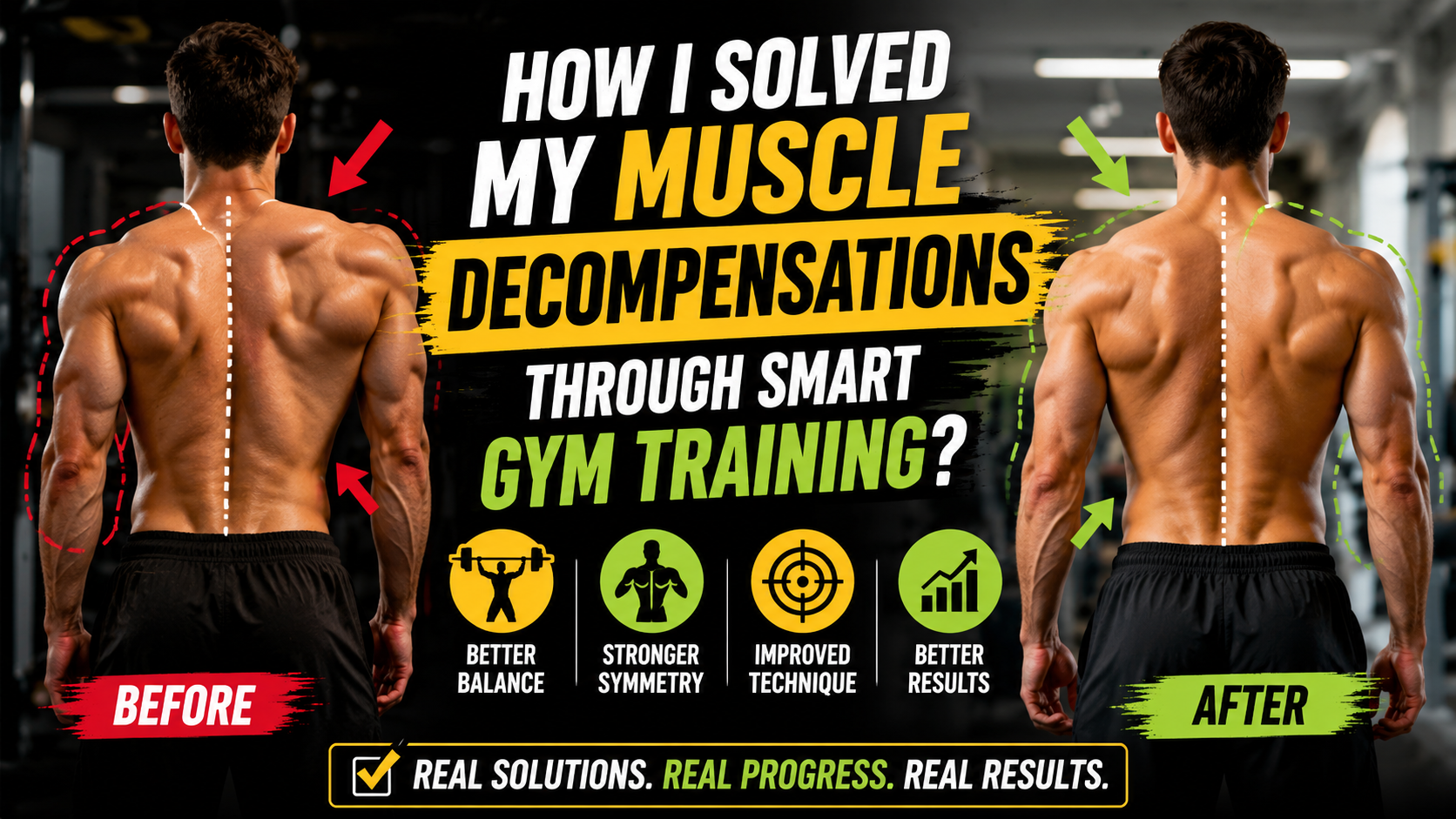
- When I monitored some of my efforts and focused on my posture I realized I was having a lot of the same problems in fitness that are pretty common – muscle decompensations.
- In exercises such as bench press and shoulder press I would have to concentrate on what I was doing because my stronger side would subconsciously take over.
- For myself, the changes that I have made in these imbalances, not only helped to make my body look better, it has also helped with the reduced joint discomfort, better exercise performance, and stability during exercise.
I’m not sure, I had the initial idea I was over thinking it. However, when I monitored some of my efforts and focused on my posture I realized I was having a lot of the same problems in fitness that are pretty common – muscle decompensations.
After enough time in the gym, it’s almost certain you will see some type of muscular imbalance in your body. Perhaps one bicep has developed quicker, one shoulder is more powerful when pushing with it, or one leg is better when squatting. The truth is that practically everyone has some of these imbalances to a greater or lesser extent.
The great news is that muscle decompensations are typically correctable if they are caught early enough and are corrected with proper training, posture correction and by wisely choosing your exercise. For myself, the changes that I have made in these imbalances, not only helped to make my body look better, it has also helped with the reduced joint discomfort, better exercise performance, and stability during exercise.
Histórias relacionadas
 Press de agachamento de minas terrestres: benefícios e variações
 7 benefícios surpreendentes para a saúde do ciclismo regular
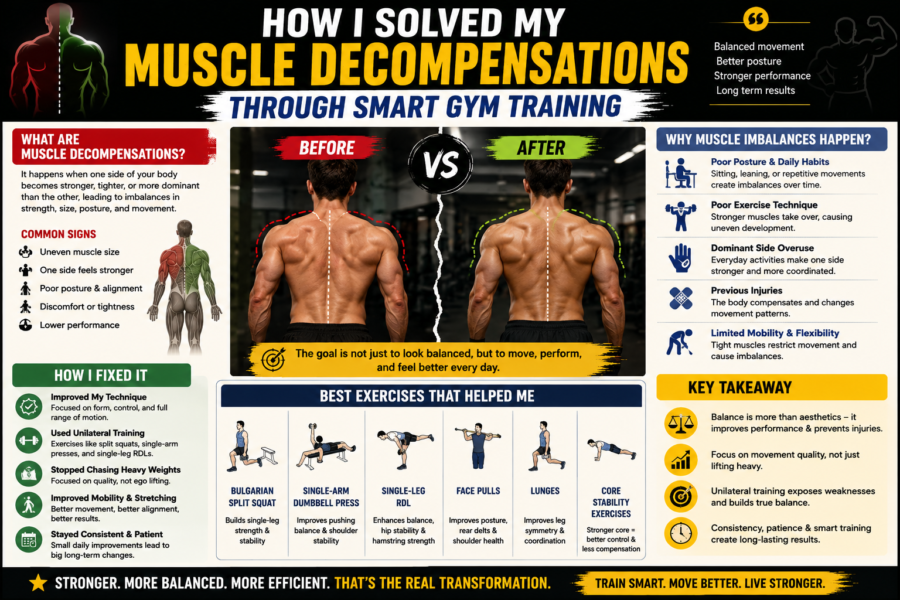
What Are Muscle Decompensations?
Muscle decompensations are when one side of the body is stronger, tighter, larger or more dominant than the other side of the body. This imbalance may have an impact on muscle size, posture, quality of movement and even joint alignment.
The biggest problem seemed to be in my upper body for me. For the most part, I was right-handed and so my right shoulder and arm took over control of nearly all my pushing. In exercises such as bench press and shoulder press I would have to concentrate on what I was doing because my stronger side would subconsciously take over.
Initially it was very slight, but over time I started to see:
- Uneven muscle size
- The barbell is adjusted for the left and right side so that they are not of the same strength.
- Poor posture
- Uneven shoulder positioning
- Rigidity of one side of the muscles
- The result is a decreased connection between the mind and muscle in less powerful músculos.
This is because the body will naturally seek to make up the difference by utilising the strongest or most co-ordinated muscles that are available.

Why Muscle Imbalances Happen?
I believe that from my experience and training research, most muscle decompensations are caused by repetitive activities and poor movement patterns.
1 Poor Exercise Technique.
This was indeed a big blunder on my part in the beginning. I put way too much emphasis on upping the weights and not the quality of my movements.

A breakdown in technique leads to the onset of compensation by stronger muscles. This results in an imbalanced development of the muscles overtime.
Por exemplo:
- When doing bench press, one of the shoulders can lead the other.
- While performing squats, one leg may exert more force.
- When performing the row exercise, one side of the back can pull more during the exercise.
2 Bad Posture.
There are a number of factors associated with our modern lifestyle that make a significant contribution and cause muscle imbalances.
Becoming a “laptop face” is possible due to sitting long hours at a desk, sitting to one side, constantly looking at phones, and carrying bags on one shoulder.
To note, from my experience, this caused my rounded shoulders and forward head posture to have an impact on my chest and back training mechanics.
3 Dominant Side Overuse.
During the daily activities, it is natural for most to use the strongest side of the body.
Whether it’s:
- Carrying groceries.
- Opening doors.
- Typing.
- Throwing.
- Even standing.
Usually one side will be more coordinated and stronger.
4 Previous Injuries.
Compensation patterns also can result from old injuries.
The body will continue to unconsciously protect the damaged area even after the pain has gone away. This can change the way a person moves, and if left untreated, this can last for years.
5 Limited Mobility and Flexibility.
Muscles that are tight can pull joints out of alignment, and restrict movement.
I was feeling that my hip flexors and chest muscles were getting tight and causing me to not be able to move as well in my squat and getting my shoulders in the best position.
How I Started Correcting My Muscle Imbalances?
I can’t say that I was wrong at first, but when I figured out what was going on.
I initially thought:
“It would be better to just condition the lesser side extensively.”
However, it’s not always the best approach to overload the weaker muscles.
The most help I got was to build up movement quality and gradually re-establish balance.
The Biggest Change: Fixing My Technique.
This was most likely the most crucial step.
I decreased my weight for the time being and concentrated on:
- Controlled repetitions.
- Proper level of motion.
- postura.
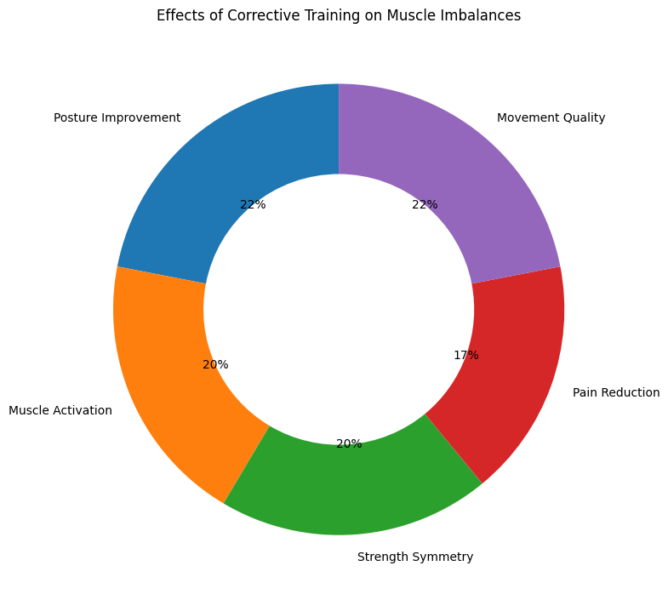
- Muscle activation.(1)
- Balance and movement patterns (both and balanced).
I also began taking pictures of my workouts from new perspectives and it was quite interesting to see how much I’d uncovered about some compensation patterns I was unaware of before.
Por exemplo:
- my hips came into motion a little bit at the squats,
- one arm pressed higher in front of the body during bench press, and/or
- Always locked arm first and my right arm started with the shape.
It was simple corrections to these little things that, over time, made a huge difference!
As a family, we are all lifelong learners.We are all life-long learners as a family.
Why Unilateral Training Helped Me?
This implies training on one side of the body, separately.(2)
The exercises that have been most helpful to me have been:
- Imprensa de halteres de um braço único.
- Single-arm rows.
- Agachamento biológico búlgaro.
- Lunges.
- Single-leg Romanian deadlifts.
- Shoulder presses, and single arm shoulder presses.
That’s why unilateral movements worked so well for me is because my stronger side wasn’t able to compensate for the weaker side.
Isolate each side and it’s very clear where the weak points are.
I had my first inkling of:
- Weaker stability.
- Reduced coordination.
- Faster fatigue.
- Poorer control.
However, they remained steady and even slowly started to even up.
I Stopped Chasing Heavy Weights.
It was quite challenging on the mental side at first.
I’m like a lot of gym-goers who would think bigger weights equal greater gains.
But I was constantly overloading myself – and that was actually aggravating compensations for me; I was getting the stronger muscles to carry the load.
With a new emphasis on:
- Tempo control.
- Muscle activation.
- Controlled eccentric phases.
- Proper positioning.(3)
My workouts got quite a lot more effective.
Oddly enough, as I lost weight I became more evenly developed.
The Role of Mobility and Stretching.
In addition to that, I found that mobility training has made it simpler for me.
I came to understand that there were muscles that were not weak, but just too tight.
The following were the areas that I personally required to enhance the most:
- Chest mobility.
- Thoracic spine mobility.
- Hip flexor flexibility.
- Hamstring mobility.
- Ankle mobility.
The addition of only 10-15 minutes of mobility work before training made a huge difference in improvement:
- Squat depth,
- Posture,
- Shoulder movement,
- Exercise control.
Exercises That Personally Helped Me Most.
1 Agachamento biológico búlgaro.
These my leg imbalances I sadly discover at once.
One side was stable and strong, and the other was weak with difficulty in coordination and movement.
This exercise helped me over time to greatly improve my symmetry in the lower body.
2 Single-Arm Dumbbell Press.
This helped me to re-balance chest and shoulders as each side is required to create force all on their own.
3 O rosto puxa.
Face pulls really helped me to develop my shoulder alignment, rear deltoids and posture.
4 Single-Leg Romanian Deadlifts.
These improved:
- Glute activation.
- Hip stability.
- equilíbrio.
- Hamstring control.
5 Plank and Core stability exercises.
Low core strength can significantly be a factor in patterns of compensation.
depois developing a strong core on a regular basis, my lifting mechanics leveled up significantly!
Leia também: 10 melhores exercícios de calistenia para costas incrivelmente fortes
Mistakes I Made While Trying to Fix Muscle Imbalances.
When trying to improve the weaker side, do not overtrain it.Avoid over training the weaker side.
At first, I believed it was more size that I was looking for.
Too much isolation work, however, was only proving to be a drain on the body and a failure to recover.
Ignoring Recovery.
Most people don’t realize how much recovery is needed and how important it is.
Inadequate sleep and recovery can make compensation patterns worse when muscles become fatigued, they become unstable and lose their coordination.
Rushing the Process.
It takes time to rectify muscle imbalances.
While some alterations occurred within a few weeks, others were more evident in terms of symmetry changes, and these took several months.
Additional Tips That Helped Me.
- I began to get ready for exercise more carefully before.
- Payed special attention to the posture while I was conducting myself in my daily life.
- Start to be aware of body positioning.
- I developed my mind to muscle communication.
- Put away all thoughts and ideas to do with ego lifting.
- Regularly stretched following training sessions.
- I did more quality than quantity.
My Personal Experience and Results.
Reflecting now, my músculo decompensations were corrected in so many ways more than just for looks.
I noticed:
- melhor postura.
- Improved stability.
- Reduced shoulder discomfort.
- Stronger core control.
- More balanced strength.
- Improved and more stable exercise mechanics.
My workouts also began to be more efficient as both sides of my body were engaged in harmony rather than in opposition.
I learned that there are a lot of muscle imbalances, and that they are not all a reason to fret and worry. They usually mean that the cadáver does not have the quality of movement, increased posture awareness, and balanced training to its optimal level.
— Jason Karp, Fitness Enthusiast & Strength Training Practitioner
“Once I focused on balanced movement and smarter training, my body stopped compensating and finally started performing as one strong, coordinated unit.”

linha de fundo.
There are times when everyone will experience a muscle decompensation. These imbalances can accumulate from poor posture, overuse on the dominant side, lack of mobility, injury and incorrect lifting over the years.
I have found, in my own experience, that this was not the solution – to train the weaker side harder. The key that made a difference was to train smarter:
- Improving technique.
- Using unilateral exercises.
- Enhancing mobility.
- Controlling movement quality.
- Trusting that the process will unfold as God desires and is willing to wait.
Imbalances can be corrected over time with consistency, awareness and training practices, but ultimately it is 100% worth it. After beginning to train more efficiently (not just more intensely), I was observing improvements in muscle symmetry, posture, strength, stability and my overall ability to perform in the gym.
+3 de fontes
A FreaktoFit tem diretrizes rígidas de sourcing e conta com estudos revisados por pares, institutos de pesquisa educacional e organizações médicas. Evitamos o uso de referências terciárias. Você pode aprender mais sobre como garantimos que nosso conteúdo seja preciso e atualizado, lendo nosso política editorial.
- Comprehensive corrective exercise program improves alignment, muscle activation and movement pattern of men with upper crossed syndrome: randomized controlled trial; https://www.nature.com/articles/s41598-020-77571-4
- A Systematic Review and Meta-Analysis on the Longitudinal Effects of Unilateral Knee Extension Exercise on Muscle Strength; https://pmc.ncbi.nlm.nih.gov/articles/PMC7739592/
- Effects of Corrective Exercises on Posture, Pain, and Muscle Activation of Patients With Chronic Neck Pain Exposed to Anterior-Posterior Perturbation; https://www.sciencedirect.com/science/article/abs/pii/S0161475420300178