

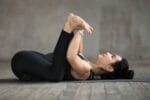










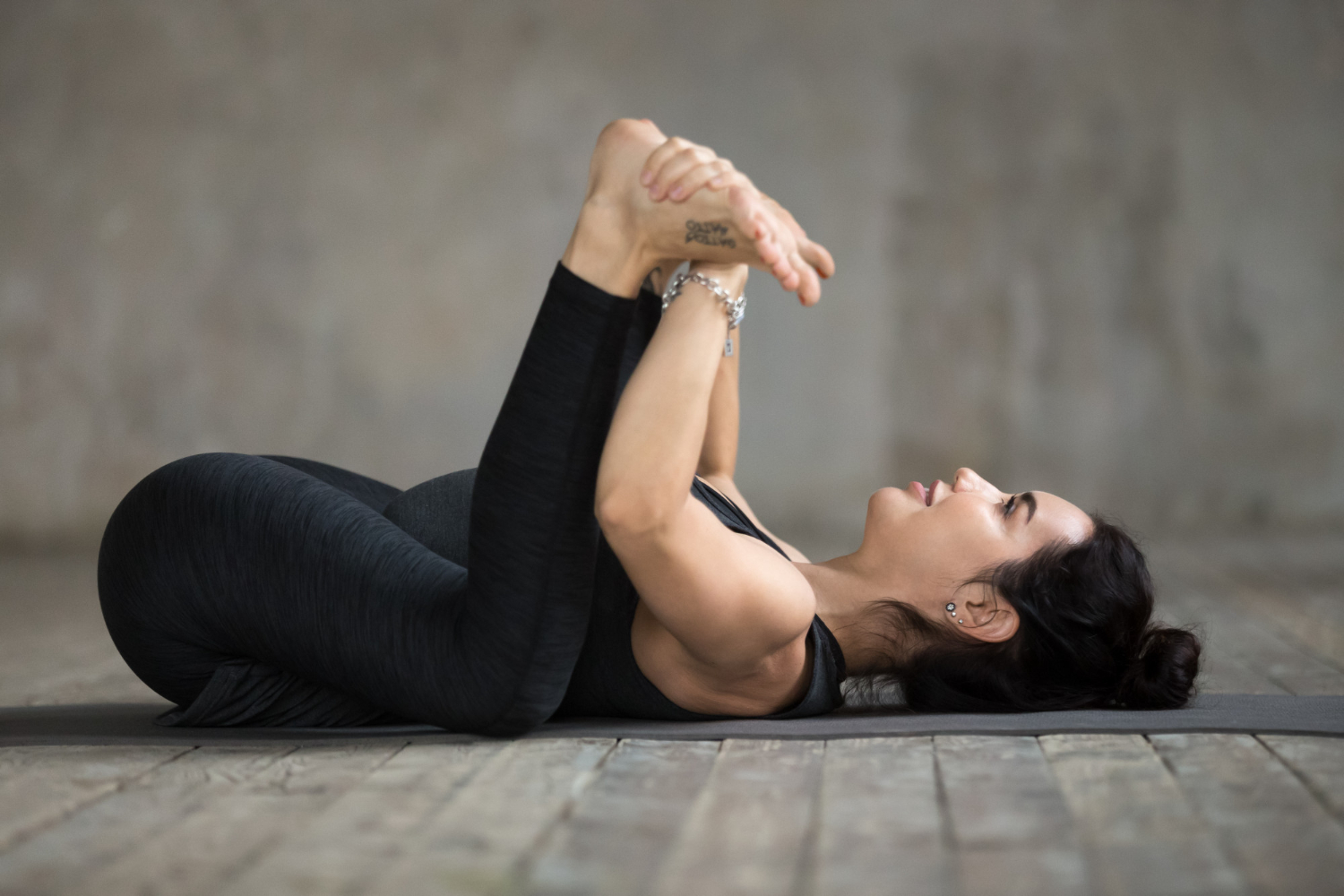
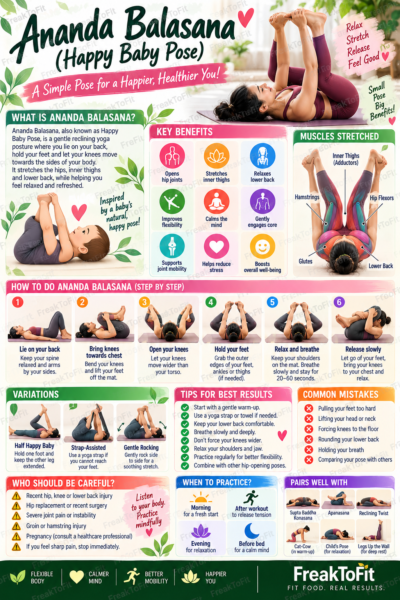
Happy Baby Pose (Ananda Balasana) is a relaxing yoga posture that is typically utilized to relax, stretch and open the inner thighs and hips.
The Sanskrit name refers to:
- Ananda – bliss or happiness.
- Bala – child
- أسانا: Any sitting or standing position, or the way one sits or stands.
The position is similar to a baby’s natural position when lying on its back with feet held.
Generally, Ananda Balasana is done lying on the back with knees bent to the sides of the torso. Hands are extended towards the feet, ankles or thighs, with the soles of the feet up.

While it may seem simple, it can be multiple places at once, such as the hips, inner thighs, hamstrings, lower back and shoulders.
It is sometimes added at the end of a yoga class as it can be relaxing and rejuvenating. When modified, it can be used as a gentle mobility exercise.
It’s critical to understand, though, the difference between the yoga language surrounding the pose and the medical science proven benefits. Research, if it occurs, is conducted on either a yoga practice, or a yoga program and not on the specific Asana of Ananda Balasana. Although the study showed that Happy Baby Pose can help boost flexibility and balance, it is important to note that the results may not be solely due to yoga, as there is evidence that yoga as a whole may have a positive impact on flexibility, balance, physical function and certain aspects of well-being.(1)
How to Do Ananda Balasana?
An advanced level of yoga is not required to learn the basic version.
الخطوة 1: استلق على ظهرك.
Begin by lying down on a yoga mat in a comfortable position.
Do not arch your back.
Rest arms to side of body for a moment, deeply breathe a few times.
Step 2: Bend Your Knees.
Pull both the knees towards the chest.
Do not flatten your lower back as far as it will go against the mat.
Step 3: Open Your Knees.
Let knees spread apart from body.
Your shins should be about 90 degrees to the floor (not exact) depending on flexibility and body alignment.
Step 4: Reach for Your Feet.
Lift feet up and towards ceiling.
Extend arms to outer edges of feet.
Hold your ankles, calves or thighs when your hands don’t reach your feet.
Step 5: Position Your Legs.
Pull knees outwards towards rib cage.
The bottom of your feet should be facing up.
Avoid pulling aggressively.
Step 6: Relax Your Shoulders.
Relax shoulders on floor.
Avoid lifting the head and straining your neck to get into the position.
Step 7: Breathe.
Breathe slowly and at a comfortable pace.
عقد هذا الوضع for about 20 – 60 seconds at first.
The length can be gradually increased if the position is comfortable.
Step 8: Release Slowly.
Let feet go العودة وجلب knees back to chest.
Then straighten your legs, or find another comfortable resting position.
What Does Ananda Balasana Stretch?
There can be stretching sensations in a number of areas with Ananda Balasana.
Depending on your anatomy and technique, you may feel the pose around:
- Inner thighs
- Groin
- الورك
- أوتار المأبض
- عضلات المزاد
- اسفل الظهر
- Back of the pelvis
This is different for everyone.
For some, there may be a deep stretch in the inner thigh area, for others, there may be more of a hip movement.
This is normal.
Everyone does not necessarily have to feel the same way.
1. The Ananda Balasana can help to promote hip mobility.
The Hip Opening Pose is one of the primary reasons that practitioners love this position.
Hips flex and out, knees away from body.
This may offer space for a range of hip motion that is comfortable.
It is important not to take the pose as a sure-fire method to “open tight hips,” however.
Factors that affect hip mobility are:
- Joint structure
- Muscle flexibility
- Previous activity
- تاريخ التدريب
- هرم
- Individual anatomy
- Pain or injury
Two people may be doing the same pose, and have totally different ranges of motion.
2. It is useful for stretching the inner thighs.
Wide-knee position can gently stretch the muscles and connective tissue of the inner thighs.
This can be especially apparent when the knees are spread apart.
But not wider is not necessarily better.
If they feel like they are pulled, move knees slightly inwards.
It is best to be comfortable rather than going deeper than you feel.
3. It can help encourage mobility of the hamstrings.
While mostly known as a hip opener, the legs and feet positioning can also provide a little stretch in the hamstrings.
Individuals that do not have adequate hamstring flexibility can have a problem keeping the feet up and the shoulders relaxed.
In such a case, supporting at the thighs or with a strap can help to make the pose easier.
4. It can stimulate gentle movements in the lower back.
The pose is done on the back so it allows a supported environment where the hips and pelvis can move.
Some practitioners like the position comfortably because it helps to relax the bottom back.
Ananda Balasana should never be offered as a back pain remedy, however.
Studies of yoga for chronic low-back pain are more diverse and indicate some benefits, but this does not necessarily apply to Happy Baby Pose.
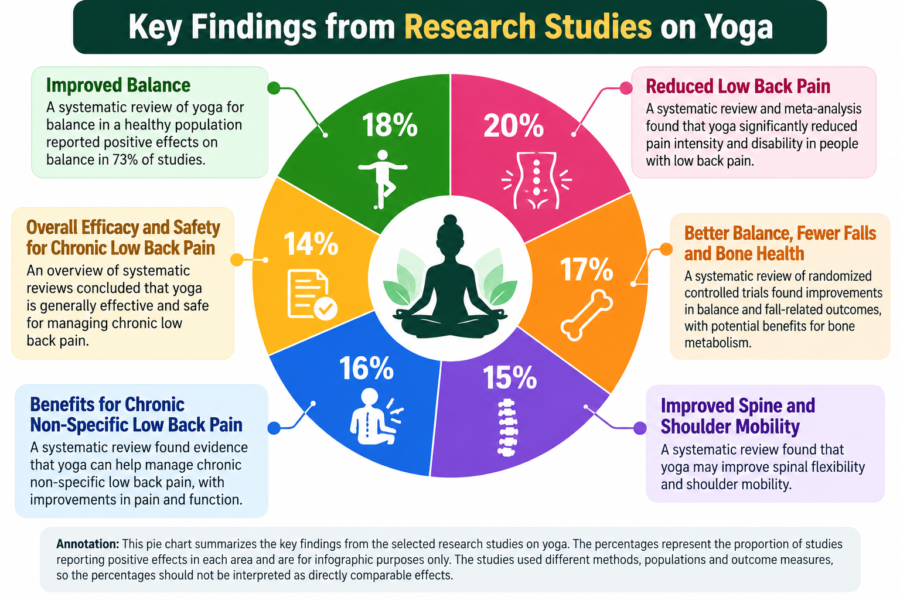
In a systematic review and meta-analysis published in 2021, 27 individual studies with a total of 2,702 participants were analyzed, and it was shown that yoga showed short-term benefits compared to passive controls in reducing pain intensity, pain-related disability, mental health and physical functioning. There was, however, a variable degree of evidence certainty and yoga did not perform better than the active exercise comparators for several outcomes.(2)
This means Ananda Balasana can be a comfortable asana for some people who are suffering from back pain, but it should not be a replacement for medical or physiotherapy treatment.
5. It Can Promote Relaxation.
Ananda Balasana is sometimes found at the end of yoga sessions.
It can be used for relaxation, as it is supported and performed at a relatively low physical level with slower breathing.
Research on yoga has identified some potential psychological benefits of wider yoga practices, but this is dependent on the population under study, and the intervention and outcome measured.
The systematic review of يوجا for positive mental health in healthy adults showed that there is some evidence for the benefits of yoga on psychological well-being, but the authors noted some gaps in the evidence.
So it would be more precise to say it’s a yoga posture for relaxation, not one to cure القلق والاكتئاب or other mental-health issues.
6. It can help to enhance body awareness.
The posture engages multiple joints at once, giving you the chance to see how your body feels when you move.
The following may become more noticeable:
- Hip tension
- Inner-thigh tightness
- Lower-back positioning
- Shoulder tension
- Breathing patterns
- Any gaps between left and right sides of the body
One of the helpful things that can come from mindful movement is this awareness.
You don’t need to push your body to the extreme position, but you can watch where your body naturally ends up.
7. It can be a helpful relaxing position to use as a cool-down.
Ananda Balasana is suitable as a movement after other more challenging moves.
For example, following:
- القرفصاء
- طعن بجهد
- Warrior poses
- Standing balances
- Hip-strengthening exercises
- Dynamic yoga sequences
you can come to the floor and maybe incorporate Happy Baby Pose as a part of a slower cool down.
The pose is particularly useful as it can be done on just a comfortable surface.
Ananda Balasana and Flexibility.
One of the most talked about attributes of yoga is flexibility.
But flexibility is not a mobility.
The term flexibility is used to describe the ability of tissues to stretch and/or a joint to move through a range of motion.
Mobility is the capacity to be active in moving within available range.
In both Ananda Balasana can be included.
You’re not letting another person push your legs around. You have tightened your feet and are in control of your hips and knees.
Yoga in general has been researched for other benefits that may include better mobility.
A 2024 systematic review which focused on yoga and spine/shoulder mobility identified eight studies, suggesting that yoga interventions can improve spinal flexibility and mobility, but with some variations in population and methodology.(3)
This doesn’t mean that Ananda Balasana directly has the same مؤثرات.
Ananda Balasana and Balance.
Unlike standing yoga poses, in Happy Baby yoga Pose you do not have to hold your body upright.
Nevertheless, the concept of balance is still applicable to yoga in general.
A systematic review of yoga for healthy populations found 15 studies with 688 participants. Eleven out of those 17 studies yielded positive results in at least one of the balance outcomes, but there was significant study design and نوع اليوجا differences as well as differences in reporting quality, the researchers found.
A more recent systematic review of 18 RCTs with 1,408 healthy people reported low certainty evidence that yoga benefits balance and inconclusive evidence for bone mineral density.(4)
These findings validate yoga, and not Ananda Balasana, as a movement practice, not a balance exercise.
Ananda Balasana for Beginners.
Happy Baby Pose is a popular beginner’s pose for a few reasons, one of them being that it is easily modifiable.
Don’t immediately catch your feet.
Try this progression.
Beginner Level 1: Knees to Chest.
Lying on your back, draw both knees to chest.
Place back against thighs.
Stay here, breathe.
Beginner Level 2: Wide Knees.
Open your knees slightly, keeping your hands behind your thighs.
Don’t tense your shoulders.
Beginner Level 3: Ankle Hold.
If possible, stretch out towards ankles.
Do not forcibly pull the legs.
Beginner Level 4: Hold the Feet.
Eventually, you may be able to hold the outer edges of your feet.
The transition should be smooth.
Using a Yoga Strap.
A strap can help make Ananda Balasana easier.
Pass strap over the bottoms of your feet.
Grasp each end of the strap.
This will ensure you keep the ساق in the same position with the flexibility of your shoulders and hamstrings not required to touch your feet.
A strap can be particularly helpful for:
- مستهل
- Those who cannot move their shoulders as far as they would like.Those who have less shoulder mobility.
- Individuals suffering from tight hamstrings.
- Individuals who have shorter arm-to-leg proportions.
- Individuals who have suffered from a lack of activity
The use of a prop does not diminish the validity of the pose.
The intent of a modification is to enable you to practice safely.
Ananda Balasana Variations.
Half Happy Baby.
Bring knee to outside of body, opposite leg straight, without gripping both knees.
This can assist in working with one hip at a time.
Supported Happy Baby.
Folded blankets or cushions under head, pelvis or feet, as necessary.
It depends on your body and reasons for modification.
Strap-Assisted Happy Baby.
Either strap around each foot or a long strap around both feet.
One of the simplest ones is this.
This is a happy baby rocking crib.This is a rocking baby crib for young ones.
Some practitioners playfully sway while holding the pose.
The motion should be quick and precise.
Do not rock your child in an aggressive manner, especially when suffering from any kind of back or hip issues.
Happy Baby With One Leg Extended.
Extend the opposite leg, holding one foot.
This puts a different kind of strain on the hamstrings and can be a different kind of movement challenge.
It should be introduced in a gradual manner.
Common Mistakes in Ananda Balasana.
The big toe is the most painful on the foot.The foot’s most painful toe is the big toe.
This isn’t to press the knees down toward the ground.
Excessive stress around the hips or knees can be created by pulling too hard.
Lifting the Head.
Your head can remain comfortably on the mat.
Raising it up to inspect your legs could be unhelpful for your neck.
It is important to flatten the lower back forcefully.The lower back should be flattened forcefully.
Some practitioners push hard on the lower back trying to go into the floor.
Rather, think about comfortable positioning.
In this position you take the knees too wide.
Too wide of a stance can put too much strain on the inner thighs.
Do not go beyond the range that is comfortable.
حبس النفس.
Breath-holding is a good sign that the position has reached intensity.
Slow back down until breathing returns to a normal pattern.
Chasing the “Perfect” Shape.
Happy Baby Pose doesn’t have to be identical to another person’s pose.
The proportions of the body and the structure of the joints are different.
The most secure position is the one that is comfortable for you.
Ananda Balasana for Tight Hips.
Don’t press the knees outwards if you have tight hips.
Instead:
1. Move with knees closer to chest.
2. Firmly place behind the thighs.
3. Slowly spread knees apart.
4. Maintain relaxed shoulders.
5. Breathe slowly.
6. Stop before you become uncomfortable, before you become in pain.
The hips can also be worked for several minutes by performing some of the following movements:
- بقرة القط
- Supine knee-to-chest
- Gentle windshield wipers
- Low lunges
- Supported butterfly pose
The focus is on the ability to move slowly, not to score right away.
Ananda Balasana for Lower Back Pain.
This area is to be watched very closely.
A supported supine hip opening position is comfortable for some people.
For others, it may be uncomfortable to have the knees turned outward, or to pull the feet.
Evidence of the benefits of using yoga for chronic low back pain is limited and only applies to certain types of yoga classes, not to individual yoga poses. In 2022, a Cochrane review examined randomized trials of yoga for chronic non-specific low-back pain, and looked at the results of pain, function, quality of life and adverse events.(5)
Further evidence indicates that yoga might be useful in the management of chronic LBP, although the level of evidence and the certainty of evidence does not always correspond to the evidence.(6)
لذلك:
Ananda Balasana is comfortable, it can be incorporated into gentle movement practice. If it causes or worsens back pain stop and try a different movement.
If your back pain persists or is severe, it’s a good idea to get a medical evaluation.
Ananda Balasana and Pregnancy.
Modifications can be made on a case-by-case basis for pregnancy.
Lying on one’s back may be comfortable at one time in pregnancy but later in pregnancy, lying flat on the back may be uncomfortable for some people.
Pregnancy also changes:
- ميزان
- حركة مشتركة
- Abdominal pressure
- Circulation
- Free from pain
Do not presume that a position that was comfortable prior to the pregnancy will be the right position during the pregnancy.
Pregnant, consult your healthcare provider and experienced prenatal yoga teacher.
Who Should Avoid or Modify Ananda Balasana?
Additional precautions should be taken when using with individuals who have:
- Recent hip injuries
- Knee injuries
- Significant lower-back pain
- Recent surgery or hip replacement
- Groin injuries
- Shoulder injuries
- Severe joint instability
- Certain spinal conditions
Before trying out deep mobility positions, obtain individual advice if recently operated on or diagnosed with a musculoskeletal problem.
Stretching Sensation vs Pain.
A slight stretch may be normal.
Pain is different.
If you feel:
- آلام حادة
- Sudden joint pain
- Burning pain
- خدر
- وخز
- ركاكة
- فقدان الإحساس
- Knee giving way or buckling on itself
Avoid the rule “no pain, no gain” to push into a yoga position.
A longer stretch is not necessarily a good stretch.
How Long Should You Hold Ananda Balasana?
Specific holding times are not required in all situations.
If you are new to the posture, 20-30 seconds may be sufficient to get used to it.
More advanced practitioners can stay in the position for 30-60 seconds or even longer.
Quality of the hold is more important than length of hold.
At the end of the pose, question yourself:
- Am I able to breathe properly?
- Is my back rounded in my shoulders?
- Does my neck feel comfortable?
- Do my knees feel at ease?
- Can the stretch be done comfortably?
- Is the position easy to let go of?
If the answer is yes, it is likely to be the right intensity.
How Often Can You Practice Happy Baby Pose?
When it is comfortable and appropriate for your mobility routine or relaxation exercise, Ananda Balasana is typically gentle enough to perform regularly.
Try it out:
Following yoga class.
- Before meditation
- As part of a mobility routine
- Within a stretching program for the bedtime.
- After prolonged sitting
If joints become irritated or remain sore, however, you should adjust the frequency.
A Simple 10-Minute Ananda Balasana Routine.
If you want to use Happy Baby Pose as part of a short routine, try:
Minute 1: Relaxed breathing while lying down
Minute 2: Knees-to-chest
Minute 3: Gentle knee circles
Minute 4: Supine windshield wipers
Minute 5: Half Happy Baby — right side
Minute 6: Half Happy Baby — left side
Minutes 7–8: أناندا بالاسانا
Minute 9: Gentle rocking or stillness
الدقيقة 10: Relaxed lying position
Ananda Balasana Before Bed.
This simple Bedtime Sequence could be:
- التنفس اللطيف
- Knees-to-chest
- Happy Baby
- Supine twist
- Legs comfortably extended
- تسلية
But it’s not correct to say that Happy Baby Pose cures insomnia.
Can Ananda Balasana Reduce Stress?
Ananda Balasana is a relaxing yoga pose that helps to calm the mind and relieve tension.
Slow breathing and mindful practice might help to relax, and gentle yoga as well.
ومع ذلك ، واحد pose cannot be termed as a cure for stress disorders.
The benefits of Ananda Balasana can be behavioral, emphasizing the importance of slowing down, feeling and breathing instead of constantly changing from one challenging posture to another.
This can be beneficial for shifting into relaxation from active practice.
It can be said with some degree of certainty that Ananda Balasana is a low impact yoga posture that includes hip movement, inner thigh lengthening and controlled positioning of the lower body.
Evidence based on yoga as a practice indicates that yoga can have an effect on outcomes like balance and physical function, and evidence related to low-back pain also suggests that structured yoga programs may have a beneficial effect.
That distinction enhances the precision and validity of health information.
الأسئلة المتداولة.
1. What is Ananda Balasana?
Ananda Balasana, commonly called Happy Baby Pose, is a reclining yoga posture in which the knees move toward the sides of the torso while the feet face upward.
2. What does Ananda Balasana stretch?
It can stretch or mobilize the hips, inner thighs, groin and hamstrings, depending on how the pose is performed.
3. Is Ananda Balasana good for beginners?
Yes. It is relatively easy to modify, making it suitable for many beginners.
4. Do I need to touch my feet?
No. You can hold your ankles, calves, thighs or a yoga strap.
5. Why can’t I reach my feet?
Limited shoulder or hamstring mobility, body proportions or hip mobility may make the feet difficult to reach. Using a strap is an excellent modification.
6. Should my knees touch the floor?
No. Your knees do not need to reach the floor.
7. Is Happy Baby Pose good for tight hips?
It can provide a gentle way to explore hip mobility, but it should not be forced.
8. Can Ananda Balasana help back pain?
It may feel comfortable for some people, but it has not been established as a stand-alone treatment for back pain. Research supporting yoga for back pain generally involves broader yoga programs rather than this individual pose.
9. Can I practice Ananda Balasana every day?
If it remains comfortable and does not cause pain or joint irritation, it can be incorporated regularly into a gentle mobility or relaxation routine.
10. How long should I hold Happy Baby Pose?
Beginners can start with around 20–30 seconds and gradually increase if comfortable.
11. Is Ananda Balasana safe during pregnancy?
It may require modification, particularly later in pregnancy. Pregnant individuals should follow individualized medical and prenatal-yoga guidance.
12. Can Happy Baby Pose improve flexibility?
Yoga broadly can improve flexibility and mobility in some populations, but evidence specifically proving that Ananda Balasana alone produces measurable flexibility improvements is limited.
13. Can I rock in Happy Baby Pose?
Gentle rocking can be comfortable for some people. Keep the movement controlled and stop if it causes pain or dizziness.
الوجبات الجاهزة النهائية.
Happy Baby Pose is a simple yet versatile reclining yoga postures which can be used to provide gentle mobility of the hips, stretch the inner thighs, practice awareness and relaxation of the body.
هو كذلك extremely versatile and that is its greatest strength.
No need to get the deepest version.
In fact, pushing the knees to the floor or actively pulling the feet towards the body can make the mobility exercise uncomfortable.
The best thing that can be done is to look at Ananda Balasana as a part of a larger yoga or mobility practice—not as treatment for any medical disease.
General yoga research indicates that yoga may help with some of the issues related to low-back pain management, balance, mobility, and physical function but the evidence is not of the highest quality and typically cannot be directly associated with any individual pose.
The deepest pose Happy Baby isn’t necessarily the best one.
This is the version where you can breathe easily, feel in control and leave feeling better as opposed to worse in this pose.
+6 مصادر
لدى Freaktofit إرشادات صارمة بشأن المصادر وتعتمد على الدراسات التي راجعها الأقران ومعاهد البحوث التعليمية والمنظمات الطبية. نتجنب استخدام المراجع من الدرجة الثالثة. يمكنك معرفة المزيد حول كيفية ضمان دقة المحتوى الخاص بنا وتحديثه من خلال قراءة سياسة التحرير.
- مراجعة منهجية لليوغا لتحقيق التوازن في السكان الأصحاء ؛; https://pubmed.ncbi.nlm.nih.gov/24517304/
- Yoga for treating low back pain: a systematic review and meta-analysis; https://pubmed.ncbi.nlm.nih.gov/34326296/
- تأثير اليوجا على التوازن والسقوط وأيض العظام: مراجعة منهجية للتجارب المعشاة ذات الشواهد على الأفراد الأصحاء ؛; https://pubmed.ncbi.nlm.nih.gov/39607489/
- استكشاف الآثار العلاجية لليوجا على حركة العمود الفقري والكتف: مراجعة منهجية ؛; https://pubmed.ncbi.nlm.nih.gov/39593648/
- Yoga for chronic non-specific low back pain; https://pubmed.ncbi.nlm.nih.gov/36398843/
- Efficacy and safety of yoga for the management of chronic low back pain: an overview of systematic reviews; https://pubmed.ncbi.nlm.nih.gov/37965167/