









































 Workout

 Meditation


 Podcast
 E-book


The Fast Facts
- I remember lying on the couch one evening — phone in hand, obviously — thinking, Why can’t I just chill.
- A LOT of people are walking around with it and don’t know there’s a name for what they’re feeling.
- Just tired in a way sleep didn’t fix.

I didn’t wake up one day and say,
“Ah yes, my autonomic nervous system is clearly dysregulated.”
I just felt… wrong.
Not sick. Not depressed. Not even that anxious.
Just tired in a way sleep didn’t fix. Restless in a way meditation didn’t touch. Focused for short bursts, then totally fried. And weirdly uncomfortable doing nothing.
Related Stories
 Unlocking the Wonders of Neem Stick: Nature’s Gift to Oral Health
 Cut on Gums: Causes, Symptoms, Treatment, Prevention and How to Heal at Home
I remember lying on the couch one evening — phone in hand, obviously — thinking, Why can’t I just chill?
Like really chill. No podcast. No scrolling. No background noise.
My body felt alert. My brain felt foggy. My eyes were tired but my nervous system was acting like it was waiting for something to happen.
That’s when it clicked.
This isn’t “stress” the way we’ve been taught.
It’s not laziness.
It’s not lack of discipline.
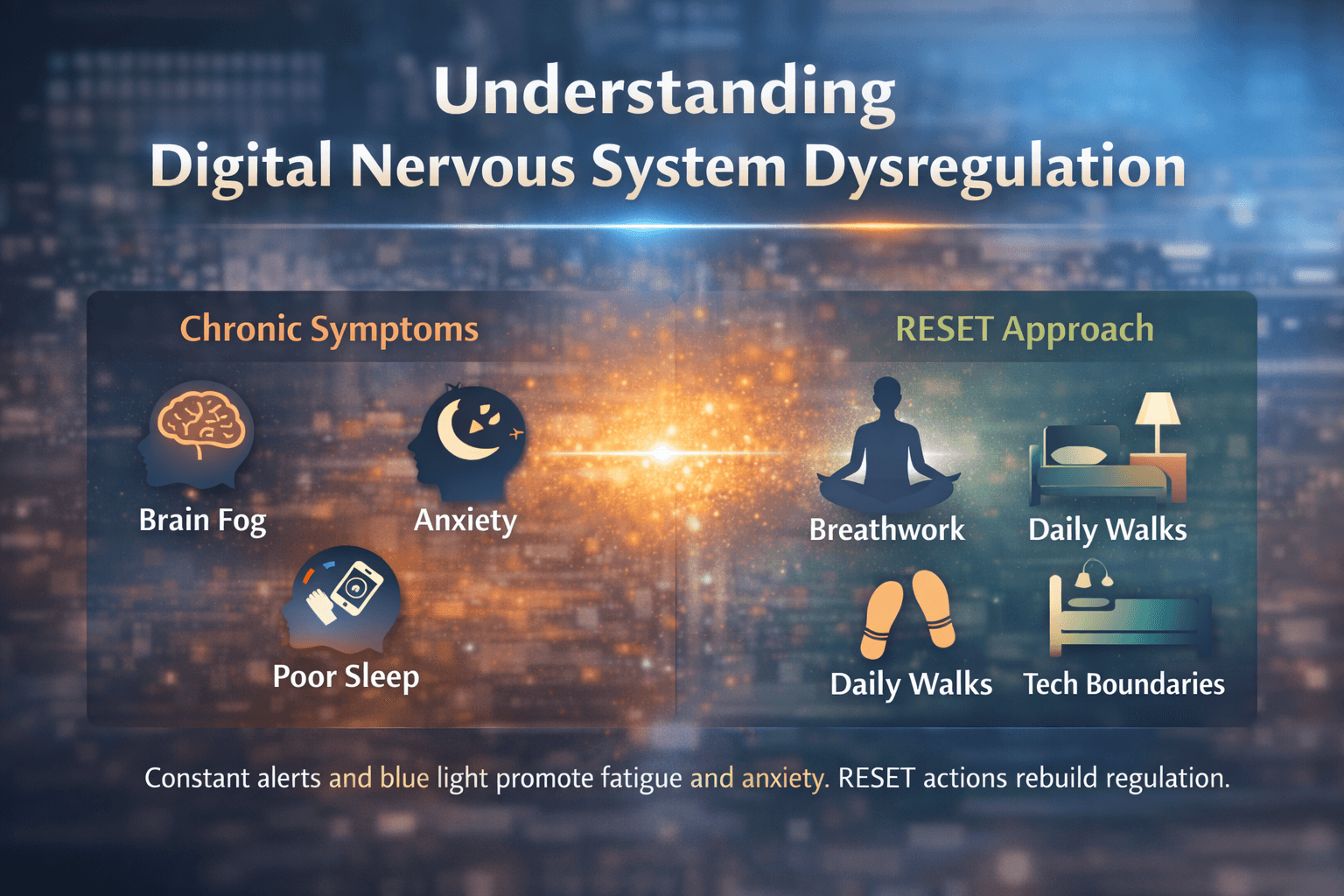
It’s what I now call Digital Nervous System Dysregulation.
And honestly? A LOT of people are walking around with it and don’t know there’s a name for what they’re feeling.
This Isn’t Burnout… But It Looks Like It.
Here’s the tricky part.
Most people with digital nervous system dysregulation get told some version of:
- You need better time management
- Try meditating more
- Just put your phone down
- You’re probably anxious
- That’s just modern life
And yeah… none of that really helps.
Because this isn’t about willpower. It’s about biology being pushed past its design limits, quietly, over years.
You don’t feel dramatically stressed.
You feel constantly slightly on.
Like your internal system forgot how to fully power down.
What I Mean by “Digital Nervous System Dysregulation”.
Let’s strip the fancy words away.
Your nervous system has two main gears:
- On (alert, focused, responsive)
- Off (rested, digesting, repairing, grounded)
A healthy system moves between these gears easily.
Digital life?
It keeps nudging the “on” button… all day… every day.
Notifications. Tabs. Messages. Blue light. Doomscrolling. Background noise. Even “relaxing” content that still keeps your brain mildly stimulated.
Over time, the nervous system stops trusting rest.
Calm starts to feel unfamiliar.
Stillness feels awkward. Maybe even uncomfortable.
That’s dysregulation.
Not broken. Not damaged. Just… stuck.

The Symptoms People Don’t Connect to Screens.
This is where things get interesting. Because the symptoms don’t scream “technology problem.”
They show up like this:
Mentally.
- Brain fog that comes and goes.
- Trouble focusing deeply, even on things you like.
- Feeling mentally tired after not much thinking.
- Forgetting words mid-sentence (hate that one).
Emotionally.
- Low-grade anxiety for no clear reason.
- Feeling flat or oddly detached.
- Irritable over tiny stuff.
- Overwhelm that comes out of nowhere.
Physically.
- Tight jaw, neck, shoulders (classic).
- Shallow breathing without realizing it.
- Digestive weirdness.
- Tension headaches.
Sleep-wise.
- Exhausted but not sleepy.
- Falling asleep late even when you’re tired.
- Waking up unrefreshed.
- Feeling better late at night (why tho??).
Behaviorally.
- Compulsively checking your phone.
- Discomfort with silence.
- Needing constant input.
- Struggling to “just sit”.
If you’re nodding right now… yeah. Same.
Why Screens Mess With Us More Than We Think.
Here’s the part I wish more people talked about.
It’s not just the content on screens.
It’s the way digital environments talk to your nervous system.
1 Constant Micro-Stimulation.
Your brain loves novelty. Screens deliver endless tiny hits of it.
Not enough to fully excite you.
Just enough to keep you hovering in anticipation mode.
That trains your nervous system to stay alert… indefinitely.
No resolution. No release.
2 Blue Light + Fake Daylight.
Your body evolved with sunlight, darkness, and gradual transitions.
Screens say, “Nah. It’s noon forever.”
Melatonin drops. Cortisol timing shifts. Recovery windows shrink.(1),(2)
And suddenly sleep stops doing its job.

3 Static Posture = Trapped Stress.
We weren’t built to process stress while sitting still.
Digital stress piles up in the body with nowhere to go.
No running. No shaking it out. No physical completion.
It just… sits there.
4 No Clear Safety Signals.
Nature gives the nervous system cues: quiet, darkness, rhythm, space.
Digital environments remove most of those.
So the body stays slightly unsure. Slightly vigilant.
Which is exhausting, even if you’re “relaxing.”
Why “Just Relax” Doesn’t Work.
If someone tells you to “just relax” and you feel worse — you’re not broken.
A dysregulated nervous system doesn’t respond to commands.
It responds to signals.
You can’t logic your way into calm.
You have to show the body that it’s safe.
That’s where most advice falls flat.
What Actually Helped Me (and My Clients).
This is where I’ll get a little opinionated.
High-intensity fixes don’t work here.
Extreme digital detoxes don’t last.
Trying to be “perfect” just adds more pressure.
What works is re-training regulation gently, consistently, and in the right order.
I use a framework I call the RESET approach — not because it’s catchy (okay, a lil bit), but because it matches how nervous systems actually recover.

R — Regulation Through Breathing (Not Fancy Stuff).
I used to overcomplicate breathing.
Then I realized: the nervous system doesn’t need tricks. It needs time and rhythm.
The biggest shift came when I stopped focusing on deep inhales and started extending my exhales.
Longer exhales = safety signal.
Nothing dramatic.
Just 5–10 minutes, once or twice a day.
Sometimes sitting. Sometimes lying on the floor like a tired housecat.
It felt boring at first. Then grounding. Then necessary.
E — Exercise That Discharges, Not Hypes.
This one surprised me.
Hard workouts didn’t fix this. Sometimes they made it worse.
What helped was:
- slower strength work
- walking outside
- mobility
- yoga that wasn’t rushed
Movement that lets stress complete.
Not everything needs to spike adrenaline.
S — Sleep + Eating Like a Human Again.
Sleep recovery starts way before bedtime. Learned this the hard way.(3)
Late heavy meals. Random eating times. Sugar at night. Bright lights at 10pm.
All of that tells your nervous system: “Stay alert.”
Simple shifts helped more than supplements ever did:
- earlier dinners
- consistent meal timing
- more daylight exposure
- dim lights at night
Not perfect. Just… better.

E — Environment Matters More Than Motivation.
This one’s underrated.
Your nervous system is constantly scanning your environment.
Noise. Light. Clutter. Screens.
Small changes made a huge difference:
- dimmer lamps
- less background noise
- going outside daily (even briefly)
- letting silence exist sometimes (wild, I know)
You don’t need a retreat. You need cues.
T — Tech Boundaries That Don’t Feel Punishing.
I don’t believe in total detoxes.
I believe in containment.
Things like:
- no phone first thing in the morning
- notifications batched
- phone-free meals
- one tech-free hour at night
Not rigid. Not moralized.
Just enough to give the nervous system breathing room.

Yoga Hits Different When You Understand This.
Yoga isn’t just stretching. It’s nervous system communication.
The biggest mistake I see? Rushing.
Longer holds. Slower transitions. Emphasis on exhale.
Poses that helped most:
- Child’s pose (supported).
- Legs up the wall.
- Gentle twists.
- Forward folds.
- Slow backbends with control.
Less “flow”. More listening.
A Simple 7-Day Reset (Nothing Extreme).
I’ve used versions of this with clients who swear they’re “too busy.”
Day 1–2:
Breathing + awareness. Fewer notifications.
Day 3–4:
Daily outdoor walk. Morning light.
Day 5–6:
Earlier dinner. Consistent bedtime.
Day 7:
Longer yoga session. Tech-light evening.
Most people report:
- better sleep depth.
- calmer mornings.
- less mental noise.
Not magic. Just biology responding.
Who This Hits the Hardest.
I see this most in:
- remote workers.
- students.
- entrepreneurs.
- creatives.
- gamers.
- knowledge workers.
Basically… people who live in their heads and on screens.
Ironically, high performers suffer quietly the most.
Where This Is Headed (And Why It Matters).
As digital life intensifies, nervous system literacy is going to matter more than motivation, productivity hacks, or hustle culture ever did.
The future isn’t about doing less.
It’s about regulating better.
Learning how to shift states.
Learning how to rest on purpose.
Learning how to use tech without letting it hijack your biology.
A Bit More of My Own Story (Because This Didn’t Start as “Research”).
I wanna rewind for a second, because this whole concept didn’t come from books or studies for me — it came from frustration.
A few years ago, I hit this phase where my life looked good on the outside. Work was steady. I was training regularly. Eating “clean enough.” No major drama.
But internally? I felt… fried.
I’d wake up already tired.
Coffee helped, but only briefly.
By evening I’d feel edgy for no reason — snapping at small things, zoning out mid-conversation. And sleep… man, sleep felt like a joke. I’d lie there exhausted, brain doing parkour.
The weirdest part?
Vacations didn’t fix it. Weekends didn’t fix it. Meditation *kind of* helped, but only while I was doing it.
I remember one night sitting on the floor, phone in hand, realizing I’d checked it without even thinking. No notification. No purpose. Just reflex.
That scared me a lil’.
That’s when I stopped asking, “How do I relax more?”
And started asking, “Why does my body not trust rest anymore?”
That question changed everything.
Real Client Case Studies (Patterns I See Over and Over).
I’m changing names here, obviously, but these are real patterns from real people, not polished success stories.
Case 1: “I’m Not Anxious, But I Never Feel Calm” (Remote Worker, 32)
One client told me this in our first session:
“I don’t think I’m anxious… but I can’t remember the last time I felt actually calm.”
She worked remotely, bounced between Slack, email, Zoom, and socials all day. No breaks, just constant low-grade stimulation.
Her biggest symptom?
She felt on all the time — even watching Netflix.
We didn’t do anything extreme. No detox. No supplements.
We focused on:
- longer exhales, twice a day.
- walking outside every morning.
- no phone during meals.
- earlier dinners.
Three weeks later she said:
“I didn’t realize how loud my brain was until it got quieter.”
That’s dysregulation easing up.
Case 2: “I’m Productive, But I Feel Empty” (Entrepreneur, 38).
This one hit close to home.
He was high-performing, disciplined, and very proud of “pushing through.” But he felt emotionally flat and disconnected from things he used to enjoy.
Sleep was light. Workouts were intense. Rest felt… uncomfortable.
When we slowed things down — added slower movement, cut late-night screen time, focused on sleep rhythm — he resisted at first.
Then one day he said:
“I didn’t realize rest was something you could train.”
Exactly.
Case 3: “My Body Feels Tense Even When Nothing’s Wrong” (Student, 24).
Jaw clenching. Neck tension. Shallow breathing. Doomscrolling late at night.
She thought something was “wrong” with her.
It wasn’t.
Her nervous system just never got a signal that the day was over.
A simple wind-down routine + breathwork + light exposure shift changed her sleep in under two weeks.
No therapy buzzwords. Just biology.
Frequently Asked Questions.
1 Is digital nervous system dysregulation real or am I just overthinking it?
You’re not overthinking it.
If your body feels tense, wired, or restless even when life is “fine,” something physiological is happening. Labels matter less than patterns — and this pattern is everywhere right now.
2 Can too much screen time really mess up your nervous system?
Yeah. Slowly. Quietly. Without obvious warning signs.
It’s not about hours alone — it’s about constant stimulation without recovery.
3 Why do I feel tired all day but awake at night?
Classic sign.
Your cortisol rhythm is flipped. Screens, light, late meals, and stimulation push alertness later, even when your body’s exhausted.
4 Is this anxiety or something else?
Sometimes anxiety is present. Sometimes it’s not.
Many people feel anxious because their nervous system can’t downshift — not because they’re mentally worried about anything.
5 How long does it take to fix nervous system dysregulation?
Depends. But most people notice:
better sleep within 1–2 weeks
calmer mornings within a month
deeper regulation over 2–3 months
It’s gradual, not instant.
6 Do I need to quit social media or my job?
Nope.
This isn’t about removing technology.
It’s about changing how your nervous system experiences it.
Boundaries > extremes.
7 Why does silence make me uncomfortable?
Because your nervous system isn’t used to neutral states anymore.
Silence removes stimulation — and that can feel unsettling at first. It gets easier. Promise.
8 Can yoga really help, or is that just wellness talk?
Yoga helps when it’s slow, intentional, and paired with breath.
Fast, performance-based yoga doesn’t always regulate the nervous system. Sometimes it just adds more stimulation.
9 Why do I feel better late at night?
Delayed alertness.
Your system finally feels less interrupted, quieter, and less demanding — so it perks up. Unfortunately, that steals from sleep.
10 Is this permanent damage?
No.
Nervous systems are adaptable. That’s their whole thing.
They just need consistent signals in the right direction.
One Last Honest Note.
If this article made you feel seen — even a little — that’s not an accident.
This isn’t some rare condition.
It’s a normal nervous system reacting to an abnormal environment.
And you’re not behind. You’re not failing. You’re just early to understanding what’s actually going on.
Start small. Stay curious. Be kind to your biology.
And hey — if tonight you turn the lights down a bit earlier or take a slow breath before bed… that counts.
A lot more than you think.
Final Thought.
If you’ve been feeling:
tired but wired
productive but disconnected
“fine” but not great
You’re not weak.
You’re not lazy.
You’re not broken.
Your nervous system is just doing its best in an environment it was never designed for.
And the good news?
It remembers how to regulate — once you start speaking its language again.
Take it slow. Be patient.
And yeah… maybe put the phone down for a sec. Just for tonight
+3 Sources
FreakToFit has strict sourcing guidelines and relies on peer-reviewed studies, educational research institutes, and medical organizations. We avoid using tertiary references. You can learn more about how we ensure our content is accurate and up-to-date by reading our editorial policy.
- High Sensitivity of Melatonin Suppression Response to Evening Light in Preschool-Aged Children; https://pmc.ncbi.nlm.nih.gov/articles/PMC8933063/
- Increase in cortisol concentration due to standardized bright and blue light exposure on saliva cortisol in the morning following sleep laboratory; https://www.tandfonline.com/doi/full/10.1080/10253890.2020.1803265
- Blue Light and Digital Screens Revisited: A New Look at Blue Light from the Vision Quality, Circadian Rhythm and Cognitive Functions Perspective; https://pmc.ncbi.nlm.nih.gov/articles/PMC11252550/