












































 Workout

 Meditation


 Podcast
 E-book

The Fast Facts
- It is based on the amendments of the Crime and Policing Bill by the UK government and the recommendation of an independent review that recommended a ban on pornographic images of strangulation due to the risks that they carry.
- The reform would make it a criminal offense to have or share pornographic content that shows strangulation or suffocation and would impose obligations on the platforms to restrict access – reforms that were part of broader reforms on pornography on the internet recommended by an independent survey.
- The review of the online pornography conducted by independent people positioned strangulation as a kind of the harmful sexual content, which it can hardly be made safe and advised to be criminalised as the measure of protecting the health of the population and decreasing the violence against women.

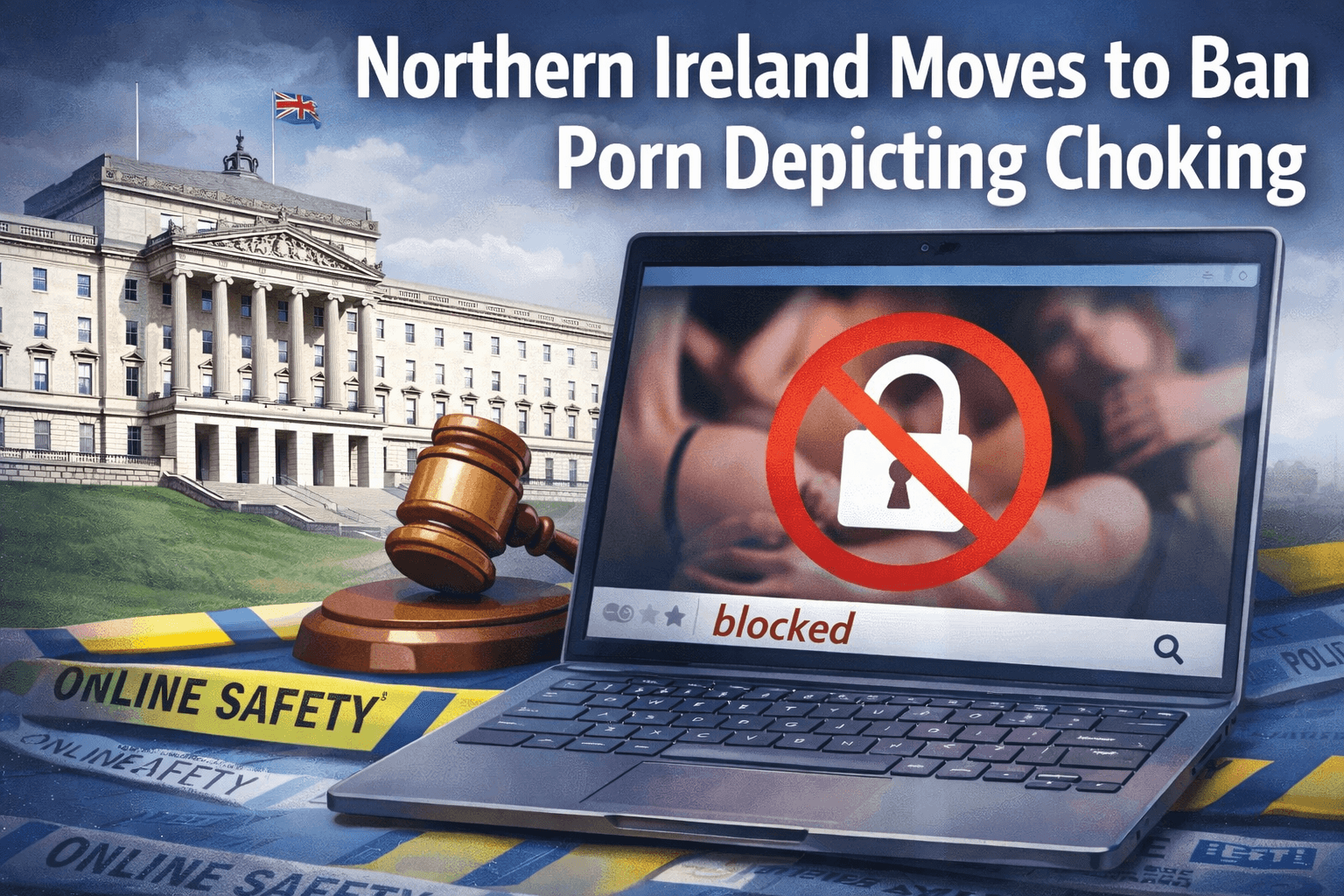
The minister of the Northern Ireland justice has mentioned that porn depictions choking/strangulation may be criminalized in Northern Ireland. The reform would make it a criminal offense to have or share pornographic content that shows strangulation or suffocation and would impose obligations on the platforms to restrict access – reforms that were part of broader reforms on pornography on the internet recommended by an independent survey.
What’s Being Proposed Regards to Porn Depictions?
The proposal would criminalize possession, publication or distribution in Northern Ireland of pornographic images and videos which depict choking, strangulation or suffocation. It is based on the amendments of the Crime and Policing Bill by the UK government and the recommendation of an independent review that recommended a ban on pornographic images of strangulation due to the risks that they carry. The rules would bring NI into the line with UK-wide reforms should they be adopted at Stormont.
Why now? The facts and reasons of the government.
Policymakers refer to studies and professional information that show that this repeated sexual violence, particularly the strangle, in online pornography may normalise unsafe sex, and may lead to copying, particularly in younger viewers. The review of the online pornography conducted by independent people positioned strangulation as a kind of the harmful sexual content, which it can hardly be made safe and advised to be criminalised as the measure of protecting the health of the population and decreasing the violence against women.
Related Stories
 Liver Cirrhosis Treatment and Prevention: Protecting Your Liver for Life
 Alice Rosenblum Nude: A Conversation About Presence, Privacy, and Interpretation
What on earth would be unlawful?
Even though final legal drafting is important, the announcements by the government as well as the proposed changes in the Bill of Law are based on criminalising:
- Having a pornographic content that involves strangulation or suffocation.
- Publication and distribution of such content in such a manner that it is accessible to the users in the UK.
- Platform and host services have a duty to adopt measures so as to ensure that the UK users do not access material that fits the definition.
These actions are a reflection of the wording and the purpose as provisioned by the Crime and Policing Bill amendments and complementary guidance by the government.

Arguments in favour.
Supporters of the ban argue:
- Public safety: Strangulation may result into severe physical damages (including brain damage) and cannot be rendered safe during sexual activity. The normalisation is minimised through the regulation of depictions.
- Reduction of harm among the youth: Since pornography tends to define the standards of sexual expectations, minimizing access to violent sexual materials can minimize the possibility that children and teenagers mimic the risky behaviors depicted.
- Consistency: The relocation is made to connect the disparity between internet and real-world regulation (where the physical distributions have had a history of being more taxing to classify).
Criticisms and concerns.
Opponents, such as proponents of freedom of speech and digital rights, complain about a number of concerns:
- Definitions and scope: The meaning of strangulation or choking will be of importance. Definitions that are poorly drafted are at risk of being too broad (that they capture consensual fetish content, simulated or educational content or material where there is a clear safety precaution in place).
- Privacy and enforcement: Policing of digital possession of personal material presents a problem of law enforcement and civil-liberties. Moderated scanning and blocking of platforms can result in mistakes or blocking a page.
- Productivity: There is some concern among researchers that criminalisation is not enough to prevent demand and that it should be accompanied by other strategies such as education, provision of performers with resources, and platform responsibility and support services to victims.
Enforcement Enforcement, what would it be like in real life?
The government is planning to have a combination of:
- Platform obligations: Tech firms may have to block access to such content by UK users (via moderation, age-gating, geo-blocking, automated detection).
- Criminal law instruments: The police have the power to investigate the publication and distribution of the same and criminal penalties to possession under specified conditions.
- Civil recourses and injunctions: Threats and injunctions of websites where the content is hosted.
Nonetheless, the professionals caution that it is technologically challenging to detect subtle sexual material automatically and that international hosting and anonymity make this process hard to implement. This has implications to creators, performers and users. - Performers and creators: The producers of consensual adult material will have to be cautious regarding the portrayal of throttling/strangulation. Content that is considered to fall under the category of the banned may be unlawfully produced, hosted, and distributed in NI (and possibly outside, as well, in the rest of the UK). Proper risk evaluation and the proper documentation of consent and safety protocols will become increasingly significant- but will not constitute a legal defence in the case where the carrying-out of the act is criminalised.(1)
- Consumers: Individuals who are in possession or share contents that meet the definition of content in the law may face criminal or civil penalties. Sites visited in the UK can block or take down content in order to abide by responsibilities.
International and comparative setting.
The NI proposal is a subset of larger UK movement: since the initial analysis and the next government declarations, the modifications to the Crime and Policing Bill will make the illustration of strangulation a crime throughout the UK (with devolved administrations questioned to duplicate equivalent action where required). There are many other regulatory reactions to violent or extreme online sexual content, which are being followed and observed in other countries and jurisdictions.(2)

Possible unwanted effects to observe.
Censorship of free speech and consensual sex.
It is deleterious to stigmatize and invade privacy of performers and survivors who need safe means to record or report abuse.
Also technical bypasses of laws in which the illegal content is transferred to less visible or encrypted channels which are more difficult to detect and may pose greater risks to performers.
Timeline — what comes next?
The problem is in the sphere of political suggestions and Bill amendments. In the case of Northern Ireland, the justice minister has suggested that the Assembly approves a change to adopt the measures; law change needs a legislative mandate and thereafter, platform and law-enforcement implementation direction. Monitor Bill stages, Stormont debates and final drafting which imposes accurate definitions and penalties.
Actionable tips (on creators, platforms, and the concerned readers)
- Creators/performers: Audit current content; delete or geo-block information that might be covered in the proposed definition; maintain a transparent consent and safety management; consult legal counsel.
- Platforms/hosts: plan your moderation, reporting and age-verification, liaise with legal departments on regulatory compliance and transparency, develop appeals and remedies to curbance unjustified takedowns.
- Parents/teachers: Focus on age-based sex education and media literacy to make the youth know about consent and dangers of imitating porn.
Bottom line.
The action by Northern Ireland to criminalise pornographic images of choking is a subset of a broader UK policy change underpinned by the issue of desensitising violent sex and safeguarding the wellbeing of the population, youth in particular, and possible victims. The effectiveness of the measure will be determined by the ultimate legal definitions, the enforcement strategies, and the support and supplementary measures that are implemented in order to minimize harm but does not interfere unduly with consensual.
+2 Sources
FreakToFit has strict sourcing guidelines and relies on peer-reviewed studies, educational research institutes, and medical organizations. We avoid using tertiary references. You can learn more about how we ensure our content is accurate and up-to-date by reading our editorial policy.
- Creating a Safer World – the Challenge of Regulating Online Pornography; https://assets.publishing.service.gov.uk/media/67bf014ca0f0c95a498d1f9a/The_Challenge_of_Regulating_Online_Pornography__A.pdf
- Crime and Policing Bill; https://publications.parliament.uk/pa/cm5901/cmpublic/CrimePolicing/memo/CPB71.htm