







































 Workout

 Meditation


 Podcast
 E-book


Bind yoga pose, also known as Baddha Konasana or the butterfly pose, is a seated asana that offers numerous physical and mental benefits. This pose involves sitting with the soles of the feet together and holding onto the feet or ankles with the hands.
The bind yoga pose is widely practiced in various yoga styles and is highly regarded for its ability to enhance flexibility, promote relaxation, and stimulate the sacral and pelvic regions.
In this article, we will delve into the benefits of bind yoga pose, explore different variations of the pose, and provide step-by-step instructions on how to perform it correctly. Whether you are a seasoned yogi or a beginner looking to explore new poses, bind yoga pose is a wonderful addition to any yoga routine.
Benefits of Bind yoga pose.
Here are some of the benefits of practicing this yoga pose:
Related Stories
 What to Wear for Yoga – Comfort, Style, and Science
 Yoni Mudra: Benefits, Side Effects, How To Do and Precautions
1 Improved flexibility.
Regularly practicing this yoga pose helps to stretch and open the hips, groin, and inner thighs. This deep stretch improves flexibility in these areas, making it easier to perform other yoga poses and daily activities that require a wide range of motion.(1)
2 Increased circulation.
The compression and release of the pelvic area in Bind pose help to increase blood flow to the lower body. This improved circulation not only nourishes the muscles and joints but also enhances overall energy levels and vitality.(2)
3 Relieved menstrual discomfort.
Bind yoga pose is highly beneficial for women experiencing menstrual discomfort. The gentle opening and stretching of the pelvic area can help alleviate menstrual cramps, reduce bloating, and promote a sense of ease and relaxation during menstruation.(3)
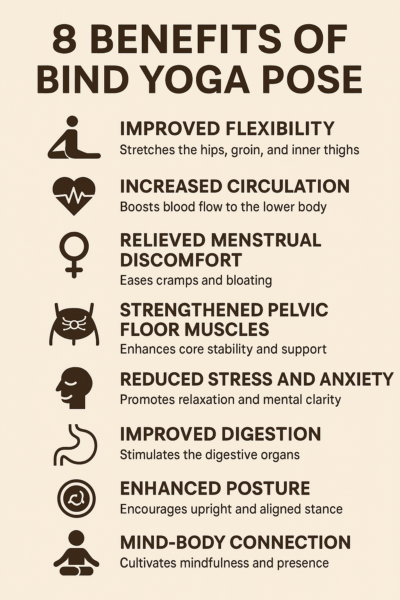
4 Strengthened pelvic floor muscles.
This pose engages the pelvic floor muscles, which play a crucial role in maintaining core stability and supporting the organs in the pelvic region. Regular practice of Bind pose can help strengthen these muscles, preventing issues such as urinary incontinence and promoting better overall pelvic health.(4)
5 Reduced stress and anxiety.
Bind yoga pose encourages a sense of calm and relaxation. The deep hip opening and grounding effect of this pose help to release tension and stress stored in the body, promoting a state of tranquility and mental clarity. It can also help alleviate symptoms of anxiety and mild depression.(5)
6 Improved digestion.
The compression and release of the abdominal area in Bind pose stimulate the digestive organs, promoting healthy digestion and relieving digestive discomfort. This can help alleviate issues such as indigestion, bloating, and constipation.(6)
7 Enhanced posture.
Regular practice of Bind yoga pose helps to improve posture by stretching the muscles of the back, shoulders, and chest. It counteracts the effects of prolonged sitting and hunching over electronic devices, thus promoting a more upright and aligned posture.(7)
8 Mind-body connection.
Bind pose encourages a deep mind-body connection through focused breathing and mindful awareness. The meditative quality of this pose cultivates a sense of presence and inner peace, helping to reduce mental chatter and promote a state of calm and centeredness.(8)
| 💡 Tips FreakToFit.com Incorporating Bind yoga pose into your regular practice can provide a multitude of benefits for both your physical and mental well-being. It is important to approach this pose with patience and respect for your body’s limitations, gradually deepening the stretch over time. As always, it is advisable to consult with a qualified yoga instructor or healthcare professional before starting any new exercise routine, especially if you have any pre-existing health conditions or injuries. |
Variations of Bind Yoga Pose and How to do?
1 Half Bound Angle Pose.
– Start by sitting on the floor with your legs extended in front of you.
– Bend your knees and bring the soles of your feet together, allowing your knees to fall out to the sides.
– Place your hands on the floor behind you for support.
– Inhale and lengthen your spine, then exhale and fold forward from the hips, keeping your back straight.
– If you feel comfortable, you can reach your right hand around your right foot, clasping your right ankle or shin.
– Hold this pose for a few breaths, then release and repeat on the other side.
2 Full Bound Angle Pose.
– Begin in a seated position with your legs extended in front of you.
– Bend your knees and bring the soles of your feet together, allowing your knees to fall out to the sides.
– Interlace your fingers around your feet, creating a bind.
– Inhale and lengthen your spine, then exhale and fold forward from the hips, keeping your back straight.
– You can gently press your elbows against your inner thighs to deepen the stretch.
– Hold this pose for several breaths, feeling the release and opening in your hips and groin.
3 Bound Angle Pose with Forward Fold.
– Start by sitting on the floor with your legs extended in front of you.
– Bend your knees and bring the soles of your feet together, allowing your knees to fall out to the sides.
– Interlace your fingers around your feet, creating a bind.
– Inhale and lengthen your spine, then exhale and fold forward from the hips, keeping your back straight.
– As you fold forward, allow your head to relax and your upper body to relax over your legs.
– Hold this pose for a few breaths, feeling the stretch in your hips, groin, and lower back.
| 💡 Tips FreakToFit.com Remember to listen to your body and take it slow when practicing these variations of the Bind Yoga Pose. With consistent practice, you will gradually increase your flexibility and experience the full benefits of this pose. Enjoy the journey of deepening your practice and finding inner peace and balance.. |
Precautions while doing bind yoga pose.
– Warm up properly before attempting the bound yoga pose to avoid straining your muscles.
– Listen to your body and do not push yourself beyond your limits. Start with easier variations of the pose and gradually progress to more advanced variations.
– Use props such as blocks or straps to help you achieve the bind if you are unable to do so with your hands alone.
– Maintain proper alignment throughout the pose to avoid any unnecessary stress on your joints and muscles.
– Breathe deeply and consistently while in the pose to help you relax and stay focused.
– If you have any pre-existing injuries or medical conditions, consult with a qualified yoga instructor or healthcare professional before attempting the bound yoga pose.
– Do not force yourself into the bind if you experience any pain or discomfort. Modify the pose or release the bind if needed.
– Practice under the guidance of an experienced yoga teacher who can provide proper guidance and adjustment.
Who can do Bind Yoga Pose?
Anyone who is looking to improve their flexibility, balance, and strength can do the Bind Yoga Pose. This pose requires a certain level of flexibility in the shoulders and hips. It is commonly practiced by intermediate to advanced yoga practitioners, as it can be quite challenging for beginners.
The Bind Yoga Pose involves twisting the body and interlacing the hands behind the back while maintaining a steady and grounded stance. It helps to open up the chest, shoulders, and upper back, improving posture and relieving tension in these areas. Additionally, this pose can also help to stimulate the digestive system and improve overall circulation.
It is important to approach the Bind Yoga Pose with patience and mindfulness, as proper alignment and technique are key to achieving its full benefits.
Who should avoid Bind Yoga Pose?
Bind Yoga Pose offers a range of physical and mental benefits. However, there are certain individuals who should avoid attempting this pose. Pregnant women should steer clear of Bind Yoga Pose as it involves deep twisting of the torso, which may potentially strain the abdominal area and jeopardize the well-being of the baby.
Additionally, individuals with chronic back pain or injuries should avoid this pose as it places significant stress on the spine. Those with shoulder or neck injuries should also be cautious, as the pose requires a significant amount of flexibility in these areas.
It is always crucial to listen to your body and consult with a qualified yoga instructor or healthcare professional to determine if Bind Yoga Pose is suitable for your individual circumstances.
How the Bind Yoga Pose Helped Me Open My Body and Mind-Personal Experience.
I am Rahul Verma, 41 — Corporate HR Manager, Bengaluru, India, I spend most of my day sitting at a desk in long meetings and interviews, which left me with constant lower back tension and tight hips.
My physiotherapist suggested trying the Bind Yoga Pose to open my hips and improve circulation. At first, I felt stiff and impatient, but I committed to practicing it every evening for 3–4 minutes.
After a few weeks, I started noticing real changes — my posture improved, my hip discomfort reduced, and I even slept better.
The biggest surprise was the mental calm I felt while holding the pose. It became a short meditation break where I could disconnect from work stress.
Now, I start and end my day with Baddha Konasana, and I recommend it to colleagues who struggle with long hours of sitting.
“Practicing the Bind Yoga Pose every evening helped me release hip tension, calm my mind, and finally find comfort in my own body.”

Expert Opinion.
Dr. Anjali Kapoor, Physiotherapist & Certified Yoga Rehabilitation Specialist, shared her thought that bind yoga pose is especially beneficial for individuals who spend long hours sitting or experience pelvic and lower back stiffness.
By gently opening the hips and activating the pelvic floor, this pose encourages better circulation to the sacral region and reduces muscular tension throughout the lower body.
When practiced consistently and without force, it not only improves flexibility but also supports hormonal balance, digestion, and emotional regulation.
For people dealing with stress or anxiety, the slow, grounded nature of Baddha Konasana can be an excellent tool to calm the nervous system.”
Frequently Asked Questions.
1 Is Bind Yoga Pose (Baddha Konasana) good for beginners?
Yes. Bind pose is beginner-friendly because you can practice it with props like blocks, cushions, or a yoga strap. Beginners don’t need to force the knees down — the goal is gentle opening, not pushing flexibility.
2 How long should I hold the Butterfly or Bound Angle Pose?
Typically 2–5 minutes in Yin-style practice.
If you’re doing it in a regular yoga class, 30 seconds to 1 minute is common.
Longer holds help in deep connective tissue release and hip opening.
3 Why does my lower back hurt in Bind Pose?
Lower back pain usually happens because:
You are rounding your spine
Your hips are tight
Knees are dropping without support
Use cushions under the knees and sit on a folded blanket to elevate the hips — this reduces strain on the lower back.
4 Can Bind Yoga Pose help with menstrual cramps?
Yes. Many people report reduced menstrual pain, bloating, tension, and pelvic discomfort because the pose stretches and relaxes the pelvic floor, hip flexors, and inner thighs.
However, if cramps are severe, avoid deep folding and use a more restorative variation.
5 How often should I practice Bind Yoga Pose to improve flexibility?
Consistency is key.
Practicing 3–5 times per week is ideal, even if it’s only for a few minutes.
Avoid forcing the stretch — slow, relaxed opening is more effective than aggressive pushing.
Bottom Line.
The Bind Yoga Pose is a challenging and invigorating posture that offers numerous benefits for both the body and mind. By engaging various muscle groups, improving flexibility, and promoting balance, this pose helps to strengthen the body and increase overall physical fitness.
Additionally, this pose encourages deep breathing and mental focus, promoting relaxation, stress reduction, and improved mindfulness. Whether practiced by beginners or experienced yogis, the Bind Pose offers a wonderful opportunity for personal growth and self-discovery on the yoga mat.
So, embrace the challenge, explore your limits, and enjoy the many rewards that the Bind Yoga Pose has to offer.
+8 Sources
FreakToFit has strict sourcing guidelines and relies on peer-reviewed studies, educational research institutes, and medical organizations. We avoid using tertiary references. You can learn more about how we ensure our content is accurate and up-to-date by reading our editorial policy.
- Effects of Yoga on Flexibility and Balance: A Systematic Review; https://pubmed.ncbi.nlm.nih.gov/27918688/
- Effects of Yoga Practices on Circulatory Health: A Systematic Review; https://www.sciencedirect.com/science/article/pii/S209525461830060X
- Effects of Yoga on Menstrual Symptoms — A Systematic Review and Meta-Analysis; https://pubmed.ncbi.nlm.nih.gov/31088565/
- Yoga for Pelvic Floor Dysfunction: A Systematic Review; https://pubmed.ncbi.nlm.nih.gov/30794420/
- Yoga as a Complementary Therapy for Anxiety and Depression: Meta-analysis; https://pubmed.ncbi.nlm.nih.gov/29157455/
- Yoga Improves Gastrointestinal Symptoms: Randomized Controlled Trials Review; https://pubmed.ncbi.nlm.nih.gov/26196189/
- Impact of Yoga Practice on Posture Alignment and Musculoskeletal Imbalances; https://pubmed.ncbi.nlm.nih.gov/30465381/
- Yoga, Mindfulness, and Interoception: Neuroscientific Review; https://pubmed.ncbi.nlm.nih.gov/28110062/