












































 Workout

 Meditation


 Podcast
 E-book


The mind-muscle connection is a strategy that has been talked about a lot and that can be very important in the sports field, especially when the goal is to increase muscle mass.
The problem is that benefits may have been attributed to it that it may not have .
This time we are going to show you what the mind-muscle connection can be used for and in which cases you should use it.
What is the mind-muscle connection for?
The mind-muscle connection is defined very simply. It is the ability we have to concentrate on a specific muscle while doing an exercise so that we can activate it better and thus achieve better results.(1)
Related Stories
 Simple 9 Exercise for Muscular and V Shape Back
 8 Types of Warm Up Exercise With Advantages
What we know for now is that this increase in muscle activation can indeed occur , but the evidence is not clear enough to affirm that this can cause us to gain more muscle mass.
In fact, generally when a person trains with the goal of gaining muscle mass, it is most normal for them to work close to failure . By doing this, the electrical activity of the muscle is already maximized without having to pay attention to the mind-muscle connection.
When you should turn to the mind-muscle connection?
If you still want to put the mind-muscle connection into practice, you can do it perfectly. There is no problem in doing it when it can really be good for you.
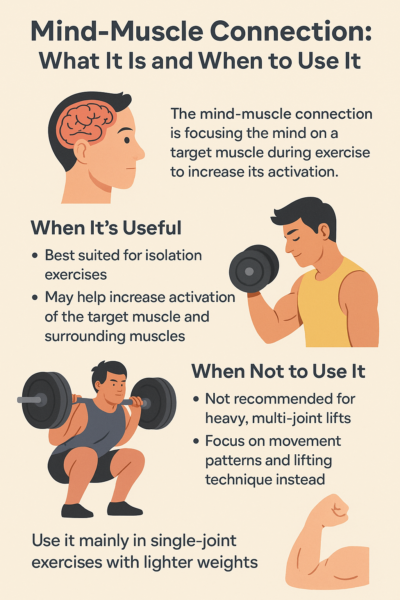
It is advisable that you reserve this especially for isolation exercises , in which preferably you do not carry too much weight and the risk of injury is relatively low.(2)
If you do this you may increase the activation of the particular muscle you focus on and also the muscles surrounding it, but again. Reserve it for single-joint exercises.(3)
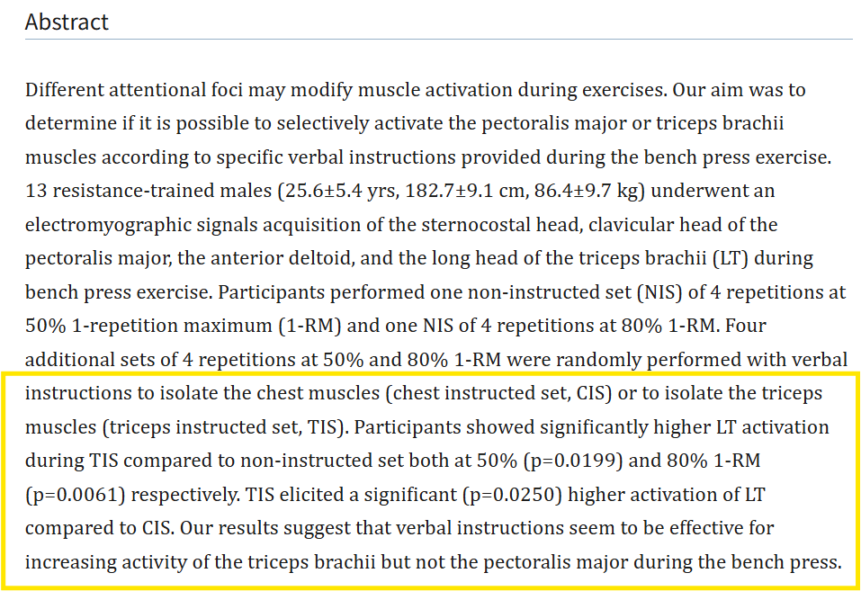
For multi-joint exercises, it is advisable that you focus on what are known as external control patterns, which are orders that you can focus on that have to do with the execution of the exercise.
For example, in a bench press it may be advisable for you to focus on lifting the bar as fast as you can.
By doing this you will allow your own body to find the most efficient movement pattern to carry out that order, instead of trying to be the one to determine which specific muscles have to be activated.
These guidelines have greater evidence than the mind-muscle connection (which is an internal control pattern) with respect to improving performance, so they can also be useful in exercises that involve heavier and more demanding work.
Practical Examples of When to Use Mind-Muscle Connection.
You can safely apply the mind-muscle connection in exercises such as:
- Biceps curls.
- Triceps pushdowns.
- Chest flyes.
- Lateral raises.
- Leg extensions.
- Hamstring curls.
In these movements, the goal is not to lift maximum weight, but to place tension directly on a specific muscle. This is where the mind-muscle connection is most useful.
When You Should NOT Rely on Mind-Muscle Connection?
You should avoid using it as a main focus during:
- Squats.
- Deadlifts.
- Bench press.
- Overhead press.
- Pull-ups.
- Rows.
These exercises involve multiple muscle groups and joints. In these cases, focusing on technique, bar path, and force production is more important for safety and performance.
How Mastering the Mind–Muscle Connection Changed the Way I Train Forever- My Personal Experience.
I am Sanav Malhotra, 34, Certified Strength Trainer, Gurugram, India, when I first learned about the mind-muscle connection, I tried using it on every heavy lift — squats, deadlifts, bench press. Instead of getting stronger, I started feeling less explosive and more fatigued. Later, I realized my mistake: I was overthinking during compound lifts. Once I limited the mind-muscle focus only to isolation exercises like bicep curls, leg extensions, and lateral raises, my muscle activation and control improved without harming my strength performance. That balance changed the way I train my clients today.
“The mind-muscle connection works best when used selectively — not on every heavy lift.”

Expert Opinion.
As per Dr. Ankit Verma, Sports Physiologist & Performance Consultant, the mind–muscle connection is most useful during isolation exercises where muscular control matters more than absolute load. For compound lifts like squats, deadlifts, and bench press, external focus cues improve performance and force output more effectively. Used correctly, both strategies have their place in intelligent training.
Frequently Asked Questions.
1 Does the mind-muscle connection really help build more muscle?
It increases muscle activation, but current research does not strongly prove that it directly leads to more muscle growth compared to training near failure.
2 Should beginners use the mind-muscle connection?
Beginners should first focus on proper form and movement patterns. Mind-muscle focus can be added later for isolation exercises.
3 Is mind-muscle connection bad for heavy lifting?
It’s not “bad,” but it can reduce performance in heavy compound lifts because overthinking may interfere with natural force output.
4 Which exercises are best for using mind-muscle connection?
Isolation exercises like:
Bicep curls.
Leg extensions.
Triceps pushdowns.
Lateral raises.
5 Can mind-muscle connection reduce injury risk?
Yes—during light, controlled movements, it helps improve awareness and form, which may lower injury risk.
Bottom Line.
The mind-muscle connection is a useful tool, but it is not a magic method for gaining more muscle. It can help improve muscle activation in isolation exercises, but when it comes to lifting heavy weights and improving performance, external focus and good execution are far more effective.
Use the mind-muscle connection wisely, apply it where it truly adds value, and do not depend on it as the primary strategy for muscle growth.
+3 Sources
FreakToFit has strict sourcing guidelines and relies on peer-reviewed studies, educational research institutes, and medical organizations. We avoid using tertiary references. You can learn more about how we ensure our content is accurate and up-to-date by reading our editorial policy.
- Importance of mind-muscle connection during progressive resistance training; https://pubmed.ncbi.nlm.nih.gov/26700744/
- Monitoring Neuromuscular Activity during Exercise: A New Approach to Assessing Attentional Focus Based on a Multitasking and Multiclassification Network and an EMG Fitness Shirt; https://pmc.ncbi.nlm.nih.gov/articles/PMC9855857/
- Mind-muscle connection: effects of verbal instructions on muscle activity during bench press exercise; https://pmc.ncbi.nlm.nih.gov/articles/PMC6615069/