











































 Workout

 Meditation


 Podcast
 E-book


The Fast Facts
- You can also perform this exercise with a partner by holding one end of the band while your partner does the same at the other end.
- Whether you’re playing in the Little or Major League, you can use these simple exercises to improve your overall skills and become a better player.
- Let’s take a look at how to use J-Bands to enhance your game skills and become a better baseball player.

J-Bands are a simple baseball training tool that can be utilized to improve several aspects of your game. Whether you’re playing in the Little or Major League, you can use these simple exercises to improve your overall skills and become a better player. Let’s take a look at how to use J-Bands to enhance your game skills and become a better baseball player.
What Are J-Bands Used For In Sports?
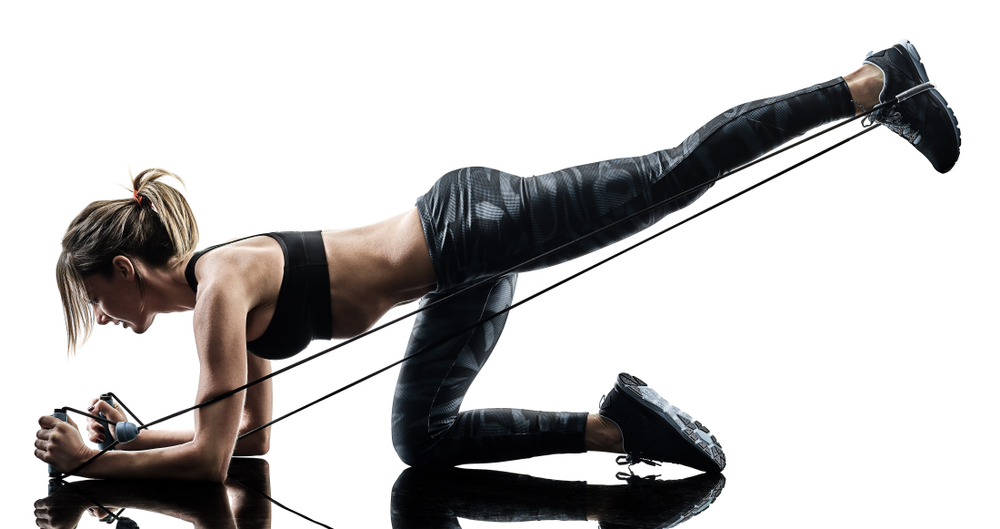
J-Bands exercises are a great way to improve your baseball skills. It provides resistance training that can assist you build strength and power in your swing. These bands can also help improve your range of motion and flexibility, which can lead to better performance on the field. Additionally, using J-Bands can help reduce the risk of injury. With all of these benefits, it’s no wonder why more players are making use of this simple but effective tool.
How Do I Get Started?
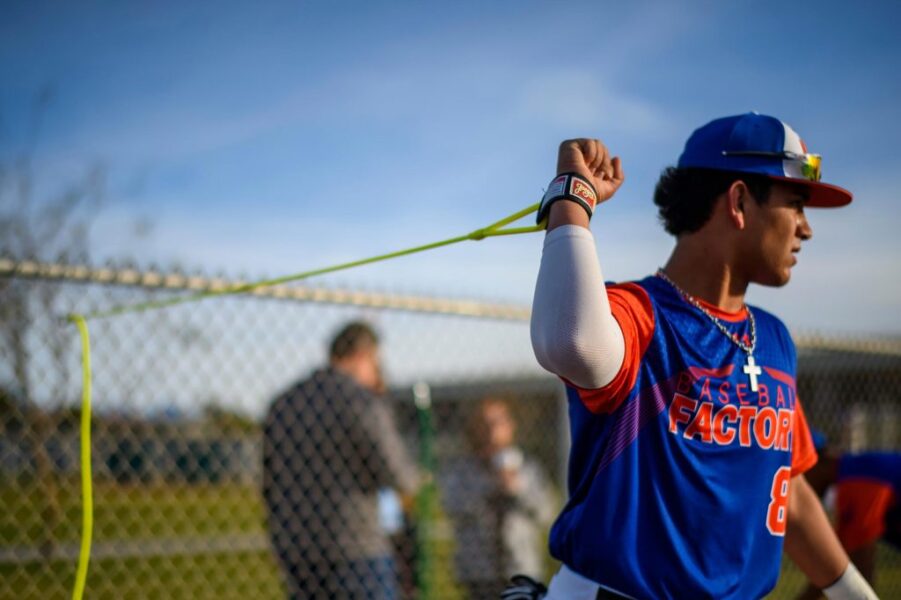
Attach the band around a sturdy post or pole, and stand with your feet shoulder-width apart. Step laterally away from the post, maintaining tension on the band. Return to the starting position, and repeat for the desired number of repetitions.
Related Stories
 14 Incredible Health Benefits of Regular Walking
 27 Best Upper Body Exercises for Strength and Mass
You can also perform this exercise with a partner by holding one end of the band while your partner does the same at the other end. Move as far in either direction as possible before returning to the start position. Switch roles so each person completes the set.
How Do I Increase My Band Resistance?
To increase the resistance of your J-Band, simply move your hands closer together. For example, if you are doing a bicep curl, bring your hands closer to your shoulder so that the band has to stretch further. You can also use a thicker band for more resistance.
As you get stronger, you will be able to increase the resistance of your J-Band exercises. These bands are great because they come in three different colors: red, blue and black. When looking at these colors, it’s easy to tell which ones would work best for you depending on your skill level.
Blue is the lightest weight and is recommended for those who have not played baseball before or are just starting out with these bands.
Black is designed for those who have been playing baseball since they were young and want something heavier to challenge themselves with.
Red is perfect for those who want an in between option where they still feel challenged but aren’t looking to push themselves too hard with intense workouts yet.
What Should I Do To Use Them At Home?
To use J-Bands at home, at first you’ll need to purchase a set. You may find these online or at a sporting goods store. Once you have your bands, set them up in a door frame or another sturdy object.
However, make sure that the band is at proper chest height. To perform the exercise, stand with your back to the band and grab each end with your hands. Step forward until there is tension on the band, then slowly squat down. Return to the starting position and repeat.
What Should I Do If I’m Playing?
On the field, follow all of the same steps as when using J-Bands at home. First make sure that the band is around waist level and stretched out tightly so that it doesn’t snap when stepped on. Next step onto one end of the J-Band by standing with your foot near one of its ends. Lift up your other foot and step onto the other side of the band, pulling it towards you so that it’s tight against your body.
| Read Now: Top 4 Benefits of Using Hip Circle Bands |
What Are Some Ways To Incorporate The J-Band Into My Training?
One way to use the J-Band is by performing bicep curls. Start by attaching the band to a sturdy post or pole. After the band is secure, stand with your feet shoulder width apart and hold the band with your palms facing up. Curl your hands towards your shoulders, keeping your elbows close to your body. Slowly return to the starting position and repeat for 12-15 repetitions.
Benefits of J-Bands Exercise?
J-Bands exercises are a type of resistance training that can help improve your baseball skills. The bands are placed around your thighs and provide resistance as you move your legs. This resistance helps to build strength and power in your legs, which can be beneficial for on-field performance.(1) Additionally, J-Bands exercises can improve your range of motion and flexibility, both of which are important for baseball players.(2)
Additional Tips For J-Bands Exercises.
1 Anchor the band around a sturdy post or pole.
2 Step away from the anchor point to create tension on the band.
3 Perform various exercises with your arms, such as arm curls or triceps extensions.
4 You can also use J-Bands to perform leg exercises, such as squats or lunges.
5 For more challenge, try doing the exercises while holding a medicine ball.
6 Be sure to warm up before performing any exercises with J-Bands, and stretch afterwards to avoid injury.
7 With regular use, you’ll see an impressive improvement in your baseball skills within a month.
| Read Now: Prone Cobra Exercise : How To Do? |
Bottom Line.
J-Bands are a great tool for any baseball player looking to improve their skills. By providing resistance training, they can help increase strength and stamina. Additionally, J-Bands can also improve your range of motion and flexibility. With regular use, you’ll see a significant improvement in your performance. If you want the best results, it’s important to find the tension that works best for you.
Stretching with J-Bands is a great way to relieve sore muscles after an intense workout or long day on the field. Give these exercises a try today.
+2 Sources
Freaktofit has strict sourcing guidelines and relies on peer-reviewed studies, educational research institutes, and medical organizations. We avoid using tertiary references. You can learn more about how we ensure our content is accurate and up-to-date by reading our editorial policy.
- Effects of training with elastic resistance versus conventional resistance on muscular strength: A systematic review and meta-analysis; https://www.ncbi.nlm.nih.gov/pmc/articles/PMC6383082/
- Effects of a Sport-Specific Upper-Body Resistance-Band Training Program on Overhead Throwing Velocity and Glenohumeral Joint Range of Motion; https://pubmed.ncbi.nlm.nih.gov/32028464/