
















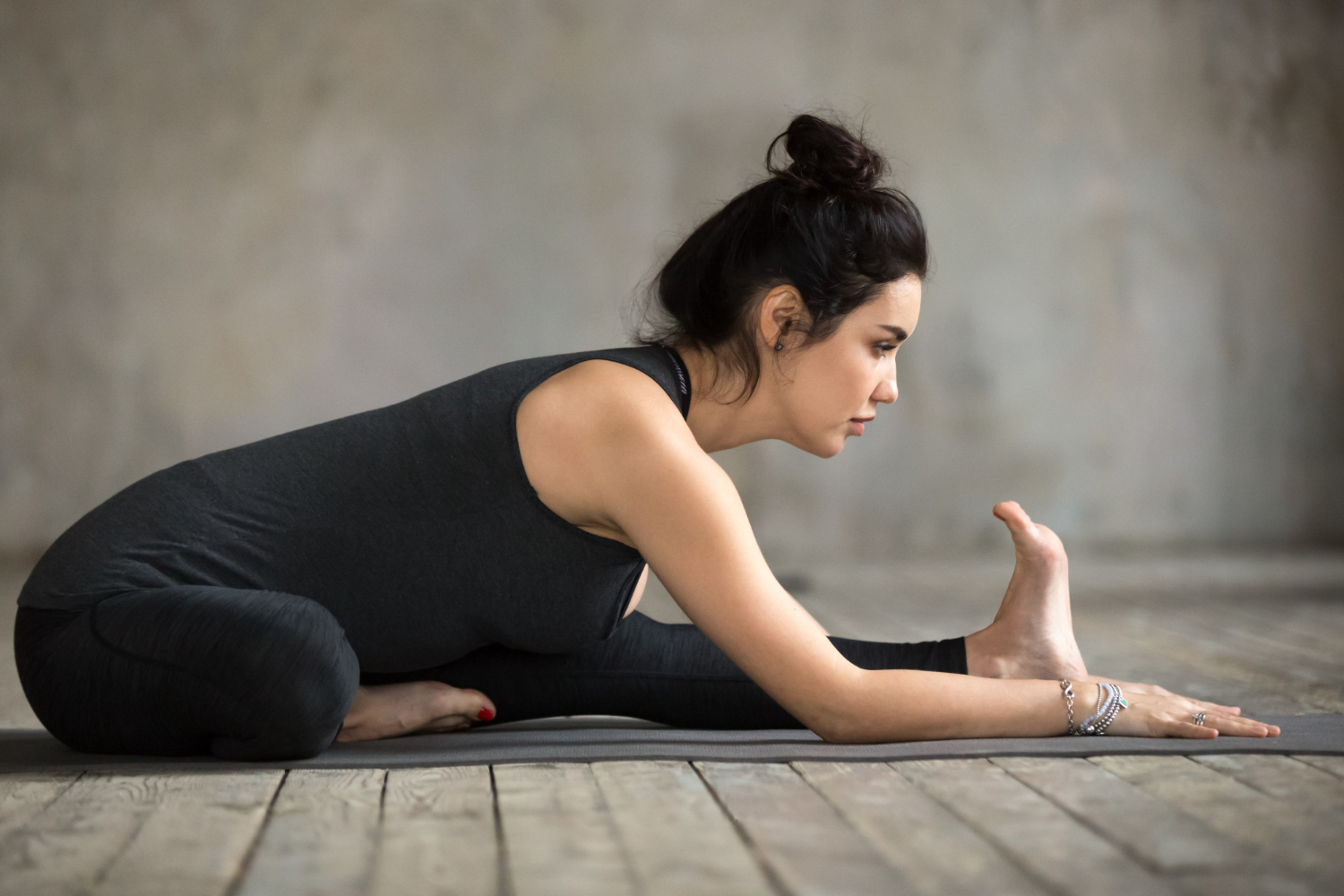
Bind Yoga Pose is typically used to describe yoga poses where the arms or hands are wrapped around the body and meet, usually by grasping hands, wrists or fingers.
“Bind Yoga Pose” is not a single standardized pose, but rather a group of poses that are all bound together. Bind is actually a method that has been used in Yoga poses rather than a pose.
There are poses you may find yourself in that could cause binding, these include:
- Bound Side Angle Pose
- Bound Revolved Side Angle Pose
- Bound Extended Side Angle variations
- Bound Half Moon variations
- Bound Lotus variations
- Bound Forward Fold variations
- Cow Face Pose arm variations
- Seated twists with a hand-to-wrist bind
It can be more difficult to perform a familiar posture with a bind because it can involve a combination of shoulder mobility, thoracic rotation, hip mobility, balance, coordination, and body awareness.
Cerita terkait
 Pengalaman Saya dengan Pose Heron Yoga: Manfaat, Bagaimana Saya Melakukannya, dan Tindakan Pencegahan yang Saya Ikuti
 Wisnu Mudra: Manfaat, Cara Melakukan dan Tindakan Pencegahan
It is important to note that the purpose of a bind should NOT be to press hands together. A safe bind is one that can be worn with the correct alignment and that allows you to breathe easily.
In general, research on yoga indicates positive effects on physical function, balance and flexibility; however, research typically focuses on a yoga practice or program, not a specific bind technique. For instance, a systematic review of yoga in healthy populations was conducted to assess its effects on balance and concluded that there was evidence for balance, but significant diversity in yoga styles and quality of studies.(1)
As a result, it is important to moderate any statements about the advantages of a specific bind.
Why Are Yoga Binds Considered Advanced?
At first glance, a yoga bind can look like nothing more than putting your hands together.

In fact, the movement can impact multiple areas at once.
There are some poses that require:

Shoulder mobility: Your shoulders may need to move through internal or external rotation.
Thoracic mobility: Twisting poses require movement through the upper and middle spine.
Hip mobility: Some binds are combined with deep hip flexion, external rotation or standing-leg stability.
Hamstring flexibility: Forward-folding binds can require considerable posterior-chain mobility.
keseimbangan: Standing binds may reduce the amount of arm movement available for balance correction.
Coordination: You have to maintain the position of the legs, pelvis, spine and arms simultaneously.
This is why forcing a bind simply because someone else can perform it is not a good strategy.
A person may have excellent hip mobility but limited shoulder mobility, or vice versa.
Potential Benefits of Bind Yoga Poses.
1. They can challenge the mobility of their shoulder girdle.
A number of binds call for the shoulders to flex more than normal standing postures.
This may include:
- Shoulder rotation
- Scapular movement
- Chest opening
- Arm coordination
But reaching hands around the body is very dependent on mobility and individual anatomy.
Therefore, a bind should not be looked at as a flexibility test, but rather a mobility challenge.
There is emerging research focusing on yoga’s effect on the mobility of the shoulders and spine. A 2024 systematic review found 8 studies that investigated yoga interventions and spine/shoulder mobility, which had some improvements in spinal flexibility and mobility, but included a range of populations and interventions.(2)
This evidence is general to yoga interventions, not specific to a specific bound pose.
2. It Can Encourage Spinal Rotation.
Twists are common in many poses that are performed.
A bound revolved side angle variation includes, for example:
- Standing-leg stability
- Hip positioning
- Spinal rotation
- Shoulder movement
- Arm binding
A controlled rotation can be used to explore the movement in the spine.
However, it is not a rule that more rotation is better.
It is important not to force the spine to twist to get a deeper looking pose.
3. It Can Help Improve Body Awareness.
One of the real advantages of doing the difficult Pose Yoga is that you learn to be aware of what is going on in your body.
Berikut adalah key ingredients to a successful praktek:
- Where you feel pain or discomfort.* Where tension is felt.
- If you experience any changes in your breathing.
- Ask yourself whether shoulders are tight.
- Ask yourself if shoulders are tight.
- Have trouble walking straight.
- If the movement is from the intended joint, what is the specific motion that is intended?
- How to tell if pain is developing.
This awareness can be more valuable than achieving the final shape.
4. It Can Challenge Balance.
Standing bound poses and poses with any rotation and/or asymmetrical position may make balance a little more challenging.
There is some research that backs up the wider connection between yoga practice and balance.
A 2014 systematic review found 11 of the 15 studies with 688 healthy participants reported positive results on at least one balance outcome. Nevertheless, the researchers highlighted the differences in the quality of the studies, Jenis Yoga, duration and frequency.
A recent systematic review of 18 RCTs with 1408 healthy participants also concluded that yoga has low certainty evidence for improving balance, and less certain evidence for falls and bone mineral density.(3)
These results reinforce the notion that yoga can challenge balance, but not that any specific bind is better for balance.
5. It may result in functional flexibility.
Flexibility and control are frequently used in yoga.
This is not the same as static, or passive, muscle stretching.
In a bind, you will try to take your body through a specific position while trying to control your body.
In older people, yoga interventions have been shown to enhance physical-function outcomes, including balance and lower-body flexibility, versus inactive controls.(4)
Again, this evidence does not pertain to training specific to bind, but to yoga interventions.
6. It can improve coordination.It can help to improve coordination.
There are multiple body parts that need to work together to create a binding.
In the case of a standing twist, for instance:
The base is formed by the feet.
2. Body is held steady by the legs.
3. Pelvis remains stable.
4. The torso rotates.
5. The shoulders move.
6. The hands connect.
7. Breathing continues.
This presents a coordination problem that can make the pose challenging to their mind.

Common Types of Bind Yoga Poses.
Bound Side Angle Pose.
One of the most popular standing bind variations is Bound Side Angle.
Practitioner starts in a side angle position, placing one arm under front thigh and other arm behind back.
Eventually, the hands will fuse together.
The pose challenges:
- Mobilitas Pinggul
- mobilitas bahu
- Thoracic rotation
- Leg strength
- imbangan
Good for beginners; they don’t have to connect their hands.
A yoga strap can come in handy for hand-to-hand connection.
Bound Revolved Side Angle Pose
More challenging rotation and binding.
Torso turns towards the front leg and arms form the bind.
This is more challenging than a traditional side angle due to the need for the shoulder and rotation to happen at the same time.
It is generally more appropriate for those who are familiar with the unbound version.
Bound Half Moon.
Bound Half Moon is a blend of:
- Single-leg balance
- Hip control
- Spinal positioning
- mobilitas bahu
- Arm binding
The bind may be too difficult to do too early because you’re performing it with one foot off the ground.
Learn and practice Half Moon first.
Proceed gradually adding the arm variation.
Bound Lotus Variations.
A bind is some of the yoga poses that use seating or balancing positions that include the legs in Lotus or a lotus-like position.
These are a lot more advanced.
They need a lot of hip mobility and attention to the knees.
A key point to understand is that the knee should NOT be forced to go into a ‘Lotus’ position just to bind.
The knee can be subjected to unwanted stress due to limited hip mobility.
Cow Face Pose Arms.
It’s okay if the lower kumpulan of Cow Face Pose is not part of the arm bind.
An upper-body position can be utilized as a mobility exercise.
One arm is extended overhead and bent behind one’s head, the other arm extended upwards behind the back.
If hands do not touch, then use a strap!
This is a great case in point as to why a bind should not be viewed as a one or the other proposition.
How to Practice a Bind Safely?
Langkah 1: Pemanasan.
Don’t try your deepest bind right away.
Start with a few minutes of ‘cool down’ activity.
You might include:
- anak sapi
- Shoulder circles
- Thread the Needle
- Gentle twists
- Low lunges
- Side bends
- Standing poses
The intent is not to “force flexibility” but rather to condition the body for movement.
Step 2: Learn the Unbound Pose.
Before attempting the bind, learn the underlying posture.
Misalnya:
Side Angle → Bound Side Angle
Revolved Side Angle → Bound Revolved Side Angle
Half Moon → Bound Half Moon
This allows you to understand the foundation before adding complexity.
Step 3: Use a Strap.
One of the most helpful props for doing binds is a yoga strap.
If hands are not able to touch each other, use an opposite end of a strap.
This will help you feel the overall position without exerting a strong grip on the shoulders.
You don’t have to be “not flexible enough” to wear a strap.
It’s just a modification tool!
Step 4: Keep the Breath Comfortable.
One of the most frequent errors is to try to do the bind while holding your breath.
Rather, take deep and steady breaths.
If breathing is difficult, it might be too strenuous.
Back off slightly.
Step 5: Avoid Pulling.
Pull arms back, but not too hard.
It’s fine if the hands are a few centimetres apart.
Mobility develops gradually.
Step 6: Exit Slowly.
The practice involves getting out of a bad position.
If needed, let go of the hands first.
Bring slowly back to neutral position.
Be careful not to make quick movements after taking an uncomfortable pose.

Beginner-Friendly Bind Progression.
If you’ve never practiced yoga binds, then give this sequence a try.
Level 1: Basic Mobility.
praktek:
- Shoulder circles
- Thread the Needle
- Gentle chest opening
- Standing twists
- Low lunge
Level 2: Unbound Poses.
praktek:
- Side Angle
- Revolved Side Angle
- Half Moon
- Forward Fold
- Cow Face arms
Level 3: Strap-Assisted Binds.
Put hands together with a strap.
Try to work on alignment instead of depth.
Level 4: Partial Bind.
Experiment with the hands being brought together—without forcing—without being too near.
Level 5: Full Bind.
Once the movement is comfortable and controlled, try to join the hands without using any assistance.
kesalahan umum.
Forcing the Hands Together.
This is likely the most frequent error!
The hands touching is not the purpose of the pose.
It’s more important that the movement is good than the final shape.
Rounding the Spine Excessively – Corrected: The spine should remain flat and rounded.
Some practitioners give up on the position of their spine just to get their hands.
This negates the purpose of the posture.
Locking the Knees.
Do not hyperextend the knees when standing.
Keep legs under body, but active and controlled.
Pulling the Shoulder.
Attempting to push the arms into position can put too much strain around the shoulder.
Release the bind if it is causing any sharp pain, instability or pinching.
Ignoring the Hips.
When making poses that require deep rotation or Lotus positions, the hips must be able to move.
It can be difficult to create the movement from the knee.
Comparing Yourself With Advanced Practitioners.
Flexible yoga photos tend to portray extremely flexible yoga practitioners.
You could have entirely different anatomy.
Differences in:
- Bone structure
- Joint shape
- Limb proportions
- Previous activity
- mobilitet
- Riwayat pelatihan
can determine if hands can reach each other.
Bind Yoga Pose and Flexibility.
Flexibility doesn’t mean one thing.
You can have:
- Good hamstring flexibility.
- Limited shoulder mobility.
- Good hip mobility.
- Limited thoracic rotation.
at the same time.
So, if you can’t do one particular bind doesn’t necessarily mean you’re “in flexible.
In 2019, yoga was found to improve lower-body flexibility and physical function compared with inactive controls in a systematic review of yoga in older adults, although the type of yoga and interventions were different among the studies.
The practice lesson is straightforward:
Concentrate on the type of movement needed for your selected position, and not on being flexible in all positions.
Bind Yoga Pose for Beginners.
If you are completely new to yoga, don’t start with advanced binding poses.
Begin with foundational movements.
Rutinitas sederhana dapat mencakup:
2 menit: Easy standing movement
1 menit: Shoulder circles
1 menit: anak sapi
2 menit: Low lunge on each side
1 menit: Standing side angle
1 menit: Gentle twist
2 menit: Side Angle without binding
1–2 minutes: Strap-assisted arm bind
Finish with relaxed breathing.
The exact duration is less important than consistency and comfort.
Who Should Be Careful With Bind Yoga Poses?
If you have any of these, take extra precautions:
A recent injury to the shoulder
- Shoulder instability
- Significant wrist pain
- An injury to the spine that occurred recently.
- Cedera pinggul
- Knee injury
- Masalah keseimbangan yang parah
- operasi baru-baru ini
- Persistent unexplained pain
Those who suffer from such problems should seek professional advice before doing difficult variations.
Some pregnancy variations also need to be modified as some twisting, compression and balancing positions may not be suitable according to the stage of pregnancy and the individual.
In the event that you’re pregnant or have a medical condition, please check with your healthcare provider to determine safe yoga practices.
Pain vs Stretching Sensation.
This is a critical distinction to make!
A slight stretch is normal.
Pain is different.
If you feel:If you feel you are experiencing:
- Sharp pain
- Burning pain
- rasa sakit yang tiba-tiba
- Joint pain
- mati rasa
- geli
- Loss of strength
- A sensation of instability in the joint
Don’t do no pain, no gain in yoga.
The more intense the activity, the more benefit it brings does not necessarily apply.
Can Bind Yoga Poses Improve Posture?
Yoga can involve postural awareness, trunk control, balance and mobility.
Others studies indicate that yoga can enhance physical-function measures, including Keseimbangan dan fleksibilitas.
But, it would be easy to believe that if someone did a bind it would somehow “fix posture.
Posture is dynamic, determined by strength, mobility, habits, environment, pain, and fatigue, and is influenced by individual anatomy.
A balanced Yoga practice where strengthening and mobility work is more useful than just repeatedly forcing one posture.
Bind Yoga Pose and Mental Well-Being.
Yoga is also regularly performed for relaxation and psychological health.
Some evidence was found for psychological well-being in healthy adults based on a systematic review and meta-analysis of 17 randomized controlled trials (RCT) (confined to a weak level of evidence due to limitations such as unclear risk of bias.(5) Therefore, a bind should not be sold as a medicine for anxiety, depression and other mental health issues.
But, breathing and practicing a controlled Yoga sequence might be part of a Mind/Body program.
I am often asked how long to hold a bind, the answer is always 10 to 15 minutes.
How Long Should You Hold a Bind?
A short and comfortable hold is generally better for beginners than a more difficult hold that they will have to maintain for several minutes.
Fokus pada:
- Smooth breathing
- Stable alignment
- Relaxed facial muscles
- Controlled shoulders
- Tidak ada rasa sakit yang tajam
As you get more proficient you can add in more practice time.
Bind Yoga Pose vs Regular Stretching.
A classic stretch could be mainly on increasing motion.
A Yoga Bind can be used in conjunction with:
- imbangan
- kekuatan
- koordinasi
- pernafasan
- pemusatan
- kesadaran tubuh
This is more stimulating than holding a static stretch.
Both of these strategies can be employed concurrently without being mutually exclusive.
Many find it more convenient to use mobility exercises in conjunction with strengthening and controlled movement than to use just one of the exercises.
Seberapa sering Anda harus berlatih?
It is usually better to stick to the low-intensity sessions rather than intense ones once in a while.
Try yoga for mobility several times a week, depending on how it feels and how well you are recovering.
When starting out, start with shorter sessions.
Daily practice of an advanced bind is not necessary.
One helpful weekly strategy is to:
- 2–3 mobility sessions
- 1–2 strength-focused sessions
- Regular walks and/or other exercise
- Days of leisure (as required)
The actual workout time will depend on your fitness and objectives.
pertanyaan yang sering diajukan.
1. What is a Bind Yoga Pose?
A Bind Yoga Pose is a yoga posture incorporating an arm or hand connection around the body. There is no single universal pose called “Bind Yoga Pose.”
2. Are bind poses suitable for beginners?
Some simplified versions are. Beginners should start with unbound poses and use a strap rather than forcing their hands together.
3. Why can’t I bind my hands?
Limited shoulder mobility, thoracic rotation, hip mobility or individual anatomy may contribute. It does not necessarily mean you are doing anything wrong.
4. Should I use a yoga strap?
Yes. A strap is an excellent modification for practicing the movement without forcing your shoulders.
5. Can yoga binds improve flexibility?
Yoga programs can improve some measures of flexibility, particularly physical function and lower-body flexibility in certain populations. However, evidence specific to individual bind poses is limited.
6. Are bind poses good for balance?
Some standing binds challenge balance, and broader research suggests yoga can improve balance. However, research has not established that bind poses themselves are uniquely effective for balance.
7. Can I practice bind poses every day?
You can practice gentle mobility work regularly, but demanding binds do not need to be performed daily. Allow recovery if your shoulders, hips or other joints become irritated.
8. Should my hands touch?
No. Your hands do not need to touch for the pose to be effective.
9. What should I do if I feel shoulder pain?
Release the bind and return to a comfortable position. Persistent or significant pain should be evaluated by an appropriate healthcare professional.
10. Is a deeper bind better?
No. Depth is not the goal. A controlled, pain-free position with comfortable breathing is more important.
Final Takeaway
Bind Yoga Pose is best understood as a family of yoga variations rather than one specific posture.
Binds can add complexity to familiar poses by combining shoulder mobility, spinal rotation, hip mobility, balance, coordination and concentration.
They can be visually impressive, but the ability to achieve a full bind is not a measure of how “good” someone is at yoga.
+5 sumber
FreaktoFit memiliki pedoman pengadaan yang ketat dan bergantung pada studi peer-review, lembaga penelitian pendidikan, dan organisasi medis. Kami menghindari penggunaan referensi tersier. Anda dapat mempelajari lebih lanjut tentang bagaimana kami memastikan konten kami akurat dan terkini dengan membaca Kebijakan Editorial.
- tinjauan sistematis yoga untuk keseimbangan dalam populasi yang sehat; https://pubmed.ncbi.nlm.nih.gov/24517304/
- Menjelajahi efek terapeutik yoga pada mobilitas tulang belakang dan bahu: tinjauan sistematis; https://pubmed.ncbi.nlm.nih.gov/39593648/
- Pengaruh Yoga terhadap Keseimbangan, Jatuh, dan Metabolisme Tulang: Tinjauan Sistematis Uji Coba Terkendali Acak pada Individu Sehat; https://pubmed.ncbi.nlm.nih.gov/39607489/
- The effects of yoga compared to active and inactive controls on physical function and health related quality of life in older adults- systematic review and meta-analysis of randomised controlled trials; https://pubmed.ncbi.nlm.nih.gov/30953508/
- The Effects of Yoga on Positive Mental Health Among Healthy Adults: A Systematic Review and Meta-Analysis; http://pubmed.ncbi.nlm.nih.gov/28437149/