

















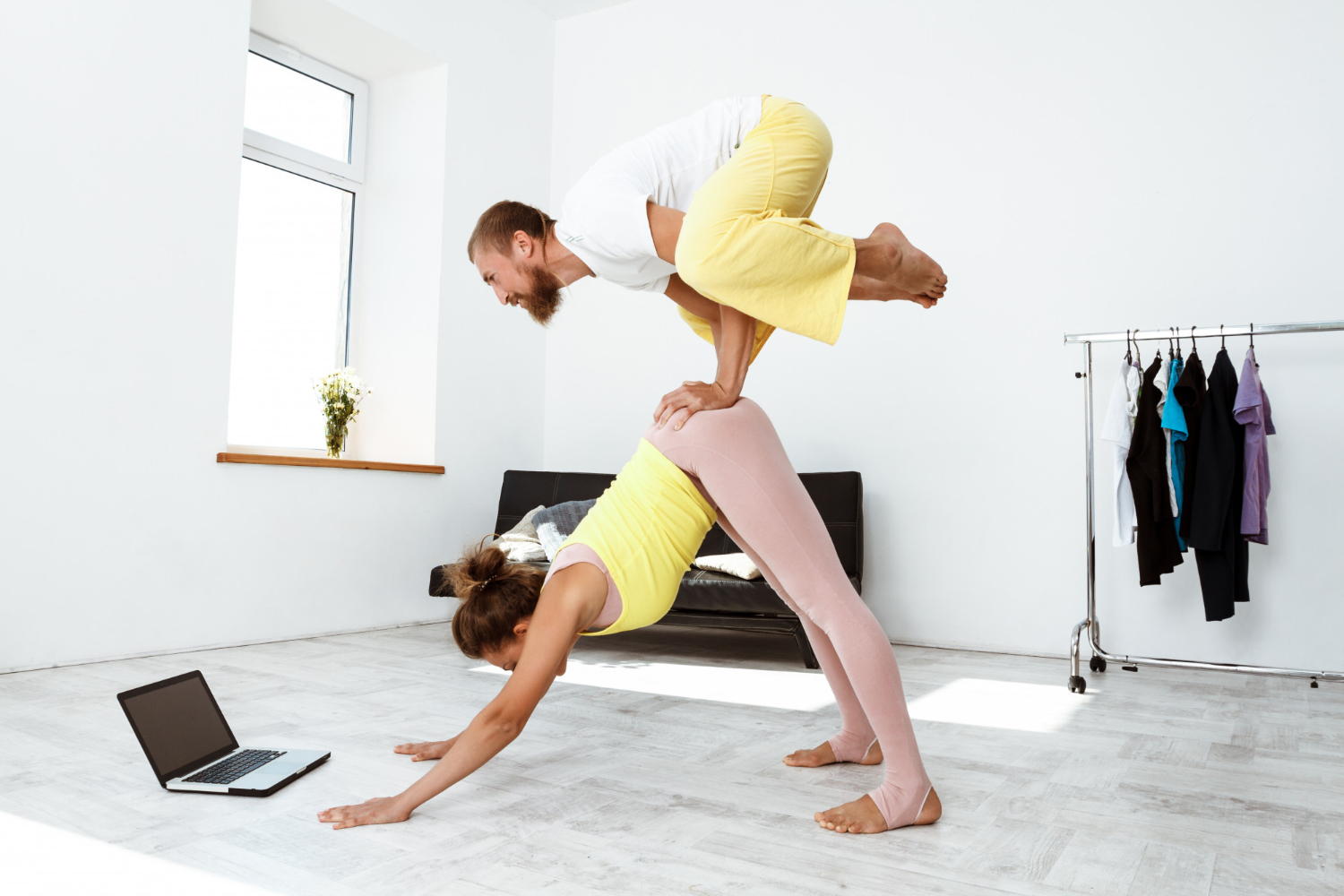
Couple yoga poses, also known as partner yoga poses, are yoga postures performed by two people together. Unlike traditional individual yoga, partner yoga involves shared movement, communication, balance, support, and coordination.
The two partners may perform the same posture facing each other, use each other’s bodies for balance, provide gentle support during stretching, or work together to create a more challenging pose.
Couple yoga does not have to be romantic. Although it is popular among romantic partners, it can also be practiced by:
- Friends
- Family members
- Parents and children
- Yoga classmates
- Training partners
The main principle is cooperation.
Cerita terkait
 Membuka Kekuatan Pose Yoga: Panduan Komprehensif untuk Empat Orang, Menjelajahi Manfaat, Jenis, Cara, dan Tindakan Pencegahan
 Pengalaman Saya dengan Pose Heron Yoga: Manfaat, Bagaimana Saya Melakukannya, dan Tindakan Pencegahan yang Saya Ikuti
Partner yoga can range from extremely simple seated stretches to challenging balancing poses. Beginners can enjoy gentle poses without previous yoga experience, while experienced practitioners may explore more advanced two-person yoga positions.
One of the most enjoyable aspects of couple yoga is that success depends less on individual performance and more on communication and teamwork.
You may need to talk, laugh, adjust your position, and try again.
That is completely normal.

What Is the Difference Between Couple Yoga and Acro Yoga?
Couple yoga and Acro Yoga are sometimes confused, but they are not necessarily the same thing.
Couple Yoga.
Couple yoga generally involves traditional yoga-inspired postures performed with a partner.

It may focus on:
- regangan
- imbangan
- pernafasan
- pengenduran
- koordinasi
- Connection
The poses can be gentle and accessible.
Acro Yoga.
Acro Yoga often combines elements of:
- yoga
- Acrobatics
- Partner balancing
- kekuatan
- yg dipercayakan
It may involve one person lifting or supporting another person.
Acro Yoga can be physically demanding and may require proper instruction and spotting.
For beginners, simple couple yoga poses are generally a safer place to start.
Benefits of Couple Yoga Poses.
The potential benefits of couple yoga depend on the poses, intensity, experience level, and individual health.
Couple yoga should not be viewed as a medical treatment. However, regular yoga practice and gentle physical activity may contribute to overall physical and psychological well-being.
1. May Improve Flexibility.
Many couple yoga poses involve gentle stretching.
For example, partners may perform seated forward folds, side stretches, spinal twists, or supported backbends.
A partner can sometimes provide gentle resistance or support.
However, support should never become force.
Your partner should not push you beyond your comfortable range of motion.
Flexibility develops gradually, and forcing a stretch can increase the risk of injury.
2. Can Improve Balance and Coordination.
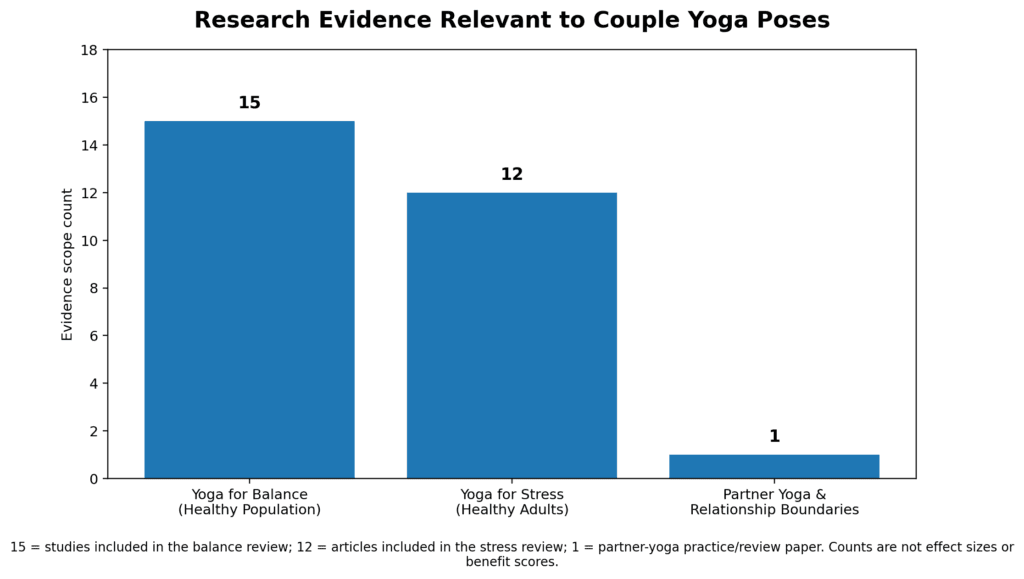
Standing partner poses require both people to coordinate their movements.(1)
You may need to:
- Match your breathing
- Adjust your body position
- Maintain your center of gravity
- Communicate when something feels unstable
These movements can challenge balance and body awareness.
3. Encourages Communication.
Communication is essential in partner yoga.
You may need to say:
- “Can you move slightly closer?”
- “I need more support.”
- “This stretch feels too intense.”
- “Let’s come out of the pose.”
- “Are you comfortable?”
This makes couple yoga an interesting exercise in clear and respectful communication.
You cannot assume that your partner feels comfortable simply because they are smiling or remaining in a pose.
Ask.
4. May Create a Sense of Connection.
Couple yoga can provide an opportunity for people to spend focused time together.
Modern life can be busy.
Partners may spend time in the same room while still being occupied with:
- Phones
- Television
- Work
- Social media
- Household responsibilities
A yoga session encourages people to slow down and focus on the present moment.
This shared activity may help some couples feel more connected.
However, couple yoga is not a replacement for relationship counseling or professional support when significant relationship problems are present.
5. Can Make Exercise More Enjoyable.
Some people find exercise easier to maintain when they do it with another person.(2)
Partner yoga can make movement feel playful.
You do not have to perform every pose perfectly.
Sometimes the most memorable part of couple yoga is trying a pose, losing balance, laughing, and trying again.
Enjoyment can be an important factor in maintaining regular physical activity.
6. Encourages Trust.
Certain partner tempat require you to rely on another person for stability or support.
This can encourage trust.
However, trust should never mean ignoring safety.
Do not attempt a difficult pose simply because you do not want to disappoint your partner.
A healthy partner yoga practice includes the ability to say:
“No, I am not comfortable doing that pose.”
How to Prepare for Couple Yoga?
Before attempting couple yoga poses, spend a few minutes preparing.
Choose a Safe Space.
Practice in an area with enough room to move.
Remove objects that could cause injury if you lose balance.
mengelak practicing difficult balancing poses near:
- Furniture
- Sharp objects
- Glass
- Stairs
A yoga mat or other non-slip surface can provide additional stability.
Wear Comfortable Clothing.
Choose clothing that allows comfortable movement.
Avoid clothing that is excessively loose if it interferes with movement or vision.
Comfortable athletic clothing is generally suitable.
Pemanasan.
Do not immediately attempt deep stretches.
Spend five to ten minutes warming up.
You can include:
- Gentle walking
- Shoulder rolls
- Arm circles
- Neck movements
- Lingkaran pinggul
- Gentle squats
- Cat-Cow movements
- Easy stretches
Warming up can help prepare your muscles and joints for movement.
Discuss Injuries and Limitations.
Tell your partner about relevant limitations.
Misalnya:
- Back pain
- Knee problems
- Shoulder injuries
- Wrist discomfort
- Balance difficulties
Your partner cannot adjust safely if they do not know your limitations.
Start Easy.
You do not need to begin with an Instagram-worthy pose.
Simple poses can still be enjoyable and beneficial.
Mastering basic communication and coordination first can help prepare you for more challenging movements.
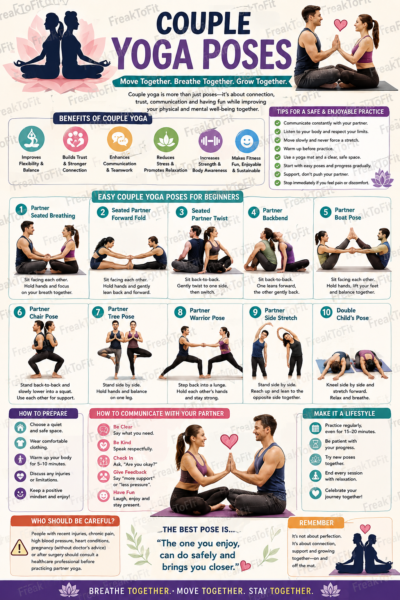
10 Easy Couple Yoga Poses for Beginners.
Here are beginner-friendly couple yoga poses to try.
1. Partner Seated Breathing.
This is one of the easiest ways to begin couple yoga.
How to Do It.
- duduk dengan nyaman.
- Sit facing your partner or sit back-to-back.
- Rilekskan bahu Anda.
- Tutup mata Anda jika nyaman.
- Ambil napas yang lambat dan nyaman.
- Try to notice the rhythm of your breathing.
If sitting back-to-back, you may be able to feel your partner’s breathing movements.
manfaat.
This pose can encourage:
- pengenduran
- ketelitian
- Awareness of breathing
- A calm beginning to your yoga session
There is no need to force synchronized breathing.
Simply breathe naturally.
2. Seated Partner Forward Fold.
This pose can provide a gentle stretch for the back of the kumpulan.
How to Do It.
- Sit facing your partner.
- Extend your legs comfortably.
- Place the soles of your feet against your partner’s feet if comfortable.
- Hold hands or wrists gently.
- One partner slowly leans backward while the other gently leans forward.
- Switch positions.
The person leaning forward should move only within a comfortable range.
Important Safety Tip.
Do not pull your partner aggressively.
The movement should feel controlled and cooperative.
If either person feels pain, release the pose.
3. Partner Seated Twist.
A gentle spinal twist can be performed together.
How to Do It.
- Sit back-to-back.
- Keep your spine comfortably tall.
- Inhale naturally.
- Slowly rotate your upper body toward one side.
- Place a hand gently on your knee or thigh.
- You may reach one hand toward your partner’s knee if comfortable.
- Hold briefly.
- Return to the center.
- Ulangi di sisi lain.
Avoid forcing the rotation.
Twists should feel gentle.
manfaat potensial.
This pose may help promote:
- Spinal mobility
- kesadaran tubuh
- pengenduran
People with back problems should modify or avoid movements that cause discomfort.
4. Partner Forward Fold and Backbend.
This is a popular beginner couple yoga pose.
One partner performs a forward fold while the other receives a gentle chest-opening stretch.
How to Do It.
- Sit back-to-back.
- Keep both legs extended or comfortably crossed.
- One partner slowly leans forward.
- The other partner gently leans backward against their partner’s back.
- The forward-folding partner should not be forced downward.
- Hold comfortably.
- Slowly return.
- Switch roles.
Important Tip.
The person leaning backward should not suddenly drop their weight.
bergerak perlahan.
Communicate throughout the movement.
5. Double Child’s Pose.
Child’s Pose is commonly used as a gentle resting position.
A partner version can be created carefully.
How to Do It.
One partner begins in a comfortable Child’s Pose.
The second partner can remain nearby and perform a gentle forward stretch rather than placing their body weight directly on the first partner.
Because body-size differences can make this pose uncomfortable, it is better to avoid placing significant weight on another person’s back.
Safer Alternative.
Sit beside your partner while both perform Child’s Pose.
You can gently hold hands or simply practice together.
6. Partner Boat Pose.
Partner Boat Pose is fun and challenges balance and core stability.
How to Do It.
- Sit facing your partner.
- Bend your knees.
- Reach forward and hold hands.
- Place the soles of your feet against your partner’s feet.
- Slowly lift your feet.
- Gradually extend your legs if both partners are comfortable.
- Keep your movements controlled.
tips.
Do not jerk your partner into position.
If your lower back becomes uncomfortable, bend your knees or come out of the pose.
7. Partner Chair Pose.
This standing pose requires coordination.
How to Do It.
- Stand back-to-back.
- Keep your feet approximately hip-width apart.
- Lean gently against each other’s backs.
- Slowly bend your knees.
- Lower into a comfortable squat-like position.
- Use each other’s backs for light support.
- Hold briefly.
- Slowly stand.
Safety.
Both partners should lower themselves gradually.
If one person drops suddenly, the other person may lose balance.
ini pose may not be appropriate for people with certain knee problems.
8. Partner Tree Pose.
Tree Pose is a classic balance Latihan.
A partner can provide light support.
How to Do It.
- Stand beside your partner.
- Place your inside hands together or lightly hold hands.
- Geser berat badan Anda ke satu kaki.
- Bend the other knee.
- Place your foot against your ankle or calf.
Avoid placing your foot directly against the side of the knee joint.
- Find your balance.
- Hold briefly.
- beralih sisi.
Why It Is Beginner-Friendly.
Your partner can provide light support.
However, do not lean your entire body weight onto your partner.
kedua-dua people should maintain as much independent balance as possible.
9. Partner Warrior Pose.
Warrior variations can be adapted for couples.
How to Do It.
- Stand beside each other.
- Step one foot backward.
- Bend the front knee comfortably.
- Keep the back leg stable.
- Extend your arms.
- If appropriate, hold your partner’s hand with the inside arm.
Try to maintain your own balance.
manfaat.
Warrior-style poses can help develop:
- Leg strength
- imbangan
- kesadaran tubuh
Adjust the stance according to comfort and mobility.
10. Standing Partner Side Stretch.
This is one of the simplest couple yoga poses.
How to Do It.
- Stand beside your partner.
- Place your inside arms around each other’s shoulders or lightly hold hands.
- Raise your outside arms.
- Slowly lean away from each other.
- Feel a gentle stretch along the side of your body.
- Return to the center.
- Ulangi di sisi lain.
Do not pull your partner.
Move slowly and naturally.
Intermediate Couple Yoga Poses.
After becoming comfortable with basic poses, you may want to explore more challenging options.
11. Double Downward Dog.
Both partners perform Downward-Facing Dog near each other.
The pose may be practiced side-by-side.
This can be a good way to practice together without placing body weight on your partner.
How to Do It.
- Mulailah dengan tangan dan lutut Anda.
- Lift your hips.
- Straighten your legs only as much as comfortable.
- Press your hands into the ground.
- Maintain a comfortable spine Posisi.
Partners can provide verbal feedback rather than physically pushing each other.
12. Partner Plank.
Partner Plank requires more strength.
There are several versions.
A safer beginner variation involves performing planks next to each other and touching hands.
How to Do It.
- Enter a high plank or modified plank.
- Position yourselves side-by-side.
- Maintain a stable core.
- Lift one hand and gently touch your partner’s hand.
- Return your hand to the floor.
Hindari menahan napas.
Stop if you experience wrist or shoulder pain.
13. Double Bridge Pose.
Both partners can perform Bridge Pose side-by-side.
How to Do It.
- Lie on your backs.
- Bend your knees.
- Place your feet on the floor.
- Slowly lift your hips.
- Keep your neck relaxed.
- Lower slowly.
Partners can perform the movement together.
There is no need for one person to support the other.
14. Partner Camel Pose Variation.
This pose can provide a chest-opening stretch.
However, deep backbends are not appropriate for everyone.
A gentle version can be practiced by kneeling back-to-back and leaning lightly against one another.
Avoid forcing the back into a deep arch.
People with neck or back problems should be particularly cautious.
Advanced Couple Yoga Poses.
Advanced two-person yoga poses should be approached carefully.
Some poses commonly shown online involve:
- Lifting another person
- Balancing on another person’s feet
- inversi
- Deep backbends
These movements can carry a greater risk of falls.
Advanced partner yoga is best practiced with appropriate instruction and, when necessary, a trained spotter.
Do not attempt an advanced pose simply because it looks easy in a photograph.
Couple Yoga Poses for Trust.
Trust is often discussed in partner yoga.
Namun, healthy trust involves more than physical support.
Try practicing these habits:
Listen to Your Partner.
If your partner says:
“This is too difficult.”
Believe them.
Do not pressure them.
Ask Before Touching.
Some poses require physical contact.
Ask before making adjustments.
Respect Boundaries.
Your partner may enjoy some poses but dislike others.(3)
That is normal.
Communicate Clearly.
Instead of saying:
“You’re doing it wrong.”
Coba:
“Would it feel better if we moved slightly apart?”
Small changes in language can make the practice more supportive.
Couple Yoga Poses for Flexibility.
If flexibility is your main goal, focus on gentle stretches.
Pilihan yang baik meliputi:
- Partner seated forward fold
- Seated twist
- Side stretch
- Gentle back-to-back stretch
- Supported seated stretches
Remember that flexibility varies between individuals.
Your partner may be naturally more flexible than you.
That does not mean you need to match their range of motion.
Yoga is not a competition.
Couple Yoga Poses for Strength.
Partner yoga can also incorporate strength.
Potential options include:
- Partner Chair Pose
- Partner Boat Pose
- Side-by-side Plank
- Warrior variations
- pose jembatan
However, bodyweight exercises can be more predictable and easier to modify when building strength.
Partner yoga should not necessarily replace a comprehensive strength-training program.
Couple Yoga Poses for Relaxation.
Not every yoga session needs to be physically demanding.
A relaxing couple yoga routine might include:
- Partner breathing – 3 minutes
- Seated side stretch – 2 minutes
- Gentle seated twist – 2 minutes
- Supported forward fold – 3 minutes
- Relaxation – 5 minutes
Finish by lying down separately or sitting comfortably together.
Relaxation is an important part of yoga practice.
How Long Should a Couple Yoga Session Last?
There is no perfect duration.
A beginner session might last 15 to 30 minutes.
A longer session could last 45 to 60 minutes.
If you are new to yoga, even 10 minutes can be enough to begin.
Rutinitas sederhana dapat mencakup:
Warm-Up – 5 Minutes.
- Shoulder rolls
- Gentle movements
- Easy stretches
Easy Partner Poses – 15 Minutes.
Choose three to five poses.
Relaxation – 5 Minutes.
Finish with comfortable breathing.
Consistency is generally more useful than making every session excessively long.
How Often Should Couples Practice Yoga?
The frequency depends on your goals and schedule.
Some couples may practice:
- Once per week
- Two or three kali per minggu
- cupat sessions several times per week
You do not need to practice every day.
Dengarkan tubuh Anda.
If you are doing physically demanding yoga, strength training, or other exercise, recovery should be considered.
Couple Yoga Poses and Relationships.
Couple yoga is sometimes promoted as a way to improve relationships.
It may create opportunities for:
- Shared activity
- Communication
- Physical proximity
- Cooperation
- Playfulness
However, it is important not to exaggerate these benefits.
Couple yoga is not scientifically guaranteed to fix relationship problems.
It cannot replace:
- Honest communication
- menghormati
- Relationship counseling
- Mental health support
- Conflict resolution
Think of couple yoga as a shared activity that may support connection rather than a treatment for relationship difficulties.
Can Beginners Do Couple Yoga?
YA.
Beginners should choose simple poses.
Mulailah dengan:
- Partner breathing
- Seated stretches
- Side stretches
- pose pohon
- Partner Chair Pose
Avoid advanced lifts and inversions.
You do not need to be flexible to begin.
Yoga can be adapted to different fitness levels.
Can People With Different Body Types Do Couple Yoga?
YA.
However, poses may need to be modified.
Couple yoga does not require two people to have identical:
- ketinggian
- berat
- kekuatan
- keluwesan
In fact, it is better to select poses appropriate for both people.
If there is a significant size difference, avoid poses where one person supports the other person’s full body weight unless properly trained.
Communication becomes particularly important.
Common Mistakes During Couple Yoga.
1. Trying Difficult Poses Too Soon.
Social media can make advanced poses look effortless.
They often require considerable practice.
Start simple.
2. Forcing a Stretch.
Never push your partner deeper into a stretch.
A stretch should not cause sharp pain.
3. Ignoring Communication.
Silence can make partner yoga more difficult.
Talk.
4. Comparing Yourself.
One person may have greater flexibility.
Another may have better balance.
That is normal.
5. Holding Your Breath.
Breathing can help you stay relaxed.
Do not hold your breath during difficult movements.
6. Practicing on a Slippery Surface.
Balance poses require stability.
Choose an appropriate surface.
7. Continuing Through Pain.
Discomfort from gentle stretching is different from sharp pain.
Stop if something feels wrong.
Safety Tips for Couple Yoga Poses.
Safety should always come before appearance.
Move Slowly.
Sudden movements can cause loss of balance.
Communicate.
Tell your partner what you are doing before changing positions.
Do Not Force Flexibility.
Never push another person’s body into a deeper stretch.
Avoid Risky Lifts.
Do not attempt lifting or inversion poses without appropriate experience.
Use Support When Needed.
A wall can be helpful for balance poses.
Stop When Necessary.
Berhenti jika Anda mengalami:
- Sharp pain
- kepuyengan
- mati rasa
- Significant discomfort
- Difficulty breathing
Seek medical attention when appropriate.
Who Should Be Careful With Couple Yoga?
People with certain health conditions or injuries may need modifications.
Speak with an appropriately qualified healthcare professional before beginning a new exercise routine if you have significant:
- Back problems
- Joint injuries
- Balance disorders
- Cardiovascular conditions
- operasi baru-baru ini
- Pregnancy-related exercise concerns
If you are recovering from an injury, a qualified physical therapist or healthcare professional can provide individualized guidance.
A Simple 20-Minute Couple Yoga Routine.
Here is an example.
Minute 1–3: Partner Breathing.
Sit comfortably and breathe naturally.
Minute 4–6: Seated Side Stretch.
Perform gentle stretches on both sides.
Minute 7–9: Partner Seated Twist.
Move slowly and avoid forcing the twist.
Minute 10–12: Seated Forward Fold.
Use gentle support.
Switch roles.
Minute 13–15: Partner Tree Pose.
Practice balance on both sides.
Minute 16–18: Partner Chair Pose.
Lower slowly and hold briefly.
Minute 19–20: Relaxation.
Sit or lie down comfortably.
Focus on slow breathing.
This routine can be adjusted according to your experience.
pertanyaan yang sering diajukan.
1. What are couple yoga poses?
Couple yoga poses are yoga-inspired positions performed by two people together. They may involve shared stretching, balance, breathing, coordination, and support.
2. Can beginners do couple yoga?
Yes. Beginners can start with simple seated stretches, breathing exercises, Tree Pose, and gentle standing poses.
3. Do you need to be flexible?
No. Flexibility is not required to start yoga.
Choose poses appropriate for your current range of motion.
4. Is couple yoga only for romantic couples?
No. Partner yoga can be practiced with friends, family members, classmates, or other trusted partners.
5. Can couple yoga improve a relationship?
It may provide an opportunity for shared activity and communication, but it is not a guaranteed way to improve a relationship or solve relationship problems.
6. Is partner yoga safe?
Simple poses can be relatively safe when performed carefully. Advanced poses involving lifting, inversions, or significant bodyweight support carry greater risks.
7. What should we wear?
Comfortable clothing that allows movement is generally best.
8. How long should we practice?
A beginner session can last approximately 15 to 30 minutes.
9. What if one partner is more flexible?
Modify the pose. Do not force one partner to match the other’s flexibility.
pemikiran akhir.
Couple yoga poses can be a fun way to combine movement, mindfulness, communication, and shared time.
You do not need to be an experienced yogi or have exceptional flexibility to start. Simple partner yoga poses such as seated breathing, gentle twists, side stretches, Partner Tree Pose, and Partner Chair Pose can provide an accessible introduction.
The most important part of couple yoga is not creating the perfect pose for a photograph.
It is practicing safely.
Communicate with your partner. Move slowly. Respect boundaries. Never force a stretch or attempt advanced movements before you are ready.
Couple yoga can also remind us that physical activity does not always need to be a solitary experience. Moving together can be enjoyable, playful, and sometimes challenging.
You may lose balance.
You may laugh.
You may need several attempts.
That is part of the experience.
Start with simple couple yoga poses, focus on comfort and communication, and gradually explore new movements as your confidence grows.
Remember: the best partner yoga pose is not the most complicated one—it is the one that both people can perform safely, comfortably, and enjoyably.
+3 Sumber
FreaktoFit memiliki pedoman pengadaan yang ketat dan bergantung pada studi peer-review, lembaga penelitian pendidikan, dan organisasi medis. Kami menghindari penggunaan referensi tersier. Anda dapat mempelajari lebih lanjut tentang bagaimana kami memastikan konten kami akurat dan terkini dengan membaca Kebijakan Editorial.
- tinjauan sistematis yoga untuk keseimbangan dalam populasi yang sehat; https://pubmed.ncbi.nlm.nih.gov/24517304/
- Efek Yoga pada Stres di antara Orang Dewasa Sehat: Tinjauan Sistematis; https://pubmed.ncbi.nlm.nih.gov/32088671/
- Partner yoga for establishing boundaries in relationship: a transpersonal somatic approach; https://pubmed.ncbi.nlm.nih.gov/22398353/