








































 Workout

 Meditation


 Podcast
 E-book


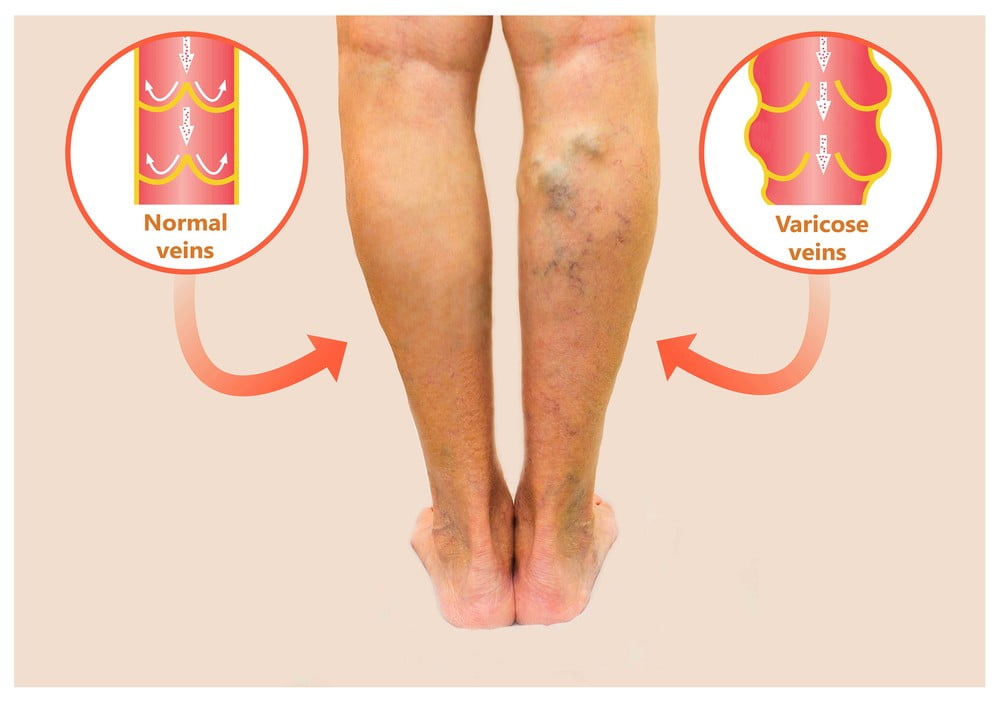
According to WHO, 2021 revision the code for varicose veins ICD 10 is 183.90. Veins are said to be varicose when they become tortuous, thin-walled, widened and easily visible below the skin. The veins in the superficial tissues of the legs are most commonly affected.
According to ICD 10 there is no known cause for varicose veins of the legs, but there are many factors which may lead to a worsening of varicose veins which are already present. Varicose veins generally run in families, but there is no clear-cut reason for this. They are also much more common in women than men.
The Veins.
Normally, the blood which supplies in the tissues of the lower limb flows down arteries to the feet and then back to the veins, and so to the heart. In the lower limb, there are two systems of veins, i.e. deep system, and the superficial system.
It is the superficial system that is affected as it consists of veins in the tissues between the muscle and the skin, veins which can easily be seen and are called varicose when they become enlarged.
Related Stories
 Top 10 Benefits of Sleep Sacks You Must Know
 Does Anti-Cellulite Creams Really Work?
Both the superficial and deep veins contains valves every few centimeters. These valves consist of tiny folds of the lining of the vein, and they allow blood to flow up the limb, but not the other way.
In patients with varicose veins, these valves are found to be defective. It is not clear whether the defective valves cause the varicose veins, or whether it is the other way round. However, the final effect of having defective valves is that the blood in the vein can flow down the vein, leading to stretching of its wall.
The superficial veins of the lower limb are divided into two main veins, the long saphenous and the short saphenous veins. The long saphenous vein carries blood from the front of foot, up the inner side of the leg and goes into the thigh just below the groin.
The short saphenous vein carries blood from the outer side of the foot up to the back of the knee, where it also goes deeply to join the deep system of veins. The long saphenous vein and its many branches are the commonest site of varicose veins.
What Causes Varicose Veins?
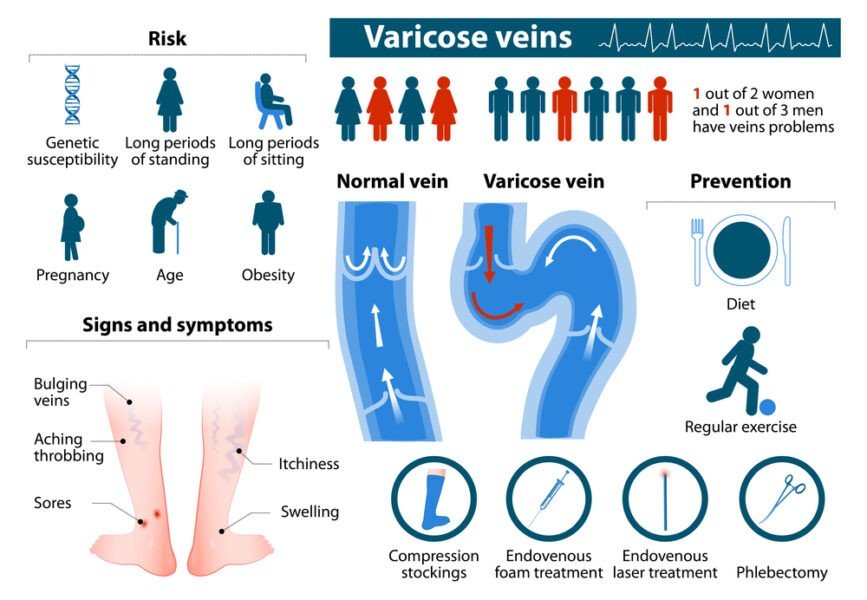
Although there are no obvious causes of varicose veins according to ICD 10, but there are a number of factors that increase their possibility.
Pregnancy.
Many women notice varicose veins after pregnancy. It is probable that the veins were abnormal before pregnancy, but that pregnancy made them worse. There are two theoretical reasons why this should happen.
First, the presence of an enlarged uterus leads to pressure on the veins in the pelvis, causing increased pressure in the veins of the leg. This pressure may cause the veins to become swollen.
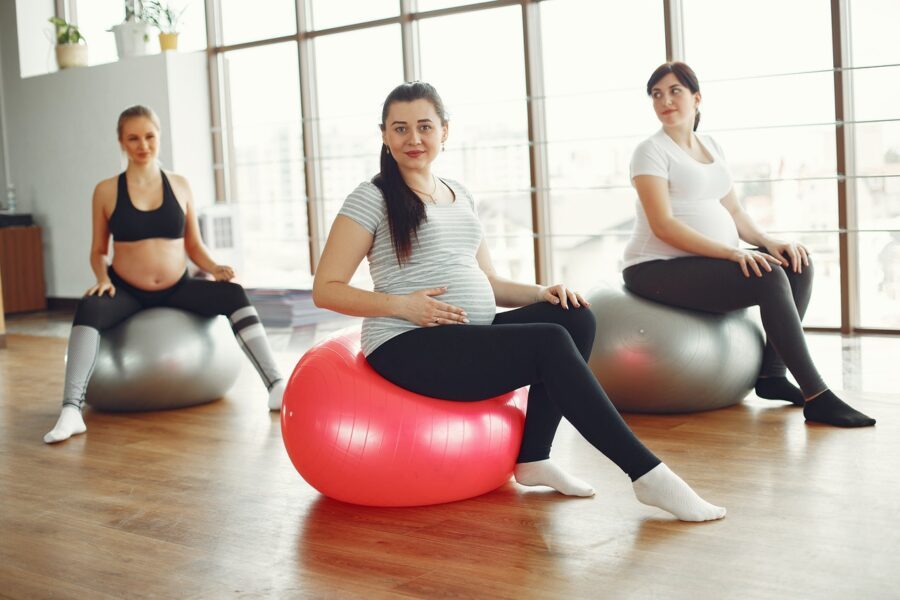
Second, hormones which are produced during pregnancy lead to a general softening-up of supporting tissues to allow the baby’s head to pass through the birth canal, and the supporting tissues of the veins can also be similarly affected.
Obesity.
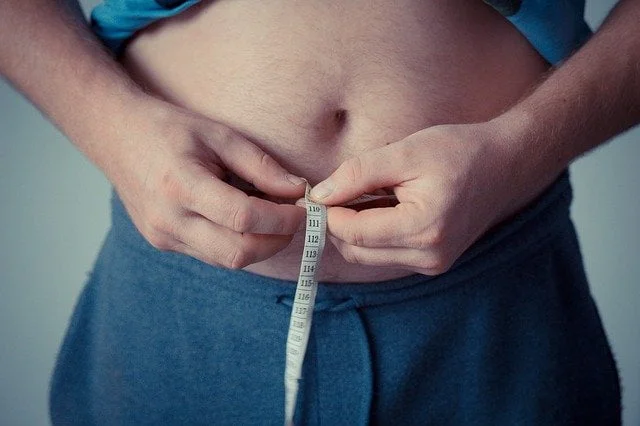
Varicose veins can be brought on through obesity because of increased pressure inside the abdomen, together with general weakening of fibrous tissue in the wall of the vein.
Prolonged Standing.
Jobs which require prolonged standing may put an undue strain on the veins of the legs. especially if they have to be kept still.
Injury.
Sometimes a large varicose vein develops at the site of an injury, such as where a cricket ball hits the leg. This may be the only varicose vein in an otherwise normal leg.
Deep Vein Thrombosis.
Occasionally, patients who have had a deep vein thrombosis may develop varicose veins in the lower leg, but these are usually of a different pattern compared with the more common varicose veins which start in the superficial veins.
Effects of Varicose Veins According To ICD 10.
Varicose veins do not look pleasant, and by far the commonest reason for people to seek medical help for their varicose veins is because the veins are unsightly. But varicose veins can cause complications and these may necessitate surgical or other treatment.
Because they are thin-walled and near the surface, they are more susceptible to injury. This, coupled with the fact that the blood flow is much more sluggish in varicose veins, can lead to a thrombosis in the vein. The resulting inflammation around the thrombosis — known as phlebitis — causes pain and redness in the affected area.
For unknown reasons, some patients develop quite bad eczema on the lower leg. This eczema can be treated with skin preparations, but if the varicose veins are treated, then the eczema usually disappears.
Varicose Veins Treatment According To ICD 10.
Various treatment have been tried, but nowadays the treatment is divided into surgery, injections and other forms, such as wearing of bandages and support stockings.
Surgery.
The aim of surgery in varicose veins is twofold. First, an attempt is made to remove the unsightly veins. Second, an operation is done to prevent the veins coming back again.
The first part of the treatment involves making several tiny little cuts in the skin over the veins, and removing them a segment at a time. The distance between the cuts will vary, but may be 5 cm (2 in).
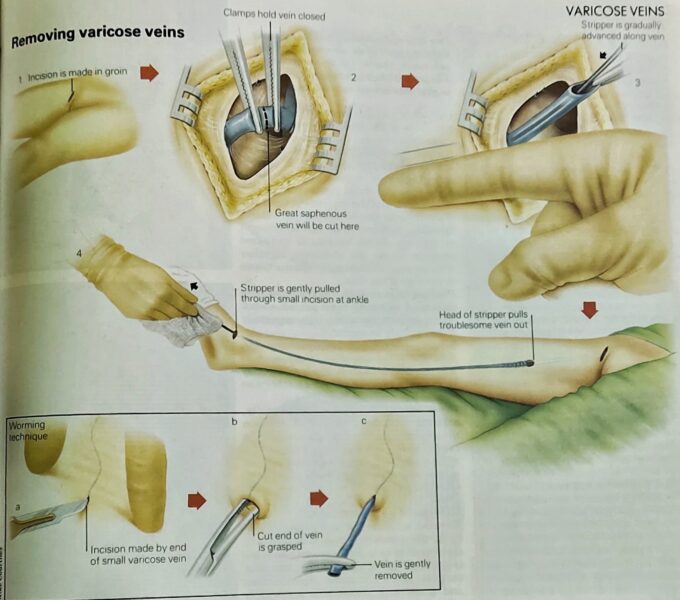
The second part of the operation — treating the root cause of these particular varicose veins — may be more difficult, and it is here that careful examination of the pattern of the individual patient’s veins is of vital importance.
By examining the patient first lying down and then standing up, the surgeon determines whether the long or the short saphenous vein is not fault, and at which point along the vein the trouble arises.
It is usually found that the valves in the upper part of the long saphenous vein (in the groin) are causing the problem, allowing blood to leak back down the vein. If the long saphenous vein is therefore tied off in the groin, then the pressure is taken off this vein at points lower down.
The blood which would normally flow through the long saphenous vein finds its way back to the heart via a different vein, of which there are dozens in the leg.
This sort of surgery, although it may seem quite elaborate, is relatively minor for the patient. Usually he or she is in hospital for one or two days and can get up and walk the day after the operation.
Injections.
In this form of treatment a special substance is injected into different parts of the vein, causing the lining of the vein to become inflamed. The leg is then tightly bandaged and remains so for about a month, so that the vein is compressed. The object of the treatment is to get the opposite walls of the vein to stick together permanently, thus effectively closing it.
The main disadvantage of this form of treatment is that it is only effective on small varicose veins, and only if they are situated below the knee (it is virtually impossible to get a bandage to stay on the thigh for more than a few hours).
Bandages.
There are no other forms of treatment which are capable of actually removing varicose veins once they are present, but the wearing of support stockings or tights can help to prevent varicose veins from getting any worse.
These stockings are specially designed to give firm, even pressure all the way up the leg, and are usually quite comfortable.
| Read Now: 12 Super Detoxifying Food With Meal Plan |
How To Prevent Varicose Veins According To ICD 10.
If you have varicose veins, the chances are that you will always have a few prominent veins for the rest of your life. Even if you have the existing ones treated. There is no guarantee that they will not appear elsewhere after treatment. However, there are some things you can try and prevent them reappearing!
Try not to do too much standing, if at all possible. Walking is fine, but do not stand still for long periods. When you sit down, always try to put your feet up on a stool or chair, so that the blood in the legs can flow more easily back up the body to the heart.
Frequently Asked Questions.
Yes, they do run in families but no definite inherited link has been identified. All that can be said is that you are more likely to develop varicose veins. However, there is not a lot you can do to avoid developing them apart from refraining from standing still for long periods.
In general, it would be better, unless, of course, they are causing a lot of trouble at the moment. There is no doubt that pregnancy makes varicose veins worse, and it would be more sensible to have them treated after having all your children.
They may be. Sometimes, particular sorts of varicose veins can lead to breakdown of the skin in the lower leg with the formation of an ulcer. However, the majority of patients with varicose veins do not have an ulcer, and so the two do not invariably go together.
Some varicose veins can be treated by injections. The ones that are suitable are small ones, confined to the area below the knee. Having injections does not affect subsequent surgery, should it prove necessary.
Unfortunately, these groups of tiny veins, or venular flares, as they are called, are impossible to treat. They are, however, associated with varicose veins and it may be that if you have treatment for the varicose veins they will cease to get any worse. Don’t forget that minor blemishes on the legs may be a lot less unsightly than scars from operations, or brown skin stains from injection treatment.
Probably, standing still for long periods of time increases the amount of blood in the veins of the legs and may worsen varicose veins. However, it is probably a combination of the tendency to develop varicose veins and the prolonged standing which leads to the final outcome.
There are many people who have varicose veins who do not stand for long periods, and conversely there are many people whose job entails standing, who do not have varicose veins. For those people who do have to spend long periods of time standing up, some form of exercise during your break is advisable.
Also, as you stand working, make a point of squeezing and relaxing your leg muscles; this helps pump blood up the veins.
Varicose veins can cause pain in the legs, but usually only if the veins are severely affected. The pain is usually worse at the end of the day and may be felt at night as a sort of night-cramp.
It is very important that pain in the legs is not automatically attributed to varicose veins, as there may be another abnormality in the leg, such as arthritis or arterial disease, causing the pain.
Vitamin B helps in fighting with health issues. But it takes long term to repair the varicose veins. So, the condition of your severity will be decided for how long you have to take B 48. It’s advised to consult with your doctor.
Generally topical creams, gels and ointments are provide to apply in varicose veins ulcer. But it also depend upon the severity of your condition. Consult with your doctor before applying.
Bottom Line.
Our upright stance, with all its many advantages, has not come without a price. For many, this price may include varicose veins — those twisted knots of vein that branches embarrassingly across the lower legs.
+5 Sources
Freaktofit has strict sourcing guidelines and relies on peer-reviewed studies, educational research institutes, and medical organizations. We avoid using tertiary references. You can learn more about how we ensure our content is accurate and up-to-date by reading our editorial policy.
- 2021 ICD-10-CM Diagnosis Code I83.90; https://www.icd10data.com/ICD10CM/Codes/I00-I99/I80-I89/I83-/I83.90
- Superficial Soft-Tissue Masses: Analysis, Diagnosis, and Differential Considerations; https://pubs.rsna.org/doi/10.1148/rg.272065082
- What is the Difference Between Superficial Veins & Deep Veins?; https://www.veinclinics.com/blog/what-is-the-difference-between-superficial-veins-deep-veins/
- Superficial Vein; https://www.sciencedirect.com/topics/medicine-and-dentistry/superficial-vein
- Phlebitis; https://www.webmd.com/dvt/phlebitis