


















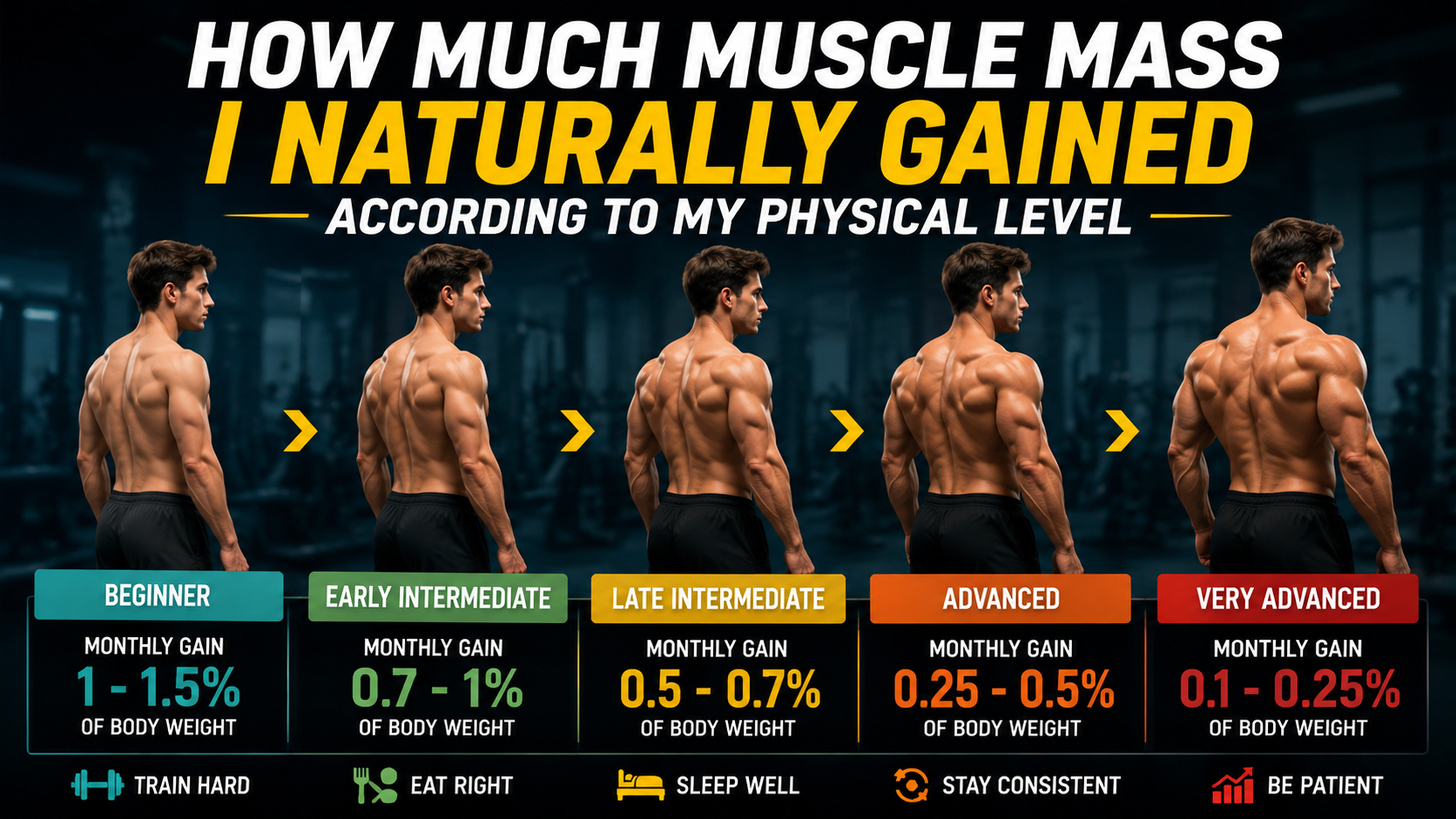
I naturally gained a certain amount of muscle mass, according to my physical level.
A fact that I discovered as soon as I started lifting was that muscle growth doesn’t occur at a constant rate. Initially, I was building muscle and strength very quickly but as time went on it would start to feel way back on the treadmill and it would take a lot more energy, planning, and persistence to get any gains.
This topic is primarily for people who love gym, like me, who really want to make a change at a muscular level. The knowledge of one’s level is very significant when attempting to gain muscle mass as it assists in the estimation of what amount of natural muscle mass one can realistically gain.
Through the years, I realized that consistent training, recovery, nutrition, genetics and experience will all play a role in natural muscle building. It is very easy to build muscle with a beginner, but much more difficult to make constant gains with an advanced muscle builder.
Related Stories
 Leg Exercise For Runners : Enhance Flexibility With Running
 My Journey With Water Pilates: Discover the Benefits and Learn How to Start
The Physiological Ceiling or Maximum Adaptive Potential.
This is one of the most critical pieces of knowledge for me personally: Muscle gains and strength building do not always happen in a straight line.
Initially, I was able to build muscle through training quite effectively, even when I wasn’t doing all the exercises perfectly. But with each passing day my body changed and I learnt more until it became difficult to keep progressing at the same pace.
Also referred to as the physiological ceiling or maximum adaptive potential. In short, the more I approached my “natural” muscle potential, the slower I progressed.
In simple terms:

- Beginners improve quickly.
- Intermediate lift progress at a slower rate.
- Advanced lifters make minute gains in the fight.
This is totally normal.
I learned that when it comes to gaining muscle, it’s like climbing a mountain. It is quick and thrilling at the beginning, but each rise is increasingly more difficult as one approaches the summit.

My Experience as a Beginner.
My body’s reaction was very rapid at first.
I saw that my body improved in the following ways:
- Muscle fullness.
- Strength.
- Recovery.
- Body composition.
- Confidence.
- Overall athleticism.
At that time, nearly all was functioning.
Simple activities such as:
- Bench press
- Squats
- Pull-ups
- Shoulder press
- Rows
Within a fairly short period of time I began to see some significant changes.
No fancy training methods, crazy workout splits, or crazy nutrition plans were required. My body just changed its tune quickly because it was getting a new stimulus.
That’s why newbies get what people refer to as “newbie gains.”
During this time, I was able to gain between 1-1.5% of my body weight every month by training and eating correctly.
The Importance of Planning My Training.
As I gained experience and came to be a more skilled trainer, I realized training needs a lot of planning.
Initially it was easy to program, since the majority of any structured training would lead to results. I had to be extremely careful, however, with all of the variables later.
As for me, I began to think more about:
- Training volume.
- Progressive overload.
- Recovery.
- Sleep quality.
- Exercise selection.
- Rest periods.
- Protein intake.
- Technique.
- Stress management.
As I got older, the more exact everything had to be.
I was made to realize that recovery was as important as training. Muscle growth was severely hampered by inadequate nutrition, water and sleep.
Why Simplicity Works Best at the Beginning?
The one thing I have learned from my experience early on is not to use advanced bodybuilding techniques until it was the right time to do so.
I was going to follow the example of elite athletes and bodybuilders and do the following:
- Extremely complicated splits.
- High-volume programs.
- Drop sets.
- Supersets.
- Advanced intensity techniques.
However, I discovered that those all of the above factors are unnecessary for the novice.
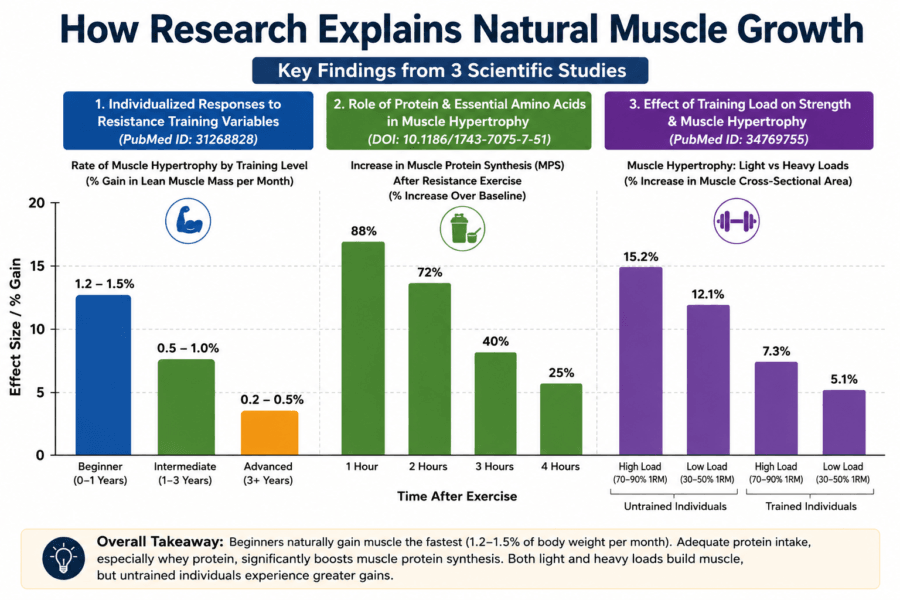
Simple and progressive training is most effective on the beginning level, as the body is very sensitive to basic resistance training.(1),(2)
These are the most important aspects that assisted me:
- Consistency.
- Proper form.
- Basic compound movements.
- Sufficient protein.
- Progressive overload.
- Patience.
After I streamlined my method my results were even better.
How I Learned to Measure My Progress?
The best thing I learned is that if I don’t measure it, I can’t improve it.
I began to measure my progress in various ways eventually.
1. Fat-Free Mass Index (FFMI).
It was one of the most useful tools to work with when trying to gauge my progress towards my true muscle potential.
It helps estimate:
- Lean body mass.
- Natural muscle potential.
- The child’s progress is considered in relation to their current height.
Representative athletes are many that use FFMI to measure realistic expectations of muscle development.
2. Skeletal Muscle Index.
Another measurement I found helpful was Skeletal Muscle Index (Lean muscle mass/Height).
This enabled me to gain insight into:
- Muscle distribution.
- Overall muscularity.
- Long-term progress.
3. Strength Tracking.
I personally followed up the following:
- Bench press progress.
- Squat strength.
- Pull-up performance.
- Deadlift improvements.
Where there was an increase in strength, this was in many cases a good indicator of an increase in muscle growth.
How Much Muscle I Naturally Gained at Different Levels?
Natural Hypertrophy principles and my experience suggests muscle growth can vary quite a bit with training experience.(3)
Beginner Level.
I had the most rapid muscle growth in the beginning.
Estimated Natural Muscle Gain:
The weight loss is approximately 1-1.5% of the total body weight per month.
For example:
A person with a weight of 70 kg can gain about:
During the early phase 0.7–1 kg per month of muscle tissue.
Typically the duration of this stage is:
With the proper training, they can be taught 1–2 years.
Intermediate Level.
After the ‘beginner’ stage, I seemed to slow down considerably.
At this point:
- Recovery gained new significance.
- Nutrition mattered more.
- The quality of training was now a must.
Estimated Natural Muscle Gain:
Use a 0.5-1% of body weight per month.Apply 0.5-1% of body weight per month.
There was still work to be done, but it was now a much slower pace than previously.
Advanced Level.
Gaining muscle at the latter stages was quite difficult.
I knew that, if I wanted to make any improvements, even minimal ones, I had to:
- Perfect consistency.
- Optimized recovery.
- Long-term dedication.
- Careful programming.
Estimated Natural Muscle Gain:
- Around 0.25–0.5% of body weight monthly.
In some cases, the changes could be seen for several months.
This was the most important lesson: patience!
Additional Factors That Personally Affected My Muscle Growth.
Genetics.
I found out that genetics are a very important factor in the following:
- Muscle insertions.
- Recovery ability.
- Testosterone levels.
- Muscle-building speed.
There are people who gain muscle quicker than others.
Nutrition.
The highest change that has helped me is the increase of protein in my diet and the quality of the food that I am eating.
I personally emphasized more the following:
- Lean protein.
- Complex carbohydrates.
- Healthy fats.
- Hydration.
- Caloric surplus.
If you don’t eat right, gaining muscle was much more difficult.
Sleep and Recovery.
For years I was wrong about sleeping.
However, as I regularly began to receive:
- 7–9 hours of sleep
I noticed a significant improvement with my recovery, strength and muscle building.
Consistency.
Consistency was the most important.
I learned that there’s nothing wrong with these guys when it comes to natural muscle growth:
- Extreme workouts.
- Short-term motivation.
- Quick fixes.
It’s about being there year after year.
My Biggest Realization About Natural Muscle Growth.
I am Ethan Walker, Natural Fitness Enthusiast & Gym Lifestyle Blogger, that’s one thing that I finally learned in the world of natural muscle building, that is that it takes a long time to build your muscles naturally.
Social media sets in unrealistic expectations, but the natural growth takes time, patience and discipline.
I personally put an end to comparing myself to others and began to concentrate on:
- Progressive improvement.
- Better recovery.
- Better technique.
- Long-term health.
This attitude altered my trajectory life forever.
“Once I stopped comparing myself to others and focused on consistent progress, natural muscle growth became a lifestyle instead of a race.”

Bottom Line.
Based on my experience, it relies on physical level, consistency, recovery, and smart programming to a great extent for natural muscle gains.
On the basic level, I acquired muscle mass quite rapidly with basic exercise and an appropriate diet. As I progressed, though, things grew harder and harder, and more and more precise and patient.
I learned that muscle growth is not progressing in a linear fashion. As I was progressing towards my potential, the harder I had to work to make a difference.
The most important thing, I realised is that there are no quick fix or perfect ways to build muscle naturally. It is about consistency, discipline, recovery and love of the process of physical and mental improvement.
+3 Sources
FreakToFit has strict sourcing guidelines and relies on peer-reviewed studies, educational research institutes, and medical organizations. We avoid using tertiary references. You can learn more about how we ensure our content is accurate and up-to-date by reading our editorial policy.
- Effect of protein/essential amino acids and resistance training on skeletal muscle hypertrophy: A case for whey protein; https://link.springer.com/article/10.1186/1743-7075-7-51
- Effects of Resistance Training Performed with Different Loads in Untrained and Trained Male Adult Individuals on Maximal Strength and Muscle Hypertrophy: A Systematic Review; https://pubmed.ncbi.nlm.nih.gov/34769755/
- Myofibrillar protein synthesis and muscle hypertrophy individualized responses to systematically changing resistance training variables in trained young men; https://pubmed.ncbi.nlm.nih.gov/31268828/