














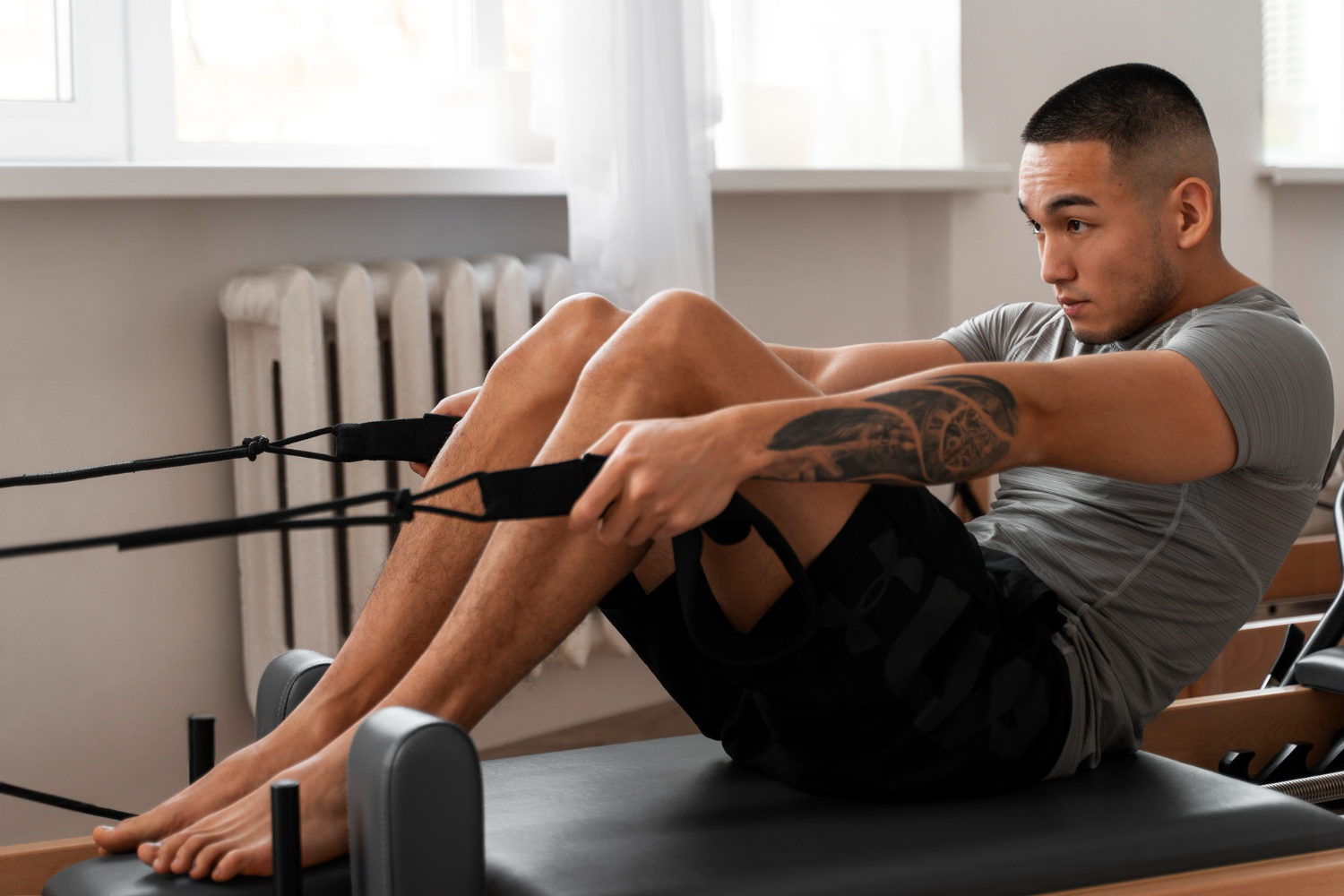
While Pilates may conjure up images of flexibility, smooth movements, and low-intensity exercise, it can be an excellent fitness regimen for men of various ages and activity levels. You need not be a weightlifter, runner, cyclist, sportster or simply just sit at your desk the majority of your working day to benefit from Pilates’ ability to build body attributes that are often neglected in traditional fitness programs.
Pilates benefits for men are improved Core strength, Muscular endurance, Mobility, Balance, Body awareness and Movement control. Depending on exercises chosen, Pilates can also be a great workout for abdominal muscles, glutes, back, hips and shoulders.
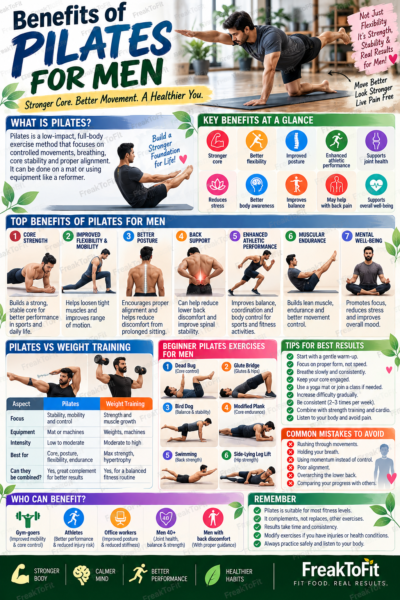
Pilates is more about controlled motion, breathing, alignment and stability compared to traditional weightlifting, where the emphasis is placed on progressively adding external resistance. It can be done on a mat or with a special piece of equipment like a reformer.
Pilates is not a programme for women, the elderly or novices. Men who wish to enhance the quality of their movement, to complement their strength training or to build a more well-rounded fitness program can reap benefits by adding it to their Plano de treino semanal.

But there is need to differentiate between general benefits of Pilates and those which have been specifically proved in men. Much of the scientific literature does not focus on mixed-sex populations, or on specific groups, and not all of the reported benefits can be documented specifically for men.
This article discusses the mechanisms behind Pilates, its benefits for men, some simple exercises to get started, safety issues, and how to incorporate it into your overall fitness routine.
What Is Pilates?
Pilates is a mind-body exercise technique created by Joseph Pilates. It incorporates a controlled movement, breathing, concentration, coordination and engagement of the muscles.
Today’s Pilates typically takes on two forms.

Mat Pilates: Exercises are done on a mat, mainly with body weight and sometimes with accessories like small balls or rings, resistance bands.
Reformer Pilates: This class works with a reformer machine, which has a sliding carriage, springs, straps and adjustable resistance.

Other equipment formats could be a cadillac or barrel or a pilates chair.
No matter how the sessions go, the following are general guidelines that are often followed:
A slow, deliberate and purposeful motion
- Pelvic stability and mobility.
- Coordination between breathing and movement.
- Attention to alignment.
- progressão gradual.
- Efficient movement patterns.
Pilates can be worked up to varying fitness levels. The beginner can begin with simple pelvic movements and modified leg exercises, while the more advanced can move on to more challenging movements that involve a high level of strength and coordination.
Studies of Pilates include results on physical function, flexibility, balance, muscular endurance, and lower-back pain. The level of evidence is different for each outcome, study population and training program.
It is valuable for men because it provides an alternative approach to the application of strength and movement control training, rather than external weights.
1. Pilates Spotting the Power of your Core Strength.
The benefit of pilates that is most well known for men is that it focuses on developing core strength.
More than the abdominal muscles are involved in the core. It is a set of core muscles around the trunk and pelvis to stabilize the body when moving.
They include the deep abdominal muscles, back muscles and those around the pelvis.
These exercises, such as the dead bug, pelvic curl, toe taps and modified plank challenge these muscles and promote controlled breathing and spinal positioning.
This improved strength and coordination of core allows men to carry out daily tasks like lifting things, carrying groceries, climbing up and down stairs, and keeping a stable position while exercising.
Pilates can also be used in conjunction with other exercises like squats, deadlifts and overhead presses for men who perform weight training.
Don’t prescribe Treinamento de resistência progressiva as a matter of course, though, to Pilates. Still, very heavy compound movements and loaded exercises continue to be equally vital for acquiring maximal strength.
Tactic: Start with simpler movements, like toe taps, glute bridges etc and build up to more complex movements that will need increased stability through the trunk.
2. Pilates increases Flexibility and Mobility.
Men who spend many hours sitting, drive a lot or put a lot of emphasis on strength training can feel stiffness around their hips, shoulders and back.
Pilates uses controlled movements to take joints through the range of movements they can comfortably perform involving the surrounding muscles.
Depending on the exercises selected, a Pilates session may work on:
- Mobilidade do quadril
- Hamstring flexibility
- Shoulder movement
- Thoracic spine rotation
- mobilidade do tornozelo
- Controlled spinal movement
Better mobility may help make some everyday activities and exercise movements more comfortable.
For instance, if a man has a challenge with keeping his body in a comfortable position while squatting, he might work on developing ankle mobility, hip control and trunk positioning.
However, there are many different reasons for poor mobility such as individual anatomy and previous injury/joint conditions. Pilates can’t assure that all of the limitations will get better.
The most effective way is to select exercises that are designed to meet your actual movement requirements rather than to be as flexible and extreme as you can.
3. The Pilates Can Support increases postural awareness.
One more reason for men to consider Pilates: posture.
Hunched shoulders, holding shoulders tightly or sitting virtually still for extended periods of time are common posture problems among office workers, drivers, and individuals who spend long hours in front of a computer.
Pilatos: Aids in awareness of spine alignment, positioning of pelvis and movement of the shoulders.
The chest lift, swimming prep, scapular movements and pelvic cachear are some exercises used to explore body movement as a practitioner.
This can be helpful to identify unwarranted tension and to shift positions durante todo o dia.
But it’s not just about sitting straight. No one size fits all when it comes to finding the perfect posture.
Other factors include regular movements, strength, mobility, work ergonomics and individual comfort.
Pilates is considered as one method to build up movement awareness, rather than as a guaranteed solution to poor posture.
4. Pilates May Help Men With Lower-Back Pain.
Men who are physically demanding, sit for extended periods, exercise strenuously or have a history of back pain are at risk of developing lower-back pain.
Pilates is a good exercise for rehabilitation and exercise programs as it has controlled movements, trunk training and slow progression.
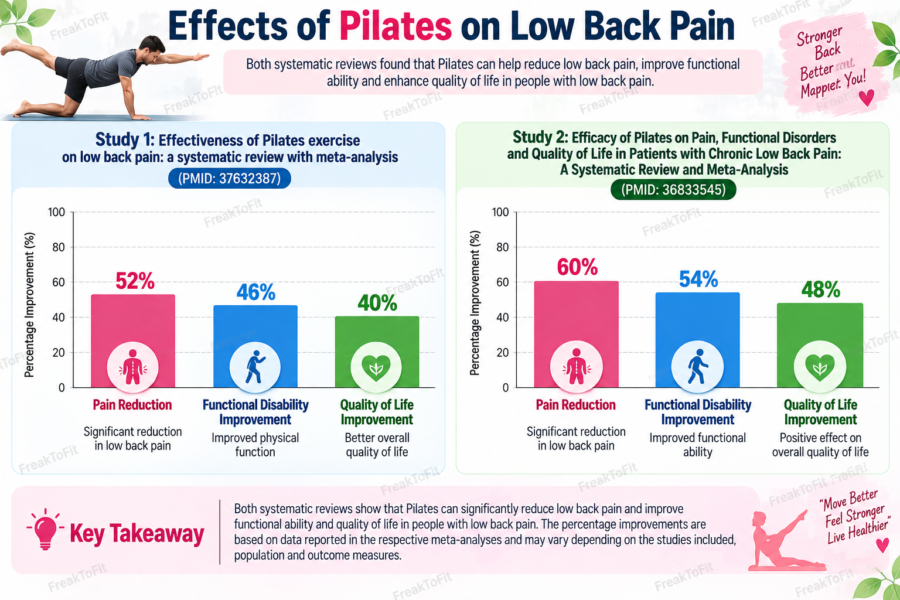
In 2024, 36 articles were included in a systematic review and 19 of these were included in a meta-analysis. It found that Pilates was found to be beneficial for lower-back pain versus no exercise, and a similar beneficial trend versus nonspecific exercise. The authors found that Pilates could be a beneficial way to treat low back pain.(1)
In 2023, another meta-analysis was published, with 19 randomized controlled trials from 1,108 participants suffering from chronic LBP. It did show improvements in pain and in some measures of disability but not all aspects of quality of life improved significantly.
While these results are promising, there are some key limitations.(2)
The studies were not solely focused on the male, nor was Pilates always more effective than all other modalities of exercise.
Men who have persistent back pain should get a proper evaluation, particularly if it is severe, worsening or accompanied by weakness, numbness or other alarming symptoms.
Pilates can be seen as a part of an appropriate exercise programme, not a surefire cure.
5. As a result, you will be able to enjoy Pilates Can Complement Weight Training.
There are some differences between pilates and weight training, but they are also complementary.
With traditional resistance training, men can gradually increase the amount of weight they put on during resistance training exercises. Pilates focuses on controlled movement, stability, muscular endurance and coordination.
If they are done together, this can help to provide a more diverse fitness program.
If a man is a four days a week weight lifter, he can use a Pilates workout to practice trunk movement control, shoulder mobility, hip control.
If a heavy lifting day is not suitable, Pilates offers a lower impact training day as well.
But, not every workout is a Pilates workout! Heavy or challenging mat work or advanced reformer movements can cause significant muscle fatigue.
Choose the intensity according to your training load, sleep, soreness and recovery needs.
6. Pilates is the exercise for enhancing muscular endurance.
Muscular endurance is how long a muscle or group of muscles can work or move for before getting tired.
Many Pilates exercises require holding a controlled position or performing movements in a controlled manner without losing technique.
Exemplos incluem:
- Modified planks.
- Pranchas laterais.
- pontes de glúteo.
- Swimming preparation.
- Controlled leg lifts.
- Repeated abdominal curl variations.
These exercises can tax the abdominal muscles, buttocks and the supporting muscles of the shoulders.
This can be beneficial for men who wish to develop the skills of holding positions in exercises and during daily activities.
Muscular endurance is not the same as maximal strength, however.
So, if your main objective is to lift more weight, progressive resistance training should be an integral part of your program.
7. Pilates Can Challenge Balance and Coordination.
Balance is important when doing sports, climbing up and down stairs, changing direction or moving across uneven surfaces.
Pilates has exercises that test the control of the trunk and limbs and maintaining a stable position.
For instance, during a bird-dog position, the opposite limbs are extended while trunk movements are controlled.
Single-leg bridge variations as well as side lying leg movements can also test coordination.
The challenge may be increased by altering the amount of range of motion, the number of limbs engaged or the stability of the starting position.
Enhanced balance and coordination can be particularly helpful for men involved in sports like tennis, football, hiking, martial arts and leisure running.
Porém, o benefits are related to the exercises performed, the person’s starting point and the regularity of exercising.
8. Pilates May Benefit Men Who Play Sports.
Pilates can serve as a complementary exercise for fun and/or competitive athletes.
Sports frequently involve a mixture of strength, mobility, balance, trunk control and coordination.
Pilates exercises can be used as a means to get a little more practice in some of these areas.
Por exemplo:
- Runners can use Pilates to practice trunk control and hip strengthening.
- For tennis players, they can concentrate on the control of shoulder movements and rotations.
- Football athletes can engage in single leg stability and controlled motion.
- Additional trunk and hip exercises may be of benefit to cyclists.
- Golfers can practice some controlled trunk rotation and mobility.
But, not all of this is replaced with sport specific training, sprint work, resistance training, or technical practice at Pilates.
Football training is still necessary for a footballer. There still needs to be a running program for the runner.
When it is used in addressing the needs of an individual, Pilates can complement those activities.
9. Pilates May Support Healthy Aging.
The strength, balance and mobility of men may also change with age.
Regular physical activity is key to maintaining physical function and independence.
Pilates can be played with varying levels of ability, so it can be enjoyed by older men who wish to continue exercising.
A beginner may begin with movements supported, with gentle pelvic work and basic trunk control.
The experienced practitioner could move on to balance and resistance training that is more difficult.
Individualized instruction is advised for older adults with health issues, osteoporosis, joint replacements and/or balance problems prior to undertaking challenging movements.
Other exercises like suitable strength training and aerobic exercise should be integrated with Pilates.
10. Pilates May Help Men Manage Stress.
Pilates is an exercise which involves focusing, controlled movement and breath.
This offers a safe space for some men to break away from work pressures and everyday distractions.
A session can help individuals concentrate on the movement they’re practicing, instead of doing more than one at a time.
Exercise is a part of a healthy lifestyle and can help improve psychological health, but the case for Pilates is not as strong.
Pilates is not a Tratamento para ansiedade, depression or any other mental health disorder.
If men continue to feel emotional, they may need professional help in conjunction with appropriate exercise.
11. Pilates May Improve Body Awareness.
Body awareness is the ability to know how your body is moving and where it is at.
The focus is on details like the position of the pelvis, movement of the ribs, breathing and control of the muscles, which Pilates asks the practitioner for.
This can aid men to recognize when they are utilizing momentum, when they have unnecessary tension or are losing control of the workout.
For instance, when you’re doing a leg lowering movement, you may observe that your lower back arches as your legs come away from your cadáver.
Describe the movement without forcing it into a short range, but until you can control it, shorten the range.
This will make exercise more flexible and focus on technique rather than looks.
12. Pilates Can Be a Low-Impact Fitness Option.
A lot of the Pilates exercises can be done without running, jumping or quick changes of direction.
This makes some Pilates session appropriate for individuals who prefer a less strenuous activity.
Low impact does not equal easy!
Slow, controlled movements can be quite a challenge for the abdominal muscles, glutes and shoulders.
Actual difficulty will vary based on the exercise, reps, resistance, ROM and practitioner’s experience.
Wrist, hip, shoulder or back exercises can be quite challenging for men who have joint issues or previous injuries, so they should still exercise caution when selecting their exercises.
13. Can Pilates Help Men Lose Weight?
Pilates can help to be active, but it is not a magic pill for weight loss.
Several factors, including treatment, medications, and physical activity, overall energy intake, and sleep, all contribute to weight management.
Men can rely on the assistance of Pilates to keep them active and build their muscles. The number of calories burned does vary, however, depending on intensity of the session, length of time, body size and type of exercise.
If your primary objective is fat loss, your plan may be more thorough, and may involve:
- Regular aerobic exercise.
- Treinamento de resistência.
- Pilates or another enjoyable movement practice.
- A sustainable eating pattern.
- sono adequado.
- Consistent daily activity.
While Pilates is one tool that can help, it doesn’t work directly to burn fat in the abdomen or other body parts in particular.
14. Pilates May Improve Exercise Consistency.
The best exercise routine is one you can maintain.
Some men like to lift heavy weights, others like to run, cycle, swim or do group fitness.
There is another method that can be used to add variety to a training programme, offered by Pilates.
It can also be used in various formats, which can be adjusted to the available time, equipment and fitness level.
If a beginner, a home mat session could be convenient, if the person prefers structured instruction, a supervised reformer class would be more appropriate.
When it comes to exercising for a longer period of time, enjoyment, convenience and manageable intensity can all be a factor.
Best Pilates Exercises for Men.

1. Dead Bug.
Focus: Core control.
deite-se em seu back with your arms raised and knees bent. Slowly lower one arm and the opposite leg while keeping your trunk controlled. Return and switch sides.

2. Glute Bridge.
Foco: Glutes and hip controle.
Lie on your back with your knees bent. Lift your hips comfortably, keeping your knees aligned with your feet, then lower slowly.

3. Bird Dog.
Focus: Coordination and trunk stability.
Start on your hands and knees. Extend one arm and the opposite leg without allowing your trunk to twist excessively. Return and alternate.

4. Modified Plank.
Focus: Core and shoulder endurance.
Begin on your forearms and knees, keeping your body aligned. Hold while breathing normally. Progress to a full plank only when you can maintain good control.

5. Swimming Preparation.
Focus: Back and glute endurance.
Lie face down and gently lift one arm and the opposite leg, keeping the movement small and controlled. Avoid forcing the lower back into excessive extension.

6. Side-Lying Leg Lift.
Focus: Hip strength and control.
Lie on one side and lift the upper leg within a comfortable range. Keep your pelvis steady, then switch sides.
These are general examples rather than a personalized prescription. Start with easier variations and stop if an exercise causes pain.
Beginner Pilates Workout for Men.
If you are new to Pilates, a short routine can help you learn the basic movements before progressing to longer classes.
15-minute starter routine.
Perform the exercises slowly, with comfortable breathing and rest as needed.
Pelvic tilts.
1–2 minutes
Learn comfortable pelvic movement.
Dead bug variation
2 minutos
Practice controlled opposite-arm and leg movement.
Glute bridges
2 minutos
Develop glute and hip control.
Bird dog
2 minutos
Practice balance and trunk stability.
Modified plank
2 rounds of 15–20 seconds
Build endurance without holding your breath.
Side-lying leg lifts
2 minutos
Work on controlled hip movement.
Gentle breathing and mobility
2–3 minutos
Finish comfortably and notice how you feel.
Practice this routine two or three times per week if it suits your current fitness level. Increase the difficulty gradually rather than adding more repetitions immediately.
Pilates vs Weight Training for Men.
| Fitness goalPilatesWeight training | ||
|---|---|---|
| Controle de núcleo | Strong focus | Can be trained directly |
| Maximal strength | Limited by exercise and resistance | Generally better suited |
| Resistência muscular | Often emphasized | Can also be developed |
| Mobility and movement awareness | Often emphasized | Depends on exercise selection |
| Increase in muscle size | May achieve some growth, but most likely limited by resistance | More growth likely with progressive loading |
| Balance and coordination | Often incorporated | Can be incorporated |
| equipamento | Mat or specialized apparatus | Weights, machines or body weight |
Both methods do not have to be substituted for each other.
In many men, a resistance training program and aerobic activities with Pilates offer a better balance for some men than a program that focuses solely on one of these.
How often do men need to practice Pilates?
This is up to each person’s experience, training objectives and recovery.
It might help to start with:
- Intermediate: 1 to 2 sessions weekly.
- Regular exercisers: Two to three vezes por semana (or more if other exercising).
- Highly trained practitioners: The frequency may be varied to satisfy the intensity of sessions and of overall training demands.
It’s not necessary to do Pilates every day to get benefits from it.
If you are doing a rigorous strength or sports training program, you may need to think about how Pilates will fit into your training.
For adults, moderate-intensity aerobic exercise should be at least 150–300 minutes per week, or vigorous exercise of an equal amount, plus two days of strengthening exercises. Although Pilates may help with physical activity, a moderate workout might not be enough to get the aerobic or resistance-training benefit needed to support these guidelines.
Is Pilates Safe for Men?
Pilates is flexible but not every time and it’s not for everyone.
If you have a new injury, or chronic back pain, a large joint issue or recently underwent surgery, it is important to get proper advice before undertaking strenuous exercises.
Additional precautions include:
- Do not hold your breath when performing challenging movements.
- Avoid putting your back in awkward positions.
- Variations of exercises when wrists or shoulders get painful.
- Use supported variations if balance is limited.
- Allow resistance and reps to ramp up slowly.
- If you have sharp pain, numbness, unusual weakness or dizziness stop.
If you have chest pain, or if you become very short of breath or if you get other worrying symptoms when you are exercising, stop the exercise and get medical help.
Once you are under the instruction of a qualified Pilates teacher, you will find that he or she can modify exercises based on your experience and objectives. Advice from a physiotherapist or other suitably trained health care professional may also be useful for those with medical conditions.
Perguntas frequentes.
1. Is Pilates good for men?
Yes. Pilates can help men develop core strength, muscular endurance, mobility, coordination and body awareness. Its usefulness depends on the exercises, consistency and individual goals.
2. Can men build muscle with Pilates?
Pilates can challenge muscles and may improve muscular endurance and strength, particularly in beginners. However, progressive resistance training is generally more effective for maximizing muscle growth and strength.
3. Is Pilates better than weight training?
Neither is universally better. Pilates emphasizes controlled movement and stability, while weight training is generally better suited to progressive increases in maximal strength and muscle-building resistance.
4. Can Pilates help men with back pain?
Research suggests Pilates may help some people with lower-back pain. However, it is not guaranteed to work for everyone and is not consistently superior to other forms of exercise. Persistent or severe pain warrants professional assessment.
5. Is Pilates useful for men who run?
It can complement running by adding trunk control, hip-strengthening exercises and movement variety. It should supplement rather than replace an appropriate running and strength-training plan.
6. Can Pilates reduce belly fat?
Pilates does not selectively burn belly fat. Fat loss depends on overall energy balance and other lifestyle factors. Pilates can be one component of a broader fitness routine.
7. Can older men do Pilates?
Many older men can participate using appropriate modifications. Those with balance difficulties, osteoporosis, recent surgery or significant health conditions should seek individualized guidance.
8. Is reformer Pilates better than mat Pilates?
Neither is automatically better. Reformer Pilates offers adjustable spring resistance and equipment support, while mat Pilates is often more accessible and requires less equipment. The right option depends on your goals, preferences and budget.
9. How long does it take to see results?
The timeline varies. Some people notice improvements in movement awareness and exercise control relatively quickly, while changes in strength, endurance and flexibility usually require consistent practice over time.
10. Can Pilates replace cardio?
Not necessarily. Some vigorous Pilates sessions raise heart rate, but many sessions do not provide enough sustained aerobic activity to meet cardiovascular exercise recommendations.
Final descolagem.
Flexibility is not the only advantage of Pilates to men. Pilates can be used to build core strength, muscular endurance, movement control, awareness and coordination, and can be a beneficial adjunct to traditional strength training and aerobic exercise.
The specific research on Pilates is important for the LBP, as systematic reviews indicated a possible beneficial effect on LBP relative to no exercise. However, results differ and other well-designed exercise programs are just as good as Pilates.
The best way to improve overall fitness for the male is to combine activities:
Pilates for controlled movement and trunk stability
- Strength & Muscle building exercises
- Cardiovascular fitness – aerobic exercise.
- Walk about if necessary.
- To get sufficient rest and recovery.
- Consistent, sustainable habits
Begin with basic exercises and work up slowly, concentrating on technique. Do not be a flexible, experienced or athletic person to get started!
The aim is not to replace your current workout with Pilates. It is the wise use of Pilates to create a well-rounded fitness program that is well balanced, sustainable and healthy.
+2 de fontes
A FreaktoFit tem diretrizes rígidas de sourcing e conta com estudos revisados por pares, institutos de pesquisa educacional e organizações médicas. Evitamos o uso de referências terciárias. Você pode aprender mais sobre como garantimos que nosso conteúdo seja preciso e atualizado, lendo nosso política editorial.
- Effectiveness of Pilates exercise on low back pain: a systematic review with meta-analysis; https://pubmed.ncbi.nlm.nih.gov/37632387/
- Efficacy of Pilates on Pain, Functional Disorders and Quality of Life in Patients with Chronic Low Back Pain: A Systematic Review and Meta-Analysis; https://pubmed.ncbi.nlm.nih.gov/36833545/