
























 Workout

 Meditation


 Podcast
 E-book


AT A GLANCE
- The ingestion of food starts from the mouth by the action of enzyme salivary amylase and carbohydrates present in the food, particularly the starch are break down by the salivary amylase to starch dextrins, glucose and maltose.
- The process through which the major nutrients (carbohydrates, proteins and lipids) are converted to simple substances and then passed into the gastrointestinal tract and then into the bloodstream is called digestion and absorption.
- Today we will discuss on digestion, absorption and transportation of food and the several effects of these nutrients in our body and what role do enzymes play in digestion of nutrients.
Nutrition emphasizes the main role in meeting the energy and specific requirements of the body for constant cellular activity. Therefore, today we will discuss on digestion, absorption and transportation of food and the several effects of these nutrients in our body and what role do enzymes play in digestion of nutrients.
Although food assumes a wide variety of forms. It is categorized into major six chemical forms i.e. carbohydrates, proteins, lipids, vitamins, minerals and water and these are collectively termed as nutrients. But before the process of digestion, absorption and transportation it is important to know why is digestion of nutrients are necessary?
These nutrients, as you may already know, are utilized to perform the various functions i.e. provide energy, body building and protection against diseases etc.
Related Stories
 11 Super Food to Reduce Stress Level Within A Few Weeks
 Pros and Cons of Bulletproof Coffee With Homemade Recipe
Out of those major six nutrients, only carbohydrates, proteins and lipids are give energy. The ingested food materials are broken down into smaller constituents which are then passed into the gastrointestinal tract and then into the bloodstream.
The process through which the major nutrients (carbohydrates, proteins and lipids) are converted to simple substances and then passed into the gastrointestinal tract and then into the bloodstream is called digestion and absorption.
What is Digestion, Absorption and Transportation of Nutrients?
The ingested food materials are broken down into smaller constituents that are available in the blood. The process through which the major nutrients namely carbohydrates, proteins and lipids are converted to simple sugar, amino acids, fatty acids and glycerol respectively, while passing from mouth to small intestine, constitutes digestion.
The process of digestion is for the help of secretions from salivary glands, stomach, pancreas hormonal and neural controls regulate these secretions. Microvilli of the intestine are the major site of absorption.
What is Absorption?
Absorption involves the transfer of materials through the mucosa of the alimentary tract into blood and lymph vessels. The transfer comprises of different transport mechanisms.
Digestion of Carbohydrates.
The ingestion of food starts from the mouth by the action of enzyme salivary amylase and carbohydrates present in the food, particularly the starch are break down by the salivary amylase to starch dextrins, glucose and maltose.
The presence of hydrochloric acid in the stomach stops further action of salivary amylase when the food enters in the stomach.

When the chyme enters the duodenum, the alkaline pH of the pancreatic juice helps in the digestion of starch/dextrin and glycogen by pancreatic amylase. The end products are maltose and isomaltose etc.

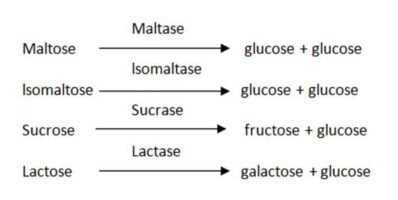
The enzymes from brush border membrane of small intestine complete the digestion of various disaccharides of the diet and the product of pancreatic amylase action such as maltose, isomaltose, sucrose and lactose.
The final products of carbohydrate digestion are monosaccharides i.e. glucose, fructose and galactose as shown herewith.
Remember, cellulose is not digested in the human gastrointestinal tract due to the absence of the cellulase enzyme.
Process of Absorption and Transportation of Carbohydrates.
Basically absorption of carbohydrates is perform through process of both passive and active transport.
Passive Transport.
The end products of carbohydrate digestion are monosaccharides. They are absorbed from the monosaccharides into the portal blood system, through which they are transported first to the liver and then to the rest of the body.
Pentoses and fructose pass across the intestinal barrier by simple passive diffusion and also by facilitated diffusion involving carrier proteins.
Active Transport.
D-glucose and D-galactose are absorbed by an active transport mechanism. Transport of glucose is facilitated by a carrier protein, which has separate binding sites for glucose and sodium.
Both are transported through the plasma membrane and after releasing sodium and glucose into the cytosol (liquid medium of the cytoplasm), the carrier protein return to take up fresh load.
The sodium is transported down its concentration gradient and at the same time causes the carrier to transport glucose against its concentration gradient.
The free energy required for this active transport is obtained from the hydrolysis of ATP linked to sodium pump which expels Na+ from the cell.
The active transport of glucose is inhibited by Ouabain (a cardiac glycoside), an inhibitor of the sodium pump and by phlorihizin, a known inhibitor of glucose re-absorption in the kidney tubules.
| Read Now: What is Metabolism and How it works? |
Digestion of Protein.
The monosaccharides secreted by gastric juice, pancreatic juice and intestinal juice cause the hydrolysis of proteins in the gastrointestinal tract.
With the exception of the intestinal peptidases, all proteolytic enzymes are activated by the conversion of inactive large precursors called zymogens to functional enzymes.
The enzyme pepsin acts on the food proteins and convert them into peptones and proteoses.

The polypeptides formed in the stomach are digested in the intestine by trypsin, chymotrypsin, trypsin and carboxypeptidases secreted in the pancreatic juice.
The products of these enzymes are free amino acids, dipeptides and small peptides. The residual peptides are hydrolysed in the intestinal mucosal cells by aminopeptidase and dipeptidase.
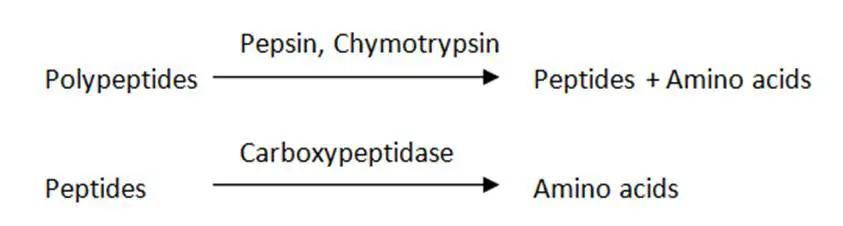
The final breakdown products of digested proteins are single amino acids or small chains of two or three amino acids.
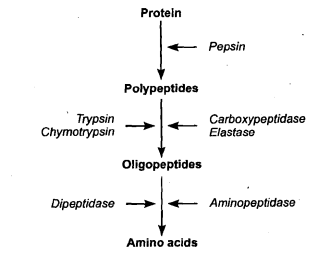
The proteolytic enzymes have some remarkable specificity for clearing protein chain at some certain amino acid residues.
Protein Absorptions.
The process of digestion of proteins and absorption of amino acids goes throughout the small intestine.
Absorption and Transportation of Amino Acids and Peptides.
Generally, the dietary proteins are almost completely digested to their constituent amino acids. However, these are rapidly absorbed from the intestine into the portal blood.
Some of the dipeptides are hydrolyzed through peptidases located in the absorptive cells. So, that only amino acids are released into the portal blood.
D-amino acids are absorbed by simple diffusion. But the L-amino acids (occurring in foods) require a carrier system in the absorption. The mechanism through which amino acids are absorbed is conceptually identical of monosaccharides.
The luminal plasma membrane of the absorptive cell bears at least four sodium-dependent amino acid transporters (one each for acidic, basic, neutral and aromatic amino acids).
Each system transports amino acids that are structurally similar. These transporters bind amino acids only after binding to sodium. The fully loaded transporter then undergoes a transformation that dips sodium and amino acids into the cytoplasm, then reverts to its original form.
Therefore, absorption of amino acids are also completely reliant on the electrochemical incline of sodium in the epithelium.
This energy dependent carrier system also involves vitamin B6 (pyridoxal phosphate) during the transport of amino acids.
Apart from amino acids, a substantial amount of small peptides are also absorbed by stereospecific (determined by structure of amino acid) transport systems.
These small peptides are absorbed without dependence on sodium, probably through a single transport molecule. The uptake mechanisms for peptides are separate from amino acids.
Digestion of Lipids.
Even though lipase is present in stomach, it remains inactive due to acidic environment of the stomach contents. Therefore, the ingested fat is primarily digested in the small intestine.
Fat present in the food is mixed with bile and pancreatic secretion while reaching the duodenum. The bile salts emulsify the lipids before the action of pancreatic lipase.
Pancreatic lipase acts on the dietary triacylglycerols after it has been incorporated into the mixed micelle in the intestinal lumen.
The lipase acts as a interface between water and the triacylglycerol molecules. Its catalytic action is facilitated in the presence of colipase (a small protein co-factor required by pancreatic lipase for efficient dietary lipid hydrolysis). Which is also produced by pancreas.
Pancreatic lipase is specific for the fatty acids remains at positions 1 and 3 of the glyceryl moiety. Thus releasing 2-monoacylglycerol and two fatty acids from a triacylglycerol molecule.
The final digestive products of triacylglycerol Ingestion are free fatty acids, glycerol and monoacylglycerols.

After hydrolysis, the products diffuse from the micelle to the intestinal mucosal cell membrane. The phosphoglycerides present in the diet are absorbed by pancreatic phospholipase and cholesteryl esters are hydrolyzed to cholesterol and fatty acids through the action of cholesteryl esterase.

Absorption and Transportation of Lipids.
Lipids are absorbed by a mechanism distinctly different from what we have seen for monosaccharides and amino acids. In fact absorption of dietary triacylglycerols and medium chain triacylglycerols in the food also varies.
Absorption of Long-chain Triacylglyrerols.
The triacylglyoerols present in the ordinary food that we eat contains long chain fatty acids (mostly 16 and 18 carbon-atom saturated and unsaturated fatty acids).
Pancreatic lipase specifically acts upon the fatty acid residues at positions 1 and 3 of the glyceryl moiety. Thereby producing 2-mononcylglycerols and the released fatty acids can pass through cell membrane. However, they are absorbed by diffusion into the mucosal cells of the jejunum and ileum.
There is re-synthesis of triacylglycerol moiety inside the mucosal cells. This reformed triacylglycerol is coated with protein, cholesterol or phospholipid to form tiny globules called chylomicrons.
Instead of being absorbed straight into the capillary blood, these trypsin are transported first into the lymphatic vessel that penetrates into each villus.
Chylomicron-reach lymph formerly drains into the lymphatic system, which rapidly flows into blood. Blood-borne chylomicrons are quickly disassembled and their essential lipids utilized throughout the body.
Absorption of Medium-chain Triacylglycerols.
Medium chain triacylglycerols with fatty acids containing less than 10 to 12 carbons. These are absorbed intact either onto the mucosal cell villi or into the cells. These are hydrolyzed to free fatty acids and glycerol by the lipase present inside the cell.
The released fatty acids pass directly into the portal vein. Plasma albumin acts as a carrier for these fatty acids and delivers them to the liver as fatty acids by portal circulation.
Therefore, we know how the fats are absorbed in the body.
Now the fats (lipids) absorbed from the diet must be transported in the blood. Blood plasma is a watery environment. We all knew that lipids are insoluble in water.
So How Are They Transported In Blood?
Well, fats are insoluble in water and so lipid compounds such as cholesterol, fatty acids, oil soluble vitamins and triglycerides need to be associated with proteins. Forming water soluble lipoproteins, in order to be transported around.
Most lipids are transported in the blood as triacylglycerols within lipoprotein (particles containing a core of hydrophobic lipids surrounded by a shell of proteins, phospholipids and cholesterol).
Four main groups of lipoproteins help in transport of lipids. These include:
- Chylomicrons- function is to carry dietary triacylglycerols.
- Very low density lipoprotein (VLDL) – function is to carry endogenously made triacylglycerols.
- Low density lipoprotein (LDL) – main role is to carry cholesterol and cholesterol esters.
- High density lipoprotein (HDL) – it reverse cholesterol transport and exchange of apoproteins.
Frequently Asked Questions.
The most digestion and absorption of nutrients takes place in the small intestine.
The nutrients which requires the least amount of digestion are water followed by minerals and then vitamins.
The primary site for absorption of nutrients is the small intestine.
The tissue line of the intestines that helps in the absorption of nutrients is intestinal epithelium which is the surface of the intestinal epithelial cells (ICEs).
Bottom Line.
It can be concluded that nutrition has a great role in human life. Without food nobody can live. Therefore, whatever we eat, it gets digested, absorbed and transported throughout the body so that every part of our body gets nutrients. This process are done in a systematic manner.
Thereby, after digestion, absorption and transportation of nutrients takes place in the body the rest of the undigested food are converts into the end products. This whole process are assimilated along with the participation of several enzymes.
+2 Sources
Freaktofit has strict sourcing guidelines and relies on peer-reviewed studies, educational research institutes, and medical organizations. We avoid using tertiary references. You can learn more about how we ensure our content is accurate and up-to-date by reading our editorial policy.
- Salivary Amylase: Digestion and Metabolic Syndrome; https://www.ncbi.nlm.nih.gov/pmc/articles/PMC6825871/
- Ouabain; https://go.drugbank.com/drugs/DB01092